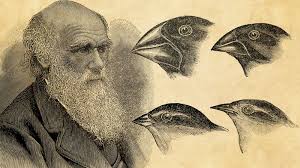
An English naturalist named Charles Darwin
went on a voyage around the world. He noticed
that animals in similar environments had similar
characteristics.
For example, in the Galapagos islands,
Darwin observed similar but non-identical species of finches on each island. He noticed that their beaks seemed to be adapted to their food source. After some time thinking and reading the work of other scientists, Darwin proposed his theory of natural selection. This states that all living things
evolved from a common ancestor.
Word Bank: adapted offspring resources more
Here's how Darwin's theory of Evolution works:
1. Not all individuals survive and reproduce, due to predators or competition for
2. Only individuals that are well
3. These individuals will pass on their beneficial traits to their
4. Over many generations, the species has evolved so that the beneficial trait is
Complete the example of Natural Selection by filling in the words in the word bank.
Word Bank: evolved black habitat mutation camouflaged variation predators survive reproduce trait
Natural selection changes the range of traits in a population - there are 3 ways it can change. Let’s look at a moth population that shows variation in its color, from light to dark brown. Show what would happen if this population moved into each scenario shown below.
Word Bank: dark against habitat light camouflaged lichen predators extremes decrease


When populations of animals are for long periods of time, the individuals of that population might look completely . If this continues to happen for many years, the animals might not be able to .
This is how new species can be made. For example, Darwins finches were separated for so long that they developed different features than neighboring , especially beak sizes. Now each finch is a .