Describe the error in the graph below as it relates to the parent function.
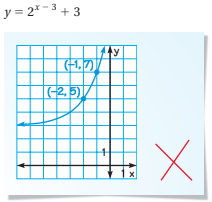
Describe the error in the graph below as it relates to the parent function.
What is the y-intercept (initial value) of the function
Which of the following functions shows an intital amount of $15 and an increase of 35% each year?
What is the inital value of the situation represented by
A new savings account is opened with $400 and gains 3% every year. Which equation best represents this situation?
Which letter represents a Vertical Shift
There is a vetical stretch of 1/2
This is a exponential growth equation
The equation of asymptote line
The y-intercept
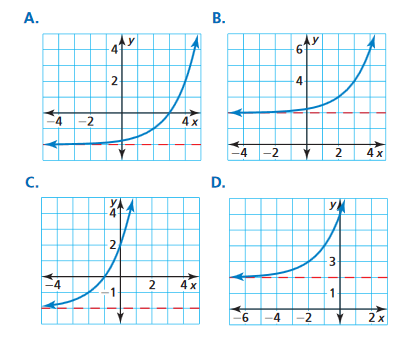
Match the function with its graph. Show your work to suppor your answer.
Tell whether the function represents exponential growth or exponential decay.
Match the function with its graph. Show your work to suppor your answer.
Tell whether the function represents exponential growth or exponential decay.
Tell whether the function represents exponential growth or exponential decay.
In the show your work box, explain how you know the function is exponential growth or decay.
Graph the function: (2 points)
Include at least 5 points in your table (4 points) and plot the "nice" points.
Using your graph from #6, what is the horizontal asymptote?
Graph the function: (2 points)
Include at least 5 points in your table (4 points) and plot the "nice" points. (HINT: Start at x = -4)
Describe the error in the graph below as it relates to the parent function.
Give a reason in the show your work section to justify your answer. Which graph is f(x).
Give a reason in the show your work section to justify your answer. Which graph is g(x).
You purchased a car for $24,000 and find that it will depreciate at a rate of 15.5% per year. Write a model to represent the value v (in dollars) after t (in years)
From 1997 to 2002, the number, n (in millions) of DVD players sold in the United States can be modeled by
where t = the number of years since 1997.
Estimate the number of DVD players sold in 2001.
You buy a new mountain bike for $200. The value of the bike decreases by 25% each year. Write a model giving the mountain bike's value y (in dollars) after t years.