Introduction: Ozone is made up of 3 oxygen molecules. The ozone layer is an important protective shield for life on Earth, filtering out more than 99% of the ultraviolet rays from the sun before they reach us. Ultraviolet rays can cause sunburns. The amount of ozone protecting us is decreasing. Some scientists predict that the increasing ultraviolet radiation that passes through our "shield" will increase the incidences of skin cancer, immune deficiencies and cataracts.
In 1987, the U.S. Environmental Protection Agency (EPA) estimated that 40 million Americans will get skin cancer during the next 88 years and of those, 800,000 will die. Even more serious is the fact that the rate of ozone depletion, or the reducing of our protective shield, is increasing, and at a fast rate.
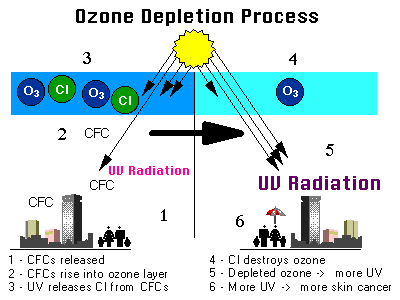
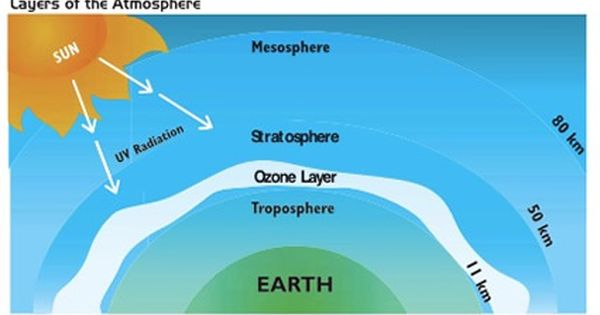
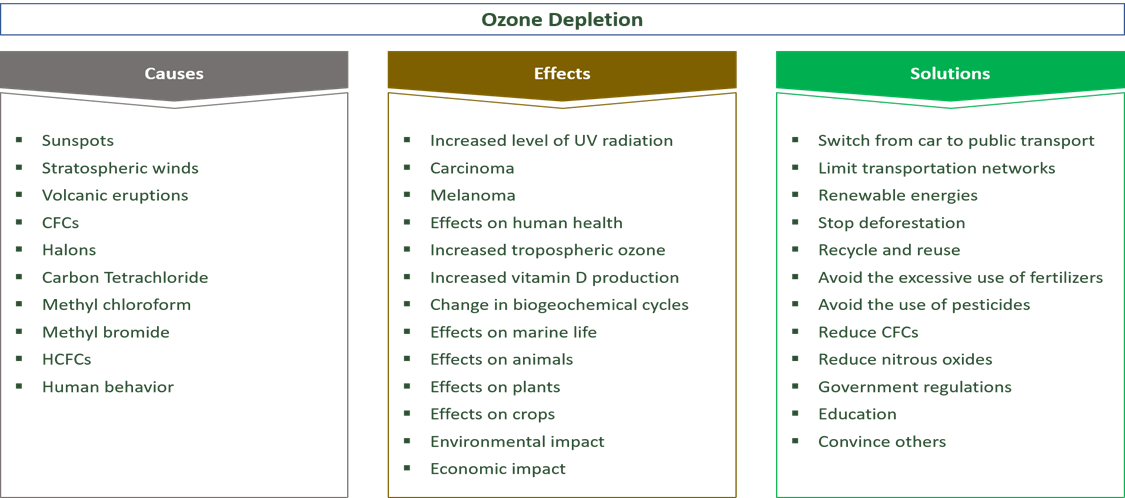
Ozone gas in the stratosphere forms when oxygen molecules interact with ultraviolet rays from the sun. The amounts of ozone in the stratosphere are changing all the time. Under normal circumstances, ozone is continuously being destroyed and regenerated by the sun's ultraviolet rays. The seasons of the year, changing winds and even sunspots affect ozone levels. Harmful pollutants in the air can also affect ozone by converting it into oxygen molecules and atoms, actually forcing ozone to break down more rapidly than it can rebuild.
Ozone "holes" are areas where the ozone concentrations in these areas are lower than under normal conditions, allowing more ultraviolet radiation to reach the Earth's surface. Ozone holes currently exist over Antarctica, the northern half of the U.S. into Canada, and northern Europe and Tibet. Since scientists started measuring the ozone layer in the mid-1970s, it has become clear that the ozone layer is thinning even more quickly than first predicted.
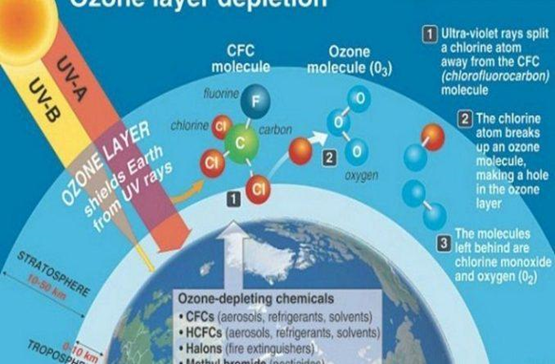
The only practical approach to stopping the destruction of the ozone layer is to reduce the amount of human-created pollutants that contribute to its depletion. Efforts to protect the ozone layer now involve many different nations and industries. The most common ozone-destroying pollutants are in a class of chemical compounds called chlorofluorocarbons (CFCs), which were once used in air conditioner refrigerator coolants, lubricants, cleaning solvents, plastic foam manufacturing and aerosol spray propellants. Engineers are inventing and designing new technologies to help save the ozone and stop its reduction due to harmful CFCs. Many halons and halogens (groups of chemicals) are used in place of CFCs and still can harm ozone molecules in the stratosphere.
1 point
1
Question 1
1.
Where is the ozone layer found?
1 point
1
Question 2
2.
Why is the ozone layer important to life on Earth?
Activity: Battling For Oxygen
When an ozone molecule absorbs UV light from the sun, it breaks down into an oxygen (O2) molecule and an oxygen atom (O). Sometimes the oxygen molecule breaks into two oxygen atoms as well. Normally, the free oxygen atom combines with other oxygen atoms or molecules to produce ozone again. Under normal circumstances, ozone is continuously being destroyed and regenerated by the sun's ultraviolet rays. When there are no outside disturbances, this process of breaking down ozone and building it back up occurs at a constant rate that keeps us protected from a lot the sun's harmful UV rays. However, harmful pollutants (such as CFCs ) can also break down ozone by converting it into oxygen molecules and atoms. When this happens ozone breaks down much faster than it can build up and "holes" appear in the ozone layer.
In today's activity, we are going to model just how pollutants destroy ozone.
Procedure
You will be in groups of 6-7.
You will use a Hula Hoop to represent the atmosphere. Place it in a place accessible to all group members. You will also use the Pop beads (various colors) to make oxygen molecules and ozone molecules (3 pop beads) and free oxygen (single pop bead). Begin by setting up the simulation by making 25 each of ozone and oxygen molecules. You will need 50 individual free oxygens.
Run the simulation:
NATRUAL CYCLING: Choose 2 students to be “Ozone Makers” and 2 students to be “UV Destroyers”. One person will need to be the time keeper and referee.
Ozone Makers- create as much oxygen and ozone molecules as you can from the oxygen molecules in your atmosphere
UV Destroyers- destroy as much oxygen or ozone molecules as you can (pull pop beads apart) and let free oxygen into the atmosphere
The makers and destroyers will have 30 seconds to create/destroy as much oxygen and ozone as they can.
After 30 seconds, count and record the amount of each molecule you have remaining and record in your data table. (trial 1)
MAN MADE IMPACT: Assign one more student to be a “CFC”. Repeat steps 3-4 but with “CFC” also destroying ozone along with “UV Destroyers”.
After 30 seconds, count and record the amount of each molecule you have remaining and record in your data table. (trial 2)
Assign one more student to be a “CFC” (so now there are 2) and repeat steps 3-4.
After 30 seconds, count and record the amount of each molecule you have remaining and record in your data table. (trial 3)
Reset the station by creating 25 oxygen molecules, 25 ozone molecules and 50 free oxygen atoms and repeat steps 1-7 above for trials 4-6!
1 point
1
Question 3
3.
Upload your table here.
1 point
1
Question 4
4.
What is the percent change in the amount of ozone from the beginning to end for trials 1-3?
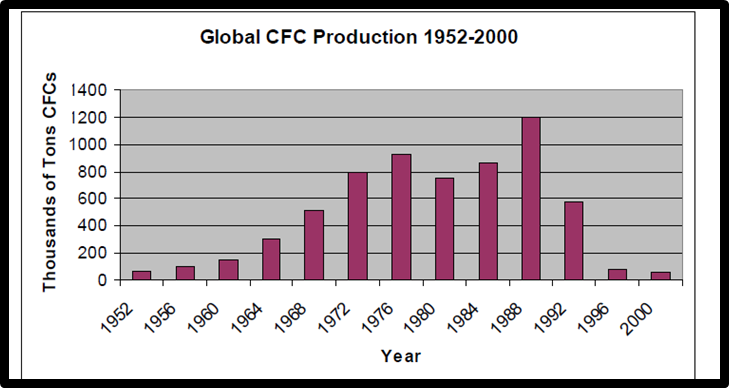
Scientists and engineers have been measuring the ozone layer for many years, and encouraging people to stop the destruction of the ozone layer by reducing the human-created pollutants that contribute to its depletion. Today, many nations and industries have taken steps, including the design of new technologies by engineers, to reduce the production of CFCs and protect the ozone layer from harmful CFCs. As pollution to the atmosphere increases, the amount of ozone decreases. In other words, an increase in the amount of pollutants that reach the upper atmosphere disrupts the process that makes ozone our safe protective shield. One CFC is capable of destroying 100,000 ozone molecules.
Summary of the Vienna and Montreal Protocol:
► The Vienna Convention: Adopted in 1985, The Vienna Convention for the Protection of the Ozone Layer is the precursor to the Montreal Protocol. The Vienna Convention is often called a framework convention, because it served as a framework for efforts to protect the globe’s ozone layer. The Vienna Convention did not require countries to take concrete actions to control ozone depleting substances. Instead, in accordance with the provisions of the Convention, the countries of the world agreed the Montreal Protocol on Substances that Deplete the Ozone Layer under the Convention, to advance that goal.
► Montreal Protocol: The Montreal Protocol on Substances that Deplete the Ozone Layer, also known simply as the Montreal Protocol, is an international treaty designed to protect the ozone layer by phasing out the production of numerous substances that are responsible for ozone depletion. There has been many alterations to this protocol
1 point
1
Question 5
5.
When were the most CFCs produced?
1 point
1
Question 6
6.
When did CFC production first reach 200 thousand tons?
1 point
1
Question 7
7.
What anthropogenic factors are causing the creation of the ozone hole?
1 point
1
Question 8
8.
What global treaty, created in 1987, created a decrease in CFCs that led to a smaller ozone hole every year since?
1 point
1
Question 9
9.
The decrease in stratospheric ozone increases the UV rays that reach Earth's surface causing what problem in humans?
1 point
1
Question 10
10.
Why is the stratospheric ozone important to the evolution of life?
1 point
1
Question 11
11.
A substitute for CFCs that will not deplete the ozone is