Select Yes or No to indicate whether each value of x is a solution to the given equation.
Yes | No | |
|---|---|---|
Pablo is studying the function f(x) shown in the graph. He claims that he can transform the function to include the ordered pair (2,2).
Which equation has no real solutions?
Enter the value of x that makes the equation true. Type only the value, not an equation (i.e. not x=___)
Write your answer as a reduced fraction.
Select no real solutions, one real solution, or infinitely many real solutions for each of the following equations.
No Real Solution | One Real Solution | Infinitely Many Real Solutions | |
|---|---|---|---|
Select the ordered pair that is a soltion to the equation represented by the graph.
A student has a savings account with d dollars in it. The student plans to withdraw w dollars each month for n months.
Enter an equation for the balance, b, in the account after n months.
Please write the equation with b= on the left hand side.
Consider the graph:
Using the graphs below, select the graph that represents h(x), given that function
The equation
represents f(x) and the graph represents g(x)
True | False | |
|---|---|---|
The line of symmetry of g(x) is | ||
The maximum of g(x) is less than the maximum of f(x) |
Select the graph that shows the solution set of the system of linear equations
The graph shows a quadratic function, f(x), and a cubic function, g(x)
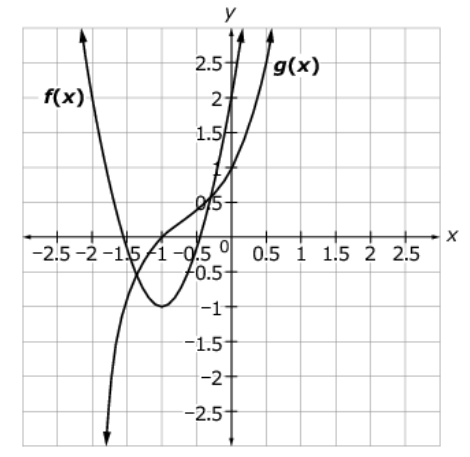
Select all values that are approximate solutions to the equation
Determine whether each function represents exponential growth or decay. Select the correct option for each function.
Growth | Decay | |
|---|---|---|