Log in
Sign up for FREE
arrow_back
Library
APUSH Period 7.1 (Ch. 27 & 30) Quiz - SY22
By Haiyen Truong
star
star
star
star
star
Share
share
Last updated over 1 year ago
11 questions
Add this activity
1
IICI.01
KC 3.3.II
WOR 2.0
1
KC 7.3.I
RAG.01
WOR 2.0
1
IIUR.01
KC 7.3.I
WOR 2.0

1
KC 7.3.I
RPV.01
WOR 2.0
1
IIRC.01
KC 6.3.II
POL 3.0
1
IICI.01
KC 6.2.I
1
CUL 4.0
IICI.01
1
IICI.01
KC 7.1.II
WXT 3.0
0
Question 1
1.
Review:
Which American foreign policy tradition did Washington's Neutrality Proclamation help
establish?
Isolationism
Nativism
The “good neighbor” policy
The “open door” policy
Chapter 27:
Empire and Expansion (1890-1909)
Question 2
2.
How did American imperialists justify the acquisition of the Philippines?
They claimed the islands would provide a strategic base for further American expansion into China.
They thought the island was rich with workers who could immigrate to the U.S. and labor on farms.
They stated that it was wealthy America's responsibility to "take up the White Man's burden" and uplift the underprivileged Filipinos.
They claimed that the Philippines were a Christian country much like the U.S.
Question 3
3.
The American desire to construct a canal across Central America was motivated primarily by
an interest in strengthening the position of the U.S. navy
the need to prevent the French or British from building a canal there.
concerns about the Panamanian Revolution.
the growing American social interests in Central America.
Questions 4-5 refer to the following excerpt.
Question 4
4.
Which of the following best explains Lodge’s point of view on markets in the excerpt?
Democrats argued that the United States should focus on domestic economic development over international trade.
Republican business leaders lobbied for imperial expansion to provide locations for new factories.
Many Americans believed that acquiring island territories would encourage economic development.
Political leaders claimed that the lives of Native Americans could be improved if they moved to new overseas colonies.
Question 5
5.
Which of the following explains the historical situation that led Lodge to deliver the speech in the excerpt?
The United States came to control new colonial possessions after the Spanish-American War.
The United States sought continued employment overseas for veterans of wars with Native Americans.
The United States invaded Pacific islands as a means to defeat Japan in the Second World War.
The United States negotiated territorial exchanges with Germany to end the First World War.
Chapter 30:
American Life During the “Roaring 20s” (1920-1929)
Question 6
6.
Under Prohibition, organized crime
enjoyed one of its most peaceful and prosperous eras.
withered under heavier police scrutiny.
became exclusively associated with bootlegging.
became one of the nation’s biggest and most lucrative businesses.
Question 7
7.
The Harlem Renaissance can best be described as
a celebration of black culture and creative expression of in a prominent Northern Black community.
the effort to resist racism and segregation in the North.
the movement for African Americans to return to Africa led by Marcus Garvey.
the migration of Southern blacks to northern sections of New York City.
Question 8
8.
A significant cloud that hung over the prosperity of the 1920s was the
technical problems in the production of radio and films.
large accumulation of consumer debt.
growing strength of labor unions.
increasing competition among business people.
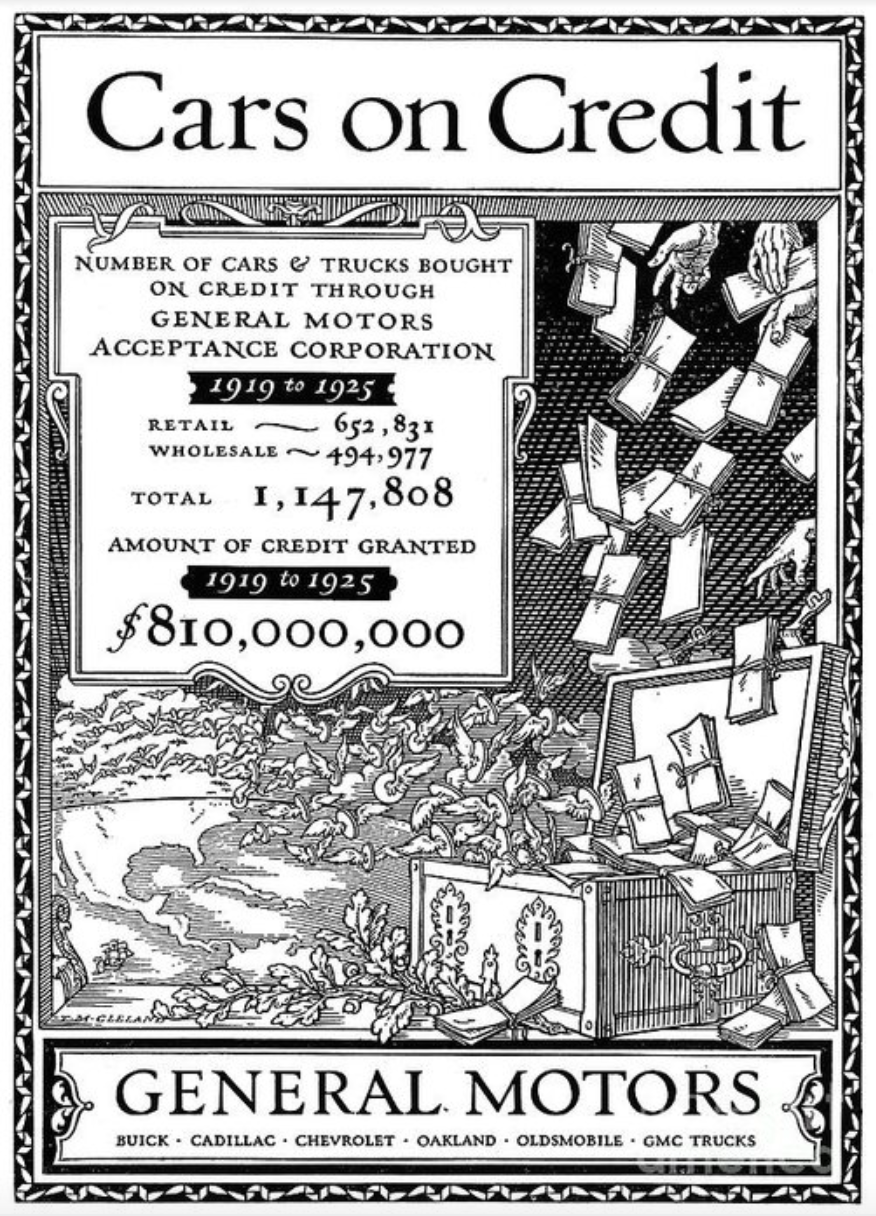
Questions 9-10 refer to the following image.
zoom_in
1
KC 6.3.II
SQN.01
1
KC 6.1.II
WXT 2.0
Question 11
11.
Halfway through Period 7 (1890-1945)! How are you feeling? Any feedback, questions or concerns about this unit?
visibility
View drawing
Question 9
9.
Which of the following trends of the 1920s is most clearly portrayed in this advertisement?
The growth of middle class incomes.
The expansion of auto dealers throughout the country.
The emergence of General Motors as the largest company.
The use of extended payment plans to purchase consumer goods.
Question 10
10.
Many historians criticize the economy that developed during the 1920s. Which of the following statements best supports that point of view?
The growth of the auto industry badly hurt the railroads.
The boom was based on speculation and borrowed money.
Advertising was based on gaining status and popularity.
Consumerism weakened the moral character of the nation.