Log in
Sign up for FREE
arrow_back
Library

2021 STAAR Grade 4 Reading

star
star
star
star
star
Last updated over 3 years ago
36 questions
1
4.3.C
1
4.7.D
1
4.10.C
1
4.9.D.ii
1
4.7.C
1
4.6.F
1
4.10.A
1
4.6.F
1
4.7.C
1
4.3.B
1
4.9.C
1
4.6.F
1
4.6.F
1
4.9.C
1
4.6.F
1
4.10.A
1
4.7.C
1
4.7.C
1
4.3.B
1
4.10.C
1
4.7.D
1
4.10.A
1
4.6.E
1
4.6.E
1
4.6.E
1
4.6.E
1
4.3.A
1
4.6.F
1
4.6.F
1
4.10.D
1
4.6.F
1
4.6.F
1
4.6.F
1
4.7.C
1
4.8.B
1
4.10.E
Content accessed from https://tea.texas.gov/student-assessment/testing/staar/staar-released-test-questions
Copyright information provided below.
All content on this site is copyrighted by the Texas Education Agency and cannot be used without the express written permission of TEA, except under the following conditions:
  1. Texas public school districts, charter schools, and education service centers can copy materials for district and school educational use.
  2. Residents of the state of Texas can copy materials for personal use.
Do not alter or make partial copies of web content. Do not charge for the reproduced materials or any document containing them except to cover the cost of reproduction and distribution.
If you are in Texas but are not an employee of a Texas public school district or charter school, you must get written approval from TEA to copy materials and enter into a license agreement that may involve paying a licensing fee or a royalty fee.
For more information, email Copyrights@tea.texas.gov.
Question 1
1.

Question 2
2.

Question 3
3.

Question 4
4.

Question 5
5.

Question 6
6.

Question 7
7.

Question 8
8.

Question 9
9.

Question 10
10.

Question 11
11.

Question 12
12.

Question 13
13.

Question 14
14.

Question 15
15.

Question 16
16.

Question 17
17.

Question 18
18.

Question 19
19.

Question 20
20.

Question 21
21.

Question 22
22.

Question 23
23.

Question 24
24.

Question 25
25.

Question 26
26.

Question 27
27.

Question 28
28.

Question 29
29.

Question 30
30.

Question 31
31.

Question 32
32.

Question 33
33.

Question 34
34.

Question 35
35.

Question 36
36.

The prefix un- helps the reader know that the word unfamiliar in paragraph 8 means —
partly known
known together
known in the past
not known
What is the best summary of the selection?
Loud trumpeting sounds are just one of the sounds elephants make. They also make rumbles, barks, snorts, and cries to communicate with members of the herd.
Elephants have many more ways of communicating than most people might think. Elephants use touch, smell, noise, and movement to give one another messages.
An elephant’s trunk lets an elephant share messages such as “Let’s play” or “Danger!” The trunk has a sensitive tip for touching other elephants and picking up smells.
People and elephants both have a larynx, a body part that lets them make sounds. Elephants “talk” in low sounds, and elephants also use their sense of touch and smell a lot.
Based on information in the selection, what is the most likely reason the author includes the photograph of the baby elephant standing close to its mother?
To suggest that the baby elephant is warning its mother that there is danger nearby
To show the reader what the baby elephant does to try to get its mother to play with it
To show the reader what the baby elephant does when it wants its mother to know it is hungry
To suggest that the baby elephant feels safe and protected when it is near its mother
How do the subheadings provide an overview of the selection?
They identify the ways elephants communicate.
They describe important roles in an elephant herd.
They tell why elephants need attention.
They compare ways that elephants find food.
Which sentence from the selection supports the idea that elephant herds try to guard themselves from danger?
But an elephant’s huge larynx produces very low sounds. (paragraph 3)
Some gestures—a twitch of an ear, a wag of the head—are so small that most people wouldn’t even notice them. (paragraph 4)
They think it may help the elephants focus all their attention on the sounds and smells around them. (paragraph 5)
If you ever wonder what an elephant is paying attention to, don’t watch its eyes. (paragraph 6)
Based on information in paragraph 4, what can the reader infer about elephants?
An elephant’s ears help the elephant communicate.
Elephants usually feel either happy or scared.
A large herd will rarely experience danger.
Scientists are confused by an elephant’s body language.
The author includes questions at the end of paragraph 6 most likely —
to show the details scientists want to learn about elephants
to show that an elephant’s most important sense is the sense of smell
to show that elephants can identify members in their herd
to show that elephants gather information from different smells
How does Mom help Bella solve her problem?
She shows Bella different ways to improve as a speller.
She reminds Bella that she needs to play with her sister.
She convinces Bella that her rapping is a special talent.
She persuades Bella to forgive her classmate Amy.
Which line from the play suggests that Scott disagrees with Amy’s opinion of Bella?
SCOTT: Remember what I told you?
SCOTT: From what I can see, “shun” words aren’t easy for you.
SCOTT: Besides, you’re really good at lots of other stuff.
SCOTT: You should just keep on rapping.
As it is used in line 28, the word excel means to —
do many tasks at once
do better than others
pretend to know everything
be afraid of trying new activities
The reader can tell that “The Gift of Rhyme” is a play because it has a —
common theme
list of characters
rhyming pattern
problem that is resolved
Samantha’s rap in Scene 3 is important to the play because it helps Bella —
realize that her sister admires her raps
discuss her concerns with her mother
understand why studying is so important
determine what has been wrong with her raps
Read this sentence from line 10.


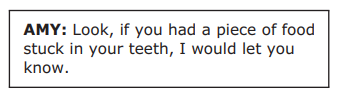
This line is meant to show that Amy —
does not like to be told that she’s wrong
wishes that Bella wasn’t such a messy eater
thinks she’s being a good friend to Bella
notices things that other people don’t see
The playwright includes the stage directions at the beginning of each scene mainly to —
identify the time and place
hint at how a problem will be solved
describe the main character’s problem
explain the characters’ feelings and actions
What can the reader tell about the article “The Broken-Crayon Solution” based on its title?
The article will most likely describe different ways to use crayons.
The article will most likely explain how crayons were invented.
The article will most likely explain an answer to a problem.
The article will most likely offer many uses for objects that are old.
The most likely reason that the author provides the information in paragraph 1 of the article “The Broken-Crayon Solution” is —
to explain why Cassidy wanted to make her invention
to explain why Cassidy has so many crayons
to explain who helped Cassidy to become an inventor
to explain what color of crayon Cassidy likes best
Which sentence from the article “The Broken-Crayon Solution” best supports the conclusion that Cassidy’s product was profitable?
She noticed that all of her crayons were broken. (paragraph 1)
Cassidy knew that her invention would make many young artists happy. (paragraph 3)
Eventually so many crayon holders were sold that Cassidy was able to pay for most of her college education out of her earnings. (paragraph 3)
Cassidy’s invention encourages others to waste less. (paragraph 4)
Which sentence from the article “The Broken-Crayon Solution” supports the idea that the author likes Cassidy’s crayon holder?
And she had an idea. (paragraph 1)
The ends of the tubes fit tightly around the crayons. (paragraph 2)
It could also hold a small broken one. (paragraph 2)
Cassidy’s invention is a brilliant idea. (paragraph 4)
In paragraph 3 of the selection “Bouncing Around,” what does the word refining mean?
Making improvements
Sharing with others
Wishing for success
Planning for the future
What is the most likely reason the author included the photographs in the selection “Bouncing Around”?
To show that the trampoline was invented many years ago
To show that the trampoline can be used for different purposes
To show that people enjoy watching others use trampolines
To show that people can perform together on a trampoline
What is the best summary of the selection “Bouncing Around”?
The 2000 Olympic Games included a trampoline event for the first time. George Nissen, the inventor of the trampoline, always dreamed that his invention would one day be used in the Olympics.
In high school George Nissen was a diver and gymnast. After watching a trapeze artist, he decided to make a bouncer in his garage. However, it did not work as he expected.
The trampoline was invented by George Nissen, an athlete who wanted a new way to practice his skills. When Nissen began selling trampolines, many people bought them and used them for a variety of purposes.
As a teenager George Nissen invented a bouncer he could use to jump on. He shared the bouncer with swimmers and divers at a swimming camp. They used the bouncer to practice flips and twists.
What is the most likely reason that the author includes the information in paragraph 8 of the selection “Bouncing Around”?
To compare how different types of athletes use Nissen’s invention
To show that Nissen’s invention is still enjoyable and useful for many people
To describe how Nissen feels about his invention years after he made it
To explain when Nissen’s invention was first used in the Olympics
What is a way that Cassidy’s crayon holders in the article “The Broken-Crayon Solution” differ from Nissen’s trampoline in the selection “Bouncing Around”?
Only the crayon holders were made while the inventor was in college.
Only the crayon holders help make a common object easier to use.
Only the crayon holders can be used to help improve a skill.
Only the crayon holders can be used by children.
Which statement best describes a difference between Cassidy in the article “The Broken-Crayon Solution” and Nissen in the selection “Bouncing Around”?
Cassidy found it easy to sell her product, but Nissen found it difficult.
Cassidy was not happy with her invention at first, but Nissen was pleased with his at first.
Cassidy got the idea for her invention at a public event, but Nissen thought of his idea at home.
Cassidy made her product to avoid waste, but Nissen made his for exercise.
What is one way the article “The Broken-Crayon Solution” and the selection “Bouncing Around” are different?
“The Broken-Crayon Solution” tells about a short period in Cassidy’s life. “Bouncing Around” describes several years of Nissen’s life.
“The Broken-Crayon Solution” explains many benefits of Cassidy’s product. “Bouncing Around” suggests that there is only one benefit from using Nissen’s product.
“The Broken-Crayon Solution” describes the steps Cassidy used to make her invention. “Bouncing Around” does not tell how Nissen made his invention.
“The Broken-Crayon Solution” shows that Cassidy had many interests as a child. “Bouncing Around” shows Nissen had only one interest.
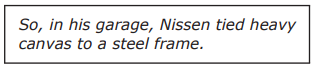
Read this sentence from paragraph 3 of the selection “Bouncing Around.”


Which sentence from paragraph 1 of the article “The Broken-Crayon Solution” describes in a similar way what led to building an invention?
One day 11-year-old Cassidy Goldstein was trying to work on an art project.
She noticed that all of her crayons were broken.
Then Cassidy found some plastic tubes used to hold single-cut flowers.
She would make her own crayon holders.
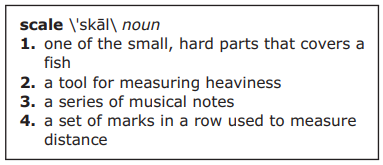
Read this dictionary entry.


Which definition most closely fits the way the word scale is used in line 20?
Definition 1
Definition 2
Definition 3
Definition 4
Based on details in the poem, which statement best describes how the speaker most likely feels about Max?
She wishes he would listen to her.
She is jealous of him.
She admires him.
She wants to protect him.
What is the most likely reason the poet includes the seasons in the poem?
To explain the safest time of year to travel by boat on the river
To suggest when the speaker likes to fish in the river
To identify the best time of year to make friends at the river
To highlight when the speaker observes changes in the river
In line 2, “like a fat brown thread” suggests that the river —
is full of many kinds of fish
makes a wide path through the land
is filled with branches
becomes darker over time
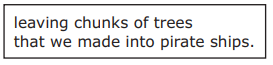
Read lines 13 and 14 from the poem.


What do these lines suggest about the speaker’s experience at the river?
The river creates problems that the speaker wants to avoid.
The river gives the speaker a chance to travel to new places.
The river provides a way for the speaker to be creative.
The river can be a confusing place for the speaker.
Based on details in the story, what can the reader infer about Phineas?
He is excited about making the meal for his family.
He likes cooking more than he likes science.
He feels confused by the unusual items in the kitchen.
He has cooked meals for his family before.
Which conclusion about Phineas is best supported by the list at the end of the story?
He hopes he never has to cook again.
He discovers that cooking is easier than he thought.
He realizes he made some mistakes while cooking.
He decides that pasta is his favorite meal to cook.
Which sentence from the story suggests that Phineas is embarrassed to ask for help?
Next, I needed a plan. (paragraph 2)
I’m not allowed to use the stove. (paragraph 5)
I felt my face turn red. (paragraph 8)
I couldn’t get the lid off the jar. (paragraph 12)
Sarah’s conversations with Phineas show that Sarah —
does not think Phineas is old enough to cook
does not mind helping Phineas in the kitchen
is surprised at how much Phineas wants to cook
wishes Phineas was better at following directions
Which sentence best helps the reader understand that the story is told from the first-person point of view?
The stove was a giant Bunsen burner, and the pots and pans were beakers and flasks. (paragraph 1)
Sarah came in from the living room. (paragraph 7)
Then she showed me what I needed to do. (paragraph 10)
Sarah wrapped the lid with one of the yellow rubber gloves by the sink, took a deep breath, and twisted. (paragraph 14)