Log in
Sign up for FREE
arrow_back
Library

2019 STAAR Grade 4 Reading

star
star
star
star
star
Last updated about 4 years ago
36 questions
Note from the author:
1
4.6.F
1
4.8.B
1
4.8.C
1
4.7.D
1
4.8.B
1
4.3.B
1
4.6.F
1
4.3.B
1
4.6.F
1
4.7.D
1
4.6.F
1
4.9.D.ii
1
4.8.C
1
4.8.B
1
4.10.E
1
4.10.D
1
4.3.C
1
4.9.D.iii
1
4.6.F
1
4.7.D
1
4.6.E
1
4.6.E
1
4.6.E
1
4.6.E
1
4.6.F
1
4.10.B
1
4.6.F
1
4.6.F
1
4.10.B
1
4.6.F
1
4.3.A
1
4.6.F
1
4.6.F
1
4.7.D
1
4.9.D.iii
1
4.6.F


Content accessed from https://tea.texas.gov/student-assessment/testing/staar/staar-released-test-questions
Copyright information provided below.
All content on this site is copyrighted by the Texas Education Agency and cannot be used without the express written permission of TEA, except under the following conditions:
  1. Texas public school districts, charter schools, and education service centers can copy materials for district and school educational use.
  2. Residents of the state of Texas can copy materials for personal use.
Do not alter or make partial copies of web content. Do not charge for the reproduced materials or any document containing them except to cover the cost of reproduction and distribution.
If you are in Texas but are not an employee of a Texas public school district or charter school, you must get written approval from TEA to copy materials and enter into a license agreement that may involve paying a licensing fee or a royalty fee.
For more information, email Copyrights@tea.texas.gov.
Question 1
1.

Question 2
2.

Question 3
3.

Question 4
4.

Question 5
5.

Question 6
6.

Question 7
7.

Question 8
8.

Question 9
9.

Question 10
10.

Question 11
11.

Question 12
12.

Question 13
13.

Question 14
14.

Question 15
15.

Question 16
16.

Question 17
17.

Question 18
18.

Question 19
19.

Question 20
20.

Question 21
21.

Question 22
22.

Question 23
23.

Question 24
24.

Question 25
25.

Question 26
26.

Question 27
27.

Question 28
28.

Question 29
29.

Question 30
30.

Question 31
31.

Question 32
32.

Question 33
33.

Question 34
34.

Question 35
35.

Question 36
36.

How can the reader tell that attending the picnic is important to Christopher?
He tries to be very careful when he arrives at school on Friday.
He invites his friends to sit next to him on the bus ride to school.
He tells the principal what happened in Mr. Gregg’s class.
He hasn’t been to the principal’s office this week.
Christopher’s friends most likely think that —
the bus driver is being unfair
the principal will tell Christopher’s mother that he can’t go to the picnic
his actions are amusing
he can stay out of trouble long enough to be allowed to go to the picnic
Paragraph 22 is important to the story because it shows that Christopher —
is hoping the principal is absent again
has been sent to the principal’s office often
expects the principal to allow him to attend the picnic
is willing to explain to the principal what really happened
What is the best summary of paragraphs 7 through 10?
Christopher tells his friends Timothy and Rashid that he doesn’t think he can go the whole day without getting into trouble.
Christopher compares how he is feeling to how the bus chugs up the hill.
Christopher has a problem that he shares with his friends Timothy and Rashid.
Christopher is too loud on the school bus and gets in trouble with the driver.
What does paragraph 11 reveal about Christopher’s character?
He has to work hard to take care of borrowed materials.
He doesn’t take responsibility for his actions.
He likes to joke around with his friends.
He depends on his friends to get him out of difficult situations.
What does the word misfortunes mean in paragraph 11?
Demanding jobs
Difficult decisions
Confusing messages
Unlucky events
Which sentence from the selection is an opinion?
Long ago, people played games that are similar to marble games played today. (paragraph 2)
Different types of marbles have been found in places all around the world. (paragraph 2)
They were beautiful, and each one was unique. (paragraph 4)
Others had swirls of one color or many different colors. (paragraph 4)
Which phrase in paragraph 11 helps the reader understand the meaning of annual?
fun of it
very seriously
This competition
Each year
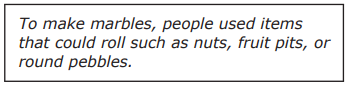
Read this sentence from paragraph 2.


Based on information in this sentence, the reader can conclude that early marbles were —
difficult to find
made by children
much smaller in size than marbles are today
created from a variety of available materials
Paragraphs 5 and 6 are mainly about how —
inventions lowered the cost of marbles
glassmakers figured out how to cut marbles easily
glass is melted in order to make a marble
the shape of marbles has improved over time
Which sentence in the selection is best supported by the photographs between paragraphs 9 and 10?
No one really knows where and exactly when they were invented. (paragraph 2)
Now, more people could buy them. (paragraph 5)
Marbles are placed inside a circle that is drawn on the ground. (paragraph 9)
Players may lose some of their favorite marbles. (paragraph 10)
In which part of the selection would the reader find information about the history of marbles?
The introductory paragraph
The section titled “Marbles through Time”
The caption under the first photograph
The section titled “Marble Games”
What effect does Max working in Grandpa’s yard have on the plot of the story?
It makes Dad proud of Max.
It causes Max to become tired and grumpy.
It leads Max to a surprise discovery.
It proves to Grandpa that Max is a good helper.
When Max shows his father the time capsule he dug up, Max’s father most likely feels —
amazed that Max found it when he could not
pleased to see things that were once meaningful to him
upset that Max is no longer helping Grandpa plant a tree
concerned about what Max will think when he sees what is in the can
Which point of view does the author use in this story?
First-person from Max’s perspective
First-person from Dad’s perspective
Third-person from the perspective of Max’s grandfather
Third-person from the perspective of an unknown observer
In paragraph 1, the author uses the phrases “wiped the sweat from his brow” and “felt like he had been digging for hours” to suggest that Max —
expects to discover a special surprise
is struggling with a difficult job
dislikes spending time outdoors
is determined to help plant trees
In paragraph 3, the suffix –er in the word sender helps the reader understand that the word refers to —
a person who sends
an object that is sent
the sending of something again
the method used to send things
What happened as a result of someone finding a bottle that had been released by students in Hawaii in 2007?
The bottle experiment quickly spread to other schools.
People around the world were encouraged to find pen pals.
Students tried to send messages in bottles to their classmates.
Two people living in different parts of the world became friends.
The author wrote this selection most likely to —
persuade the reader to try sending a message in a bottle
tell the reader how to start a floating bottle experiment at school
describe some examples of messages sent in bottles and tell what happened to them
explain some of the challenges of trying to communicate with people who live across the ocean
Paragraphs 2 and 3 are mainly about —
rewards people have received for returning bottles that were found
what keeps bottles with messages in them from sinking in the ocean
bottles that have drifted in the sea and then been found
what people write on the notes that are placed inside bottles
What conclusion can the reader make based on both the story and the selection?
People enjoy the experience of finding hidden objects or messages.
It is important to follow instructions that are included with messages.
People can become friends with someone whom they have never met.
It is common to find objects that have been left in secret places.
Based on the story and the selection, what is one way a time capsule differs from a message in a bottle?
A time capsule is opened by the person who made it, while a message in a bottle is opened by a stranger.
A time capsule stays in the same place, while a message in a bottle travels to a new place.
A time capsule is hidden for a long time, while a message in a bottle is found quickly.
A time capsule is for everyone to share, while a message in a bottle is intended for a specific person.
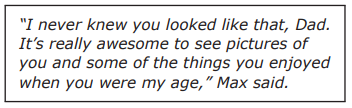
Read these sentences from paragraph 12 of “Max’s Find.”


Which sentences from “Messages in Bottles” express a similar idea?
It is a glass bottle, and inside is a rolled-up piece of paper. This message in a bottle may have traveled halfway around the world before landing on this beach.
They do so for different reasons. Most often it is simply for fun.
Occasionally someone tries to use a message in a bottle to contact a particular person. In 1914 a British soldier fighting in World War I wrote a letter to his wife.
The fisherman delivered the letter to the soldier’s daughter, who was an adult by then. She was thrilled to receive the letter and learn more about her father.
How is the time capsule in “Max’s Find” similar to the bottles in “Messages in Bottles”?
It was made in the 1980s.
It was covered by water.
It was found by accident.
It held many items.
The imagery in the third stanza (lines 9–12) most appeals to the reader’s sense of —
sound
taste
smell
touch
Which statement best describes how the poet uses rhyme in each stanza of the poem?
Only the second and fourth lines rhyme.
Only the first and third lines rhyme.
The first and third lines rhyme, and the second and fourth lines rhyme.
The first and second lines rhyme, and the third and fourth lines rhyme.
Why is the first stanza (lines 1–4) important to the poem?
It describes how Grandma’s visit makes every day exciting.
It explains why Grandma does not visit the speaker very often.
It describes the activities Grandma has planned for her visit.
It shows the speaker’s surprise that Grandma has come to visit.
Which statement correctly describes a way that stanzas 2 through 7 (lines 5–28) are similar?
Each stanza introduces a new reason that Grandma comes to visit.
Each stanza offers interesting facts about the history of the speaker’s family.
Each stanza highlights the reasons the speaker enjoys Grandma’s visits.
Each stanza describes delicious foods that Grandma prepares.
Which of these statements describes an element of the poem?
All the lines have the same number of words.
Most of the lines have the same meter.
Each stanza introduces a new character.
Each stanza solves a different problem.
The end of the poem expresses the idea that the speaker —
would like Grandma to stay longer
shares many secrets with Grandma
is curious why Grandma has to leave
knows when Grandma will visit again
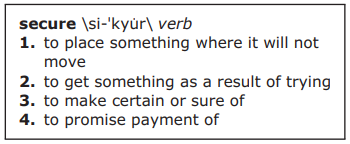
Read the dictionary entry for the word secure.


Which definition most closely fits the way the word secured is used in paragraph 4?
Definition 1
Definition 2
Definition 3
Definition 4
Which fact in the selection is best supported by the last photograph?
Acorn weevils are the first insects to live in acorns.
Acorn weevil larvae eat the inside of the acorn.
Acorn weevils can use their snouts to drill holes in acorns.
Acorn weevil larvae are inside an acorn when it falls from the tree.
Based on the selection, the reader can conclude that acorns —
are similar to many other types of nuts that people eat
must be properly prepared before humans can eat them
are becoming rare because many animals use them
can cause serious damage when they fall off trees
What is the best summary of the selection?
Acorns are nuts which drop from oak trees in the fall. People have found ways to prepare and eat acorns for many years. Some animals, including several types of insects, use acorns for food and even for shelter.
Acorns usually drop from trees before colored leaves do. They hit everything beneath them and are often gathered by squirrels. At certain points in history, they were also gathered, prepared, and eaten by people.
The ancient Romans, Native Americans, and Pilgrims all ate acorns. Some animals also use acorns in interesting ways. However, the Native Americans were the only ones who thought of using acorns for medicine.
Native Americans used to prepare baskets of acorns. Animals such as the acorn woodpecker may hide many acorns in dead trees or telephone poles. The acorn weevil and the acorn moth lay their eggs in or near an acorn.
Which statement best describes how baby acorn weevils know that it is time to leave their acorn homes?
They finish eating all the nut meat inside of the acorn.
An adult acorn weevil drills a new hole in the acorn.
The acorn drops from the oak tree to the ground below.
The weather becomes so warm that no acorn shelter is needed.
The photograph of the acorn woodpecker and the information in paragraph 6 best support the idea that the woodpecker —
uses acorns to attract the insects it likes to eat
will lay its eggs inside the acorn-filled tree
prefers sweet-tasting acorns to bitter ones
is creating storage for many acorns