Log in
Sign up for FREE
arrow_back
Library

The Three Gunas

star
star
star
star
star
Last updated about 4 years ago
12 questions
Note from the author:
Required
1
Required
1
Required
1
Required
1
Required
1
Required
1
Required
1
Required
1
1
1
Required
2
Required
4
Philosophy; Hindu metaphysics, the Three Gunas
Watch the following video and answer the questions as best you can while you listen.

Take your time. Pause as needed.
Reflect and rewind or replay as needed while you work through the video and the questions.

The concluding question requires a very high level of reflection. So think hard before you attempt to answer it! There are multiple good answers, but dozens of bad answers to that question.
Question 1
1.

Question 2
2.

Question 3
3.

Question 4
4.

Describe a person who is "tamas." Give an example from fiction or literature.

Question 5
5.

The teacher compares the "tamas personality" to a physical object and to a state of being. What physical object does he compare the person to? What word does he use to describe the person and the thing's "state of being?"

Question 6
6.

Question 7
7.

Why do you suppose it is impossible and even undesirable to exhibit only ONE guna in one's way of being or character? (sattva, rajas, or tamas) Why must everything exhibit all three in different proportions depending on their character or way of being?

Question 8
8.

Describe a person who is "rajas." Give an example from fiction or literature.

Question 9
9.

Describe a person who is "sattva." Give an example from fiction or literature.

Question 10
10.

Question 11
11.

In the Bhagavad Gita, Krishna says "Action is better than inaction." Why does this make sense in light of the teacher's discussion of the gunas in this video?

Question 12
12.

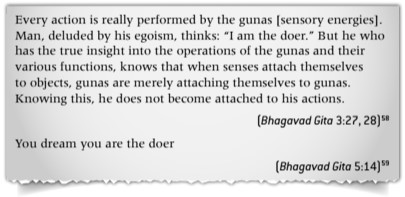
You have seen these quotes before from a homework assignment.

1. Restate your understanding of the quotes from the Bhagavad Gita (the words are from the god, Krishna) in light of the explanation of the teacher in this video.
2. Why should we not be attached to the gunas (sattva, rajas, or tamas)?
3. What is an advantage found in detachment?
4. Why do you think Krishna say we only "dream" that "we" are the "doer?"

(Krishna will later claim that only GOD, HE (Krishna) himself, is the ONLY true "Do-er" in the universe. Thus, when we think that "we" are "doing," we are deceived and living in maya, "illusion.")

What are the three gunas?
rojas
tapas
rajas
tamas
sattva
sutta
The student asked a question:
All things, living and non-living, have the three gunas. Yet how can a non-living thing, which is man-made, have the three gunas?
All things, living and non-living, have the three gunas. Yet how can man have three gunas?
All things have the three gunas. Yet how can non-living things have the gunas, these spiritual realities?
The preliminary understanding explored by the teacher is:
The gunas tell us how the human world interacts with the physical world.
The gunas permeate the physical and the human world. They permeate the whole of creation.
The gunas show that everything is the same and only consists of the three things.
The gunas are mainly realities of the human world and human perceptions; they are real only insofar as we perceive them.
What is the metaphysical claim that underlies the concept of the gunas?
Everything that exists has three attributes. It is woven together from three threads: sattva, rajas, and tamas.
Non-living things have one of three attributes. They are sattva, rajas, or tamas.
Human beings exhibit predominantly one of three attributes. They are sattva, rajas, or tamas.
Sattva, rajas, and tamas correspond completely to Newton's laws of motion.
Drag and drop the following adjectives to the correct guna using the descriptor terms the teacher used in his talk.
things at rest remain at rest
heavy
lazy
dull
ignorant
moving
forces
active
ants in the pants
balance
equal and opposite reaction
sober
content
darkness
illumined
things in motion stay in motion
intertia
tamas
rajas
sattva