Air Tab: Use the website to help answer these questions.
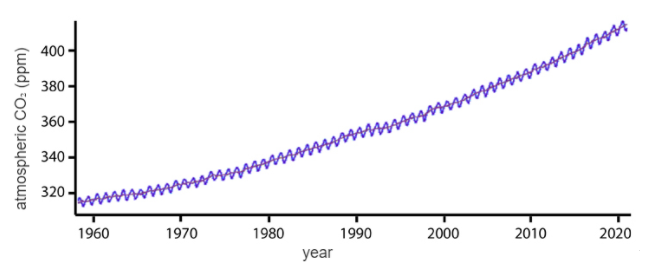
Why is the blue line wavy?
Air Tab: Use the website to help answer these questions.
Why is the blue line wavy?
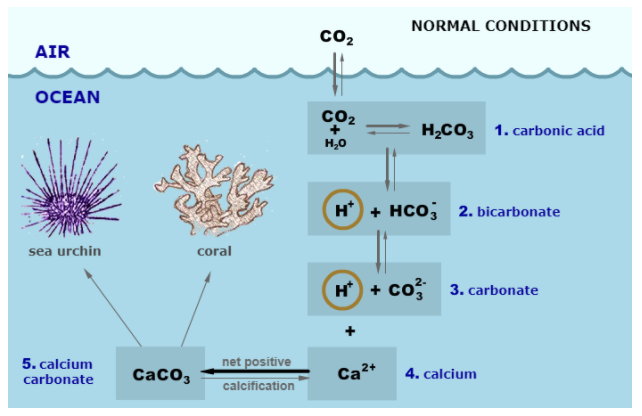
Ocean Acidification is the process by which the earth’s oceans decrease in pH level (become more acidic). This is due to an increase in atmospheric CO2 from anthropogenic activities like fossil fuel combustion. CO2 dissolves in the ocean water and reacts with H2O to form carbonic acid (H2CO3), a weak acid. This process decreases the amount of calcium carbonate in the ocean, which makes it difficult for coral and other shell formers to create new shells.
Air Tab: Use the website to help answer these questions.
Why is the blue line wavy?
pH Tab: What is the difference in strength between a substance that is 8 on the pH scale compared to a substance that is a 6? (Moving from 6 -->8)
Ocean pH Tab: How would you characterize the pH of the ocean currently?
Ocean pH Tab: What is predicted to be happening to the pH of the ocean over time (through to 2100)?
Acidic waters can cause many problems for sea life, most notably corals, mussels, scallops, and any other shelled organism. These shells are made of calcium carbonate, which will react with carbonic acid and break down, dissolving the shell/skeleton. This makes it difficult for corals and other organisms to build new skeletons and decreases the survivorship of larvae (babies).
Chemistry Tab: What does it mean when the arrows go both directions in the chemical equation?
Chemistry Tab: Why is one arrow thicker than another?
Prior knowledge: How does carbon dioxide enter the ocean (TWO large reasons)?
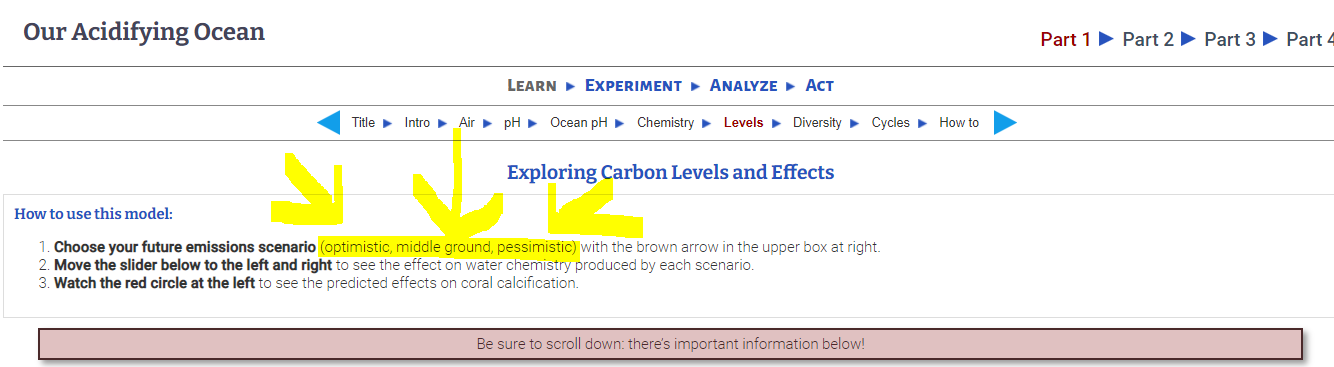
Levels Tab: Pick one of the scenarios (in the levels tab) and describe what is happening to the coral calcification as you increase carbon dioxide.
Diversity Tab: What do you notice about the organisms that are calcifiers? What trophic level would you put most of them in?
Before you start the virtual lab.
Formulate a hypothesis to test how acidification might impact the sea urchin larval stage.
Why did you choose to test pH 8.1 and pH 7.7 as your treatment levels? Which flask is the control experiment?
When we increased the amount of CO2 in the sea water, ________________________.
Suggest at least two actions that could be taken to decrease the amount of carbon dioxide added to the atmosphere.