Log in
Sign up for FREE
arrow_back
Library

2021 STAAR English 2 - Fiction + Informational: The Piano Shop on the Left Bank + Those Old Piano Blues

star
star
star
star
star
Last updated about 4 years ago
19 questions
1
E2.4F
1
E2.4F
1
E2.4F
1
E2.4F
1
E2.4F
1
E2.8F
1
E2.8F
1
E2.7D.ii
1
E2.4F
1
E2.4F
1
E2.8A
1
E2.2A
1
E2.8A
1
E2.2B
1
E2.5D
1
E2.4F
1
E2.2B
1
E2.4F
1
E2.4F
Content accessed from https://tea.texas.gov/student-assessment/testing/staar/staar-released-test-questions
Copyright information provided below.
All content on this site is copyrighted by the Texas Education Agency and cannot be used without the express written permission of TEA, except under the following conditions:
  1. Texas public school districts, charter schools, and education service centers can copy materials for district and school educational use.
  2. Residents of the state of Texas can copy materials for personal use.
Do not alter or make partial copies of web content. Do not charge for the reproduced materials or any document containing them except to cover the cost of reproduction and distribution.
If you are in Texas but are not an employee of a Texas public school district or charter school, you must get written approval from TEA to copy materials and enter into a license agreement that may involve paying a licensing fee or a royalty fee.
For more information, email Copyrights@tea.texas.gov.
Question 1
1.

Question 2
2.

Question 3
3.

Question 4
4.

Question 5
5.

Question 6
6.

Question 7
7.

Question 8
8.

Question 9
9.

Question 10
10.

Question 11
11.

Question 12
12.

Question 13
13.

Question 14
14.

Question 15
15.

Question 16
16.

Question 17
17.

Question 18
18.

Question 19
19.

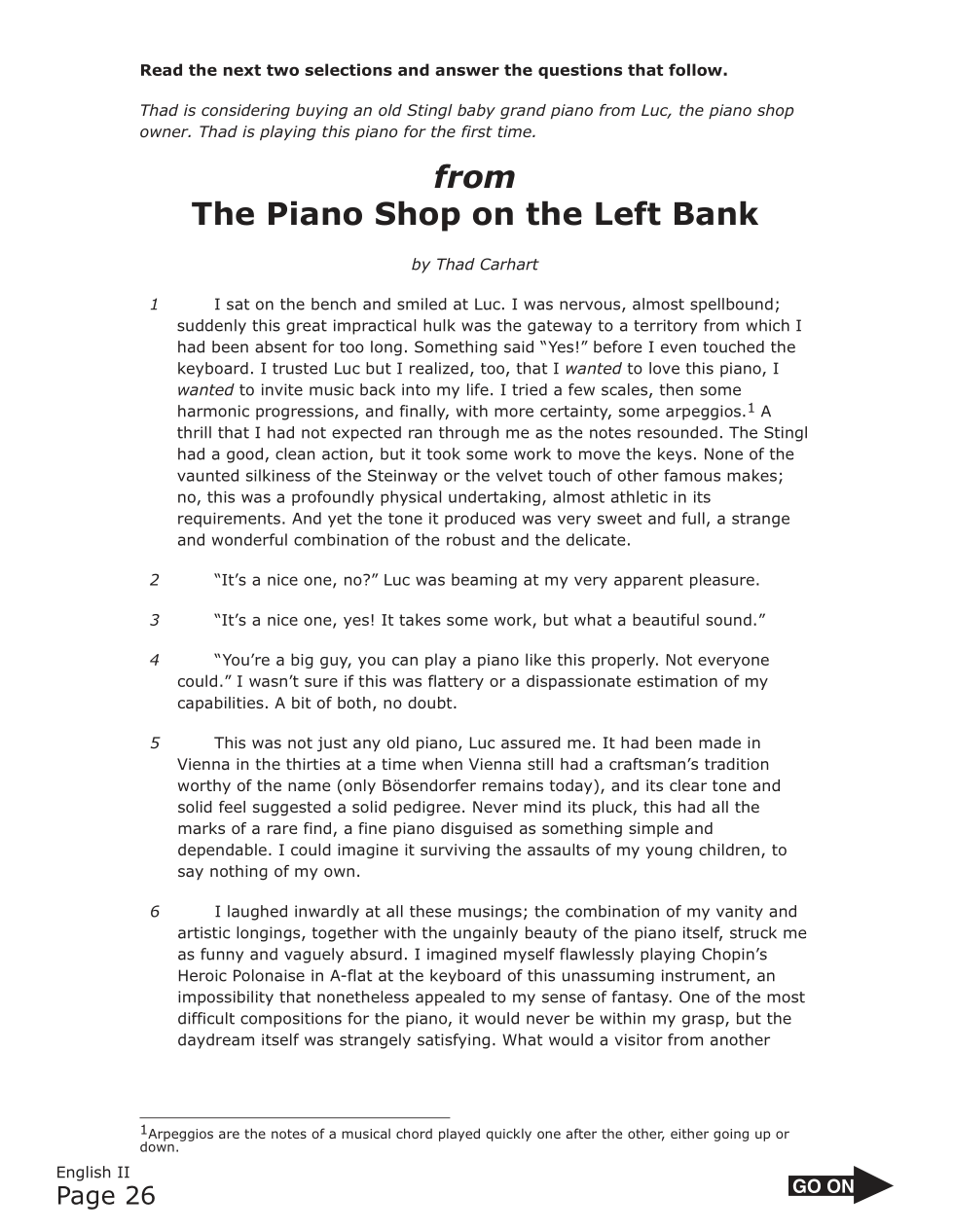
Use The Piano Shop on the Left Bank (pp. 26–28) to answer questions 1-7.

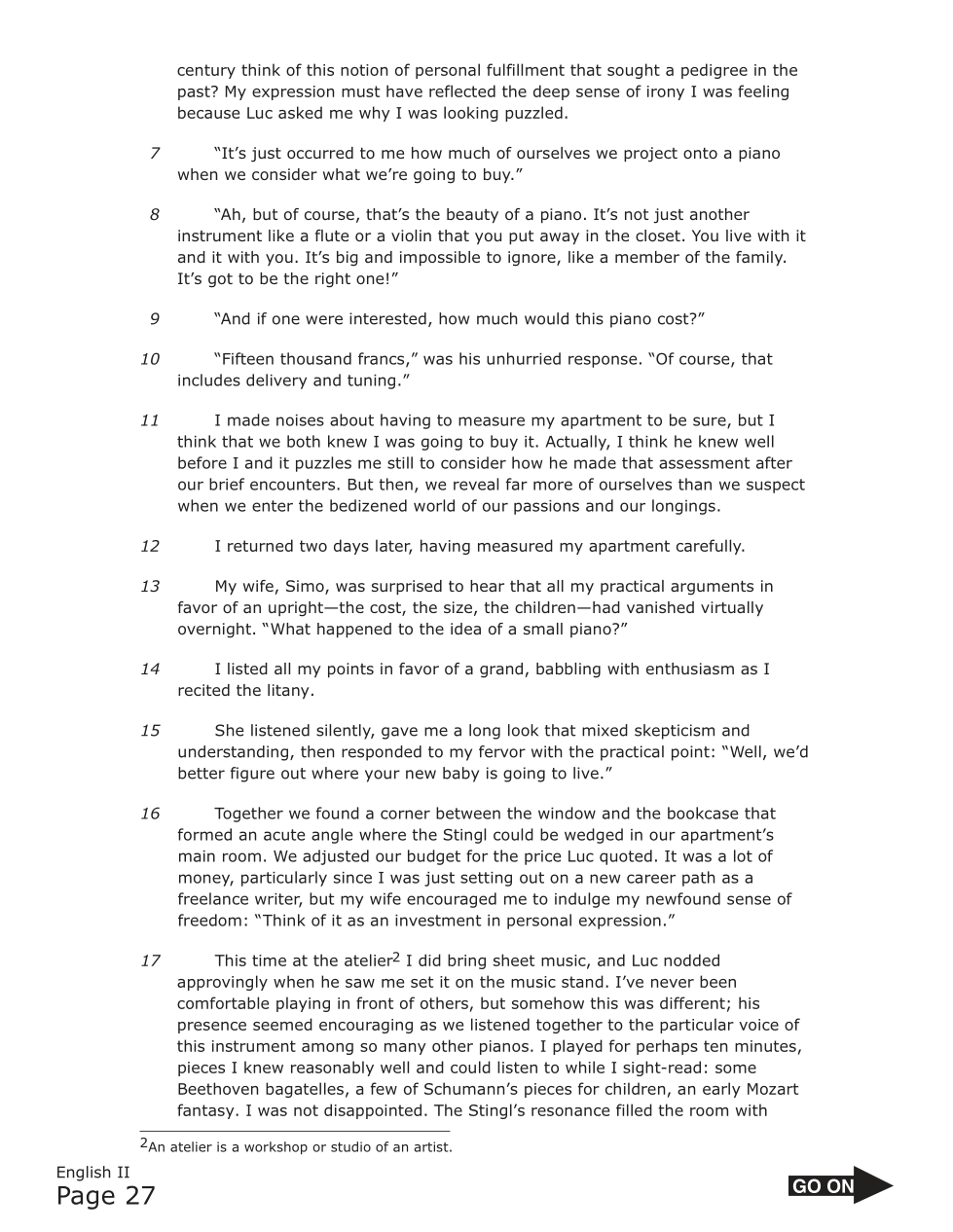
Read this quotation from paragraph 17 of the excerpt from The Piano Shop on the Left Bank.


Why does the narrator use a metaphor to describe his response to playing the piano?
To explain how he is able to remember a piece of music
To show how sharing music increases enjoyment
To suggest that owning a piano can spark enthusiasm
To reveal the depth of his feelings towards the piano
In paragraph 8 of the excerpt from The Piano Shop on the Left Bank, Luc suggests that the narrator —
trust his ability to make decisions
reflect on the commitment of buying a piano
be willing to consider other pianos
think about playing different instruments
In paragraph 1 of the excerpt from The Piano Shop on the Left Bank, which idea is introduced?
The power of intuition
An unachieved goal
Impractical choices
The wisdom of experience
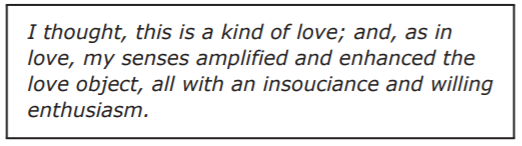
Read this quotation from paragraph 16 of the excerpt from The Piano Shop on the Left Bank.


What can the reader infer about the narrator’s wife based on her words?
The wife believes it is more important to invest in the arts than in other things.
The wife does not believe people should deny themselves things that they want.
The wife views the piano as an attractive addition to their living room.
The wife sees music as a necessary outlet for her husband’s creativity.
In paragraph 17 of the excerpt from The Piano Shop on the Left Bank, how does the narrator feel about playing the Stingl piano in the piano shop?
He needs Luc to help him build confidence in his musical ability.
He hopes Luc will believe that he is worthy of the Stingl.
He feels oddly comfortable playing in front of Luc.
He enjoys showing Luc that he can play different types of music.
In paragraph 1 of the excerpt from The Piano Shop on the Left Bank, why does the narrator describe the piano as “a strange and wonderful combination of the robust and the delicate”?
To explain why he feels this particular piano is special
To reveal that he needs a piano that is not too fragile or ornate
To state why he is physically able to play this particular piano
To suggest that he prefers a piano that won’t require much upkeep
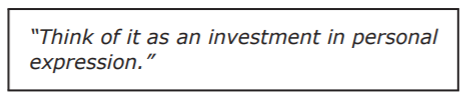
Read this quotation from paragraph 1 of the excerpt from The Piano Shop on the Left Bank.


What is the narrator’s purpose for including this description?
To explain where he is shopping for a piano
To highlight his doubts about wanting a piano
To show how he exaggerates when describing events
To reveal the strength of his desire to play the piano again
Use “From Those Old Piano Blues” (pp. 29–30) to answer questions 8-15.

In the excerpt from the article “Those Old Piano Blues,” how does the author mainly organize his ideas?
He lists the benefits of owning a piano by referencing a magazine article about musical instruments.
He supports people learning to play the piano with stories from students who enjoy the instrument.
He argues against getting rid of old pianos by explaining how important they once were.
He discusses trends in piano ownership by describing his experience trying to get rid of an old piano.
Read this quotation from paragraph 2 of the excerpt from the article “Those Old Piano Blues.”


What does the author’s use of musical terminology convey in the quotation?
How the popularity of the piano has shifted like notes in a song
How piano dealers use musical language when they speak
How piano tones affect the price of the instruments
How piano music will persist despite its decrease in popularity
Which quotation best shows that the author of the excerpt from the article “Those Old Piano Blues” is relieved someone wants his old piano?
The song had gone from major to minor, but we pressed on. (paragraph 4)
Then the song shifted to the saddest of blues. (paragraph 4)
But like many a blues song, this piano riff ends with hope. (paragraph 6)
And to be sure, many older pianos have reached their coda. (paragraph 7)
What is the purpose of the information in the excerpt from the article “Those Old Piano Blues”?
To explain why traditional pianos have greatly declined in value
To describe the differences between old pianos and new ones
To prove that pianos made in the last century are irreplaceable
To inform people about new American trends with musical instruments
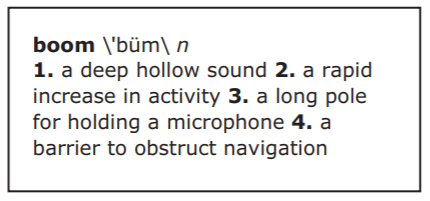
Read this dictionary entry.


Which definition most closely matches the meaning of boom as it is used in paragraph 4 of the excerpt from the article “Those Old Piano Blues”?
Definition 1
Definition 2
Definition 3
Definition 4
In the excerpt from the article “Those Old Piano Blues,” what is the primary purpose of paragraph 7?
To explain why letting go of pianos is acceptable at times
To state the reasons why pianos are still important
To detail the life cycle of pianos
To describe pianos in a historical context
Which word from the excerpt from the article “Those Old Piano Blues” means “an approximate amount”?
peak (paragraph 1)
substantial (paragraph 3)
roughly (paragraph 4)
treacherous (paragraph 5)
Which is the best summary of the excerpt from the article “Those Old Piano Blues”?
Many families in America once owned acoustic pianos, but there are now fewer families who want them. In fact, if you have an old piano, it can be very hard to sell it or find someone who wants it. That’s why there are companies now offering to pick up old pianos. It is sad these instruments were once prized but have little value today, unless someone is willing to restore them to their original working condition.
Although acoustic pianos were once a popular item in American life, many are now being disposed of or recycled for parts. Changes in American entertainment, as well as the space and upkeep required to own an acoustic piano, have led people to pursue other interests or purchase less expensive digital pianos. However, the number of Americans learning to play the piano has not changed, which shows that the instrument is still appreciated.
Many families in America still own pianos but many of them are now digital pianos. People who own old acoustic pianos still feel sentimental about them and believe they are worth a lot of money. However, the people who make money from pianos are the ones that know how to remove or recycle them.
Today, Americans are learning to play piano as adults, and they often go to piano studios in cities like Los Angeles and New York. Piano playing was popular in the 20th century and still is. Pianos used to be an important part of family entertainment, but other instruments have taken their place. Today, old acoustic pianos are stored in warehouses because they take up too much room in houses.
Use The Piano Shop on the Left Bank and “Those Old Piano Blues” to answer questions 16-19.

In the excerpt from The Piano Shop on the Left Bank and the excerpt from the article “Those Old Piano Blues,” with which statement would both authors most likely agree?
Old pianos offer a great deal of emotional value to their owners.
Old pianos are constructed from better materials than new pianos.
People can learn a lot about the history of pianos from musicians.
People should learn to play on an acoustic piano before moving to a digital one.
While the narrator of the excerpt from The Piano Shop on the Left Bank finds an old Stingl valuable enough for him to spend a lot of money on it, the author of the excerpt from the article “Those Old Piano Blues” —
expects to sell an old Steinway for a high price
insists on donating his old piano to a school
gives an old Steinway to someone who wants it
thinks old pianos should be destroyed
What is one notable difference between the two excerpts?
The selection from The Piano Shop on the Left Bank explains why someone wants to play piano, while the selection from the article “Those Old Piano Blues” explains why piano lessons are less popular.
The selection from The Piano Shop on the Left Bank describes evaluating and buying an old piano, while the selection from the article “Those Old Piano Blues” describes an abundance of unwanted old pianos.
The selection from The Piano Shop on the Left Bank emphasizes the craftsmanship of a new acoustic piano, while the selection from the article “Those Old Piano Blues” emphasizes today’s preference for digital pianos.
The selection from The Piano Shop on the Left Bank shows how rare it is for someone to appreciate an old piano, while the selection from the article “Those Old Piano Blues” shows how people overvalue all musical instruments.
What feeling is conveyed by both the excerpt from The Piano Shop on the Left Bank and the excerpt from the article “Those Old Piano Blues”?
Amusement
Ambition
Attachment
Awe