Formative version of the 5 extension- The Physics of Building a Guitar
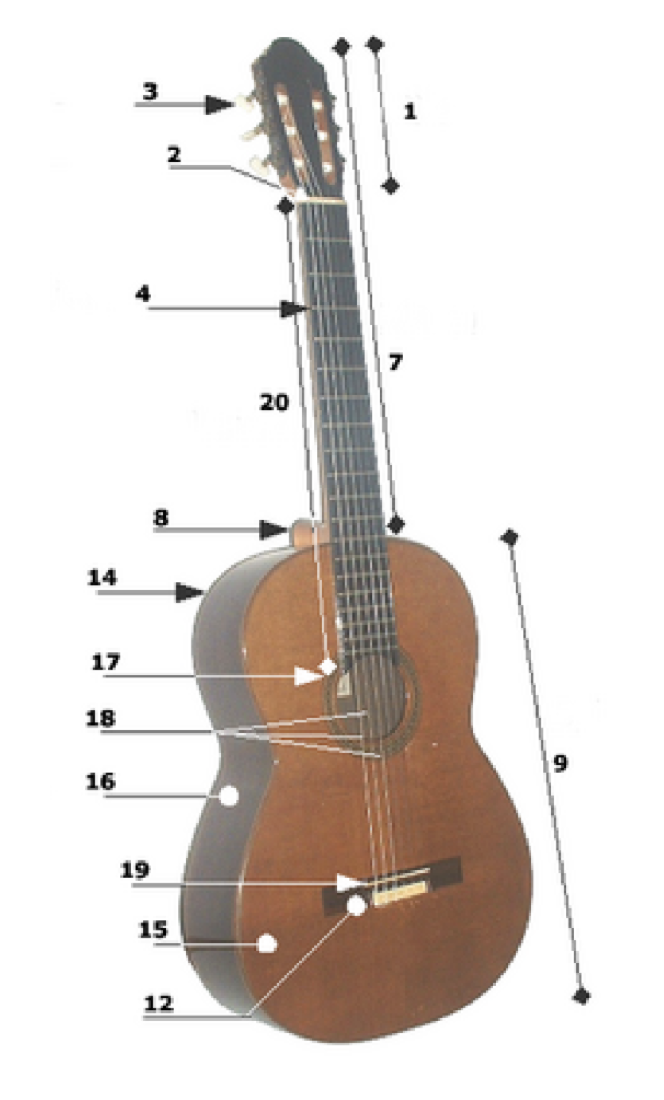
Parts of a typical acoustic guitar

1. Headstock
2. Nut
3. Tuning Pegs
4. Frets
6. Inlays
7. Neck and fretboard
8. Heel
9. Body
12. Bridge
14. Back
15. Soundboard (top)
16. Body sides (ribs)
17. Sound hole
18. Strings
19. Saddle
20. Fretboard
Citation:
Information gathered from Wikipedia 2013
Wild Guess: How does a guitar work?
Brainstorm - Think of 3 variables (things you could reasonably change) that could affect the pitch (frequency modulation, or FM) and 1 variable that could affect the volume (loudness) of sound (amplitude modulation, or AM) you would hear from a guitar.
Graph a low data prediction about the variables’ relationships and a one sentence explanation for how you think your idea would have an effect on the pitch.
Graph a low data (wild guess) prediction about Variable A's relationship to pitch.
Graph a low data (wild guess) prediction about Variable B's relationship to pitch.
Graph a low data (wild guess) prediction about Variable C's relationship to pitch.
Graph a low data (wild guess) prediction about Variable D's relationship to volume.
To Play
Attempt to tune your guitar to as close as possible the following scale, known as "standard tuning" (EADGBe), and is as follows:
sixth string: E - lowest tone - (a minor thirteenth below middle C—82.4 Hz)
fifth string: A (a minor tenth below middle C—110 Hz)
fourth string: D (a minor seventh below middle C—146.8 Hz)
third string: G (a perfect fourth below middle C—196.0 Hz)
second string: B (a minor second below middle C—246.92 Hz)
first string: e - highest tone - (a major third above middle C—329.6 Hz)
Standard tuning has evolved to provide a good compromise between simple fingering for many chords and the ability to play common scales with minimal left hand movement.
What is standard tuning?
What is one reason you can think of for why standard tuning is an important part of playing music?
Once your guitar is built to specifications and tuned as well as you are able, experimentally investigate all three of your variables relating to pitch (A, B, and C) and one for volume (D).
Graph your outcomes below.
Graph your data informed result showing Variable A's relationship to pitch.
Graph your data informed result showing Variable B's relationship to pitch.
Graph your data informed result showing Variable C's relationship to pitch.
Graph your data informed result showing Variable D's relationship to volume.
Watch the video below for more information about the physics of guitar to at least 4:29 to answer the question on the right.
You are now ready to explain the Advanced Physics of a Guitar.
Helpful questions to think about when constructing your explanation of how guitars work:
Why does a guitar have its various parts?
Why does it have tuning pegs?
Why does it have frets?
Why are the strings different?
What makes a guitar sound different than the similar violin or cello?
Why do guitars have that big front and box with a hole?
For the written description cite your evidence (graphs) and include the technical terms: pitch, string, natural frequency, tension, length, thickness (linear mass density), transfer of energy, bridge, soundboard, loudness, resonance, vibration, motion.