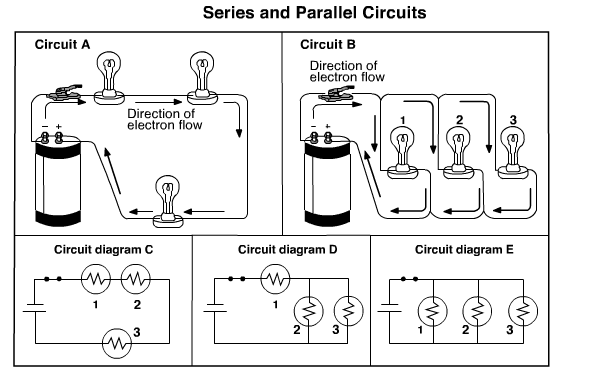
Which circuit illustration represents circuit B?
Which circuit illustration represents circuit B?
The build-up of charges on an object is called
What happens when an object is rubbed against another object to charge by friction?
What causes charges to move in a circuit?
The ampere is a unit of
According to Ohm’s law, resistance is equal to voltage divided by
Materials through which charge can flow easily are called
An example of an insulator is
Batteries and power plants are examples of
Which of the following does not determine the resistance of a wire?
Lisa built an electric circuit. When she added a seond light bulb, the first bulb became dimmer. What type of circuit did Lisa build?
A complete, unbroken path through which electric charges can flow is a(n)
Your alarm clock has a voltage of 120 V and a resistance of 1200. What current does the alarm clock draw?
The law of
11. In a(n)
The continuous flow of charges through a material is called electric
When the electric field of one object causes a transfer of electrons from one part to another in a second object, without the two objects touching, it is called
The transfer of charge when electrons move from a charged object to another object by direct contact is called
The resistance of a parallel circuit
As the temperature of most conductors increases, the resistance decreases.
Electric charges that are different attract each other.
The electrons in an insulator are tightly bound to their atoms.
The unit of measure for voltage is the ohm.
For a constant voltage, increasing the resistance will cause the current to decrease.
What are the basic features of an electric circuit?
How is current related to resistance?
Explain why you may produce a static discharge if you touch a metal door knob after walking on a wool carpet.
Which circuit illustration represents circuit B?
Look at the diagram in question 27. Will removing bulb 1 in circuit B cause bulb 3 to go out? Explain.