Answer the questions that follow. You have 20 minutes to complete the quiz
Required
1 point
1
Question 1
1.
The motion of an electron in an atom creates an electric current
Required
1 point
1
Question 2
2.
In two separate experiments, a magnet is brought near an unmagnetized iron bar. This causes the bar to become magnetized
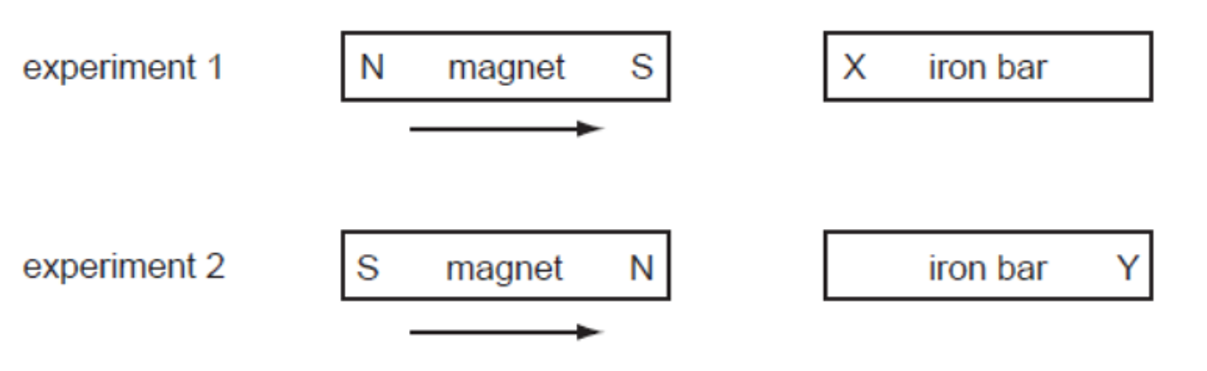
Which magnetic poles are induced at X and at Y?
Required
1 point
1
Question 3
3.
Which statement describes a property of a magnet?
Required
1 point
1
Question 4
4.
A magnetic domain is where small groups of atoms group together in __________ direction
Required
1 point
1
Question 5
5.
Which of the following is true when drawing magnetic field lines?
Required
0 points
0
Question 6
6.
How many protons are needed to make 1 nC of charge? Give your answer in Coulombs.
The charge of an electron is -1,6 x10⁻¹⁹ C
Required
1 point
1
Question 7
7.
In a physics lab, you charge up three metal spheres, two with +3nC and one with −4nC. When you bring all three spheres together so that they all touch one another, what is the total charge on the three spheres?
Required
1 point
1
Question 8
8.
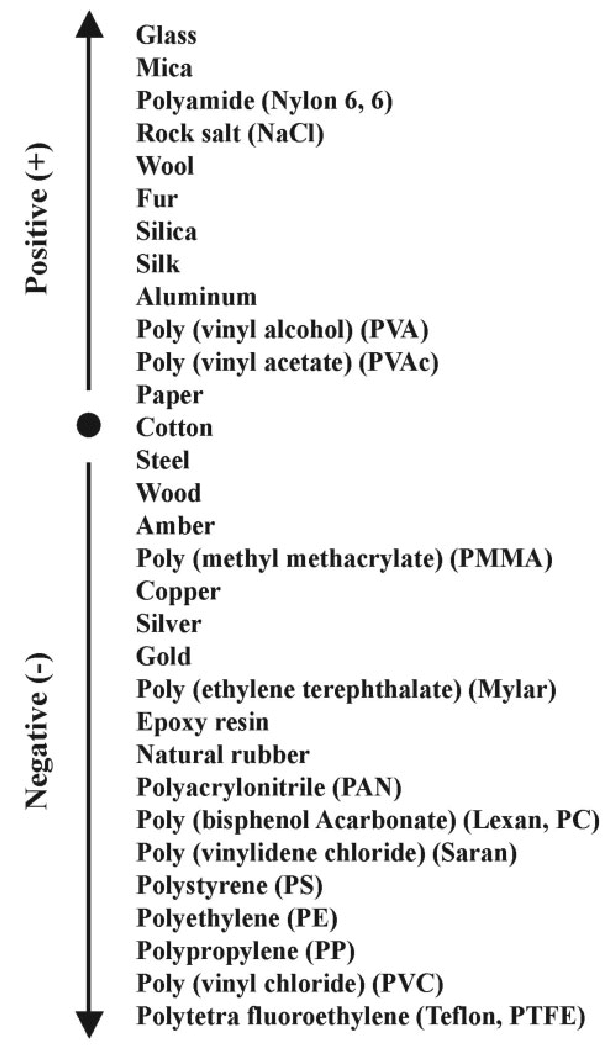
Consider the triboelectric series given below:
Pick the correct statement describing what will happen when a glass rod is rubbed against silk
0 points
0
Question 9
9.
A polarized material must have a zero net electric charge.
Required
2 points
2
Question 10
10.
Two charged pith balls on isolated strings are brought into contact with each other. Initially ball one had a charge of +11nC and ball two has a charge of +7nC. Calculate the number of electrons transferred from one ball to the next. The charge of an electron is -1,6 x10⁻¹⁹ C
Required
4 points
4
Question 11
11.
Match the definitions to the correct terms.
Draggable item
arrow_right_alt
Corresponding Item
The neutral body is charged by a charged body through direct contact.
arrow_right_alt
conduction
When an electric field distorts the negative cloud of electrons around positive atomic nuclei in a direction opposite to the field
arrow_right_alt
induction
The process of removing the excess charge on an object by means of the transfer of electrons between it and another object of substantial size
arrow_right_alt
polarization
The neutral body is charged without any direct contact between the neutral body and the charged body.