Solve for y.
Solve for x.
Round to the nearest hundredth.
Solve for x.
Round to the nearest tenth.
Solve for x.
Round to the nearest tenth.
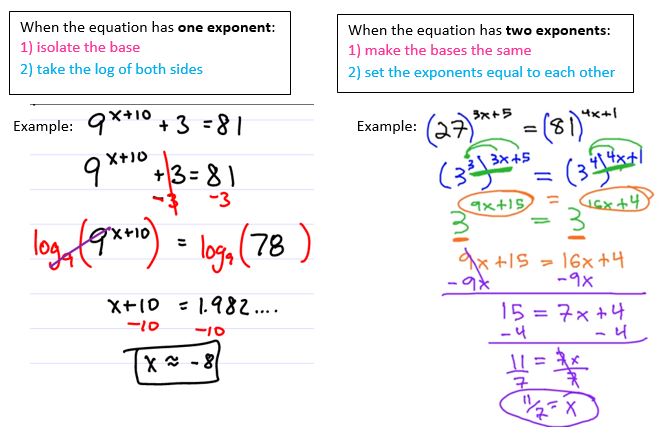
How do you solve for x when the base is not "e" ?
Identify the base of the exponent so you can isolate it. What is the base?
Isolate the base by
Then take the log of both sides.
Finish solving the equation for x to answer #6.
Solve for x.
Round to the nearest whole.
Solve for x.
Round to the nearest tenth.
Solve for x.
Round to the nearest tenth.
Solve for x.
Round to the nearest tenth.
Solve for x.
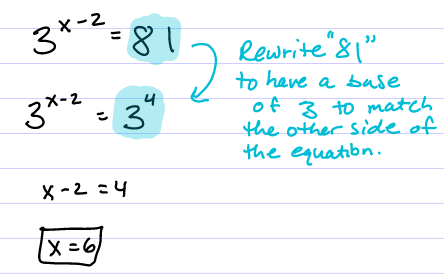
Now you try! Solve for x by re-writing the right side of the equation with a base of "2".
Then set the exponents equal to each other and solve for x.
Rewrite the equation below so each side has the same base.
Use your answer for #12 to finish solving for x.
Now you try! Solve the equation by making both sides have the same base.
Solve for x.
Solve for x.
Solve for x.
Solve for x.
Solve for x.
This equation only has one exponent. So instead of trying to make the bases the same, you can just take
Round to the nearest tenth.
Solve for x.
Round to the nearest tenth.
Hmm, only one exponent but it may be easier to make the bases the same still. Up to you!
Solve for x.
Round to the nearest tenth.
The population of a small farming community is declining at a rate of 7% per year. The decline can be expressed by the function
Round to the nearest whole year.
How long will it take $1500 to triple if it is invested at 2.25% interest compounded monthly?
Round to the nearest whole.
100 bunny rabbits are left in a field and their rate of reproduction is given by the function below, where
Round to the nearest whole day.