Below is a selection of types of questions you could see on the LEAP 2025 test for Algebra I. Be sure to read the directions for each set of questions and the tips/hints provided to get you through.
This unit focuses on extended linear concepts.
Piecewise-Defined Graphs
A piecewise-defined function is a function that is defined differently for different disjoint intervals in its domain. This is fancy lingo for pieces of different functions on the same graph.
Remember that a closed circle means including that value and an open circle means you can not include that value.
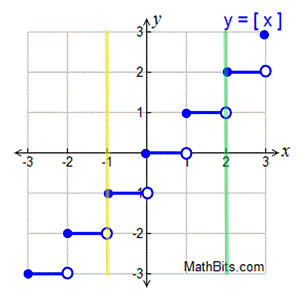
Here are some example questions you could have based on the graph.
1.) What is f(-1) = ?
When I look at the graph, I go to where x = -1 and that is where I put the light yellow to clarify. I find the point on the graph that has that value for x. We see two points, one is open and one is closed. When choosing between the two, I can only choose the one that is closed circle. So...
f(-1)= -1
2.) What is f(2) = ?
I do the process again. I go to where x = 2 and that is where I put a light green line to clarify. Again, I see two points on the graph and I must choose the closed circle. So..
f(2) = 2
Required
4 points
4
Question 1
1.
1.) f(1) = _______
2.) f(-4) = _______
3.) f(0) = _______
4.) f(_______ ) = 2
Piecewise-Defined Functions
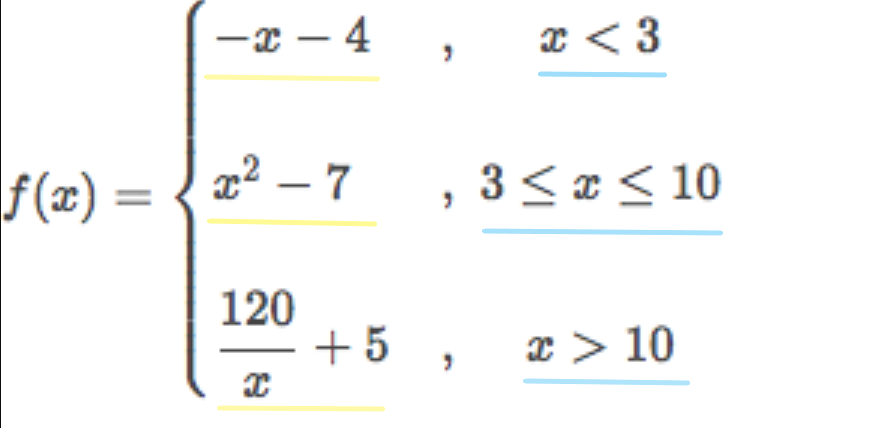
When given a piecewise function, you must determine which values can be applied to which function. I underlined the functions in yellow and the restrictions of the domain (x-values) in blue.
Here are a few examples.
1.) f(3) = ?
Look to the restrictions to determine which function I can use. I see that the first two fuctions have a 3. When this happens, you must determine which one is equal to 3. This would be the second function. So what I do is I substitute the x-value with 3 and find the output. So....
2.) f(12) = ?
Again, look at the restrictions and determine which was includes 12. I can see that 1 is greater than 10 so I will use the third function. So...
Required
1 point
1
Question 2
2.
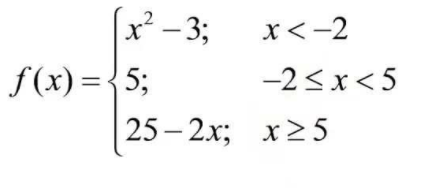
What is f(0) = ?
Required
1 point
1
Question 3
3.
What is f(-4) = ?
Required
1 point
1
Question 4
4.
What is f(10) = ?
Required
1 point
1
Question 5
5.
What is f(-2) = ?
Required
1 point
1
Question 6
6.
What is f(5) = ?
Required
1 point
1
Question 7
7.
What is f(-10) = ?
Graphs of Inequalities in Two Variables
When graphing inequalities, we must know the basics of graphing. This was partly covered in the previous unit. You must plot the y-intercept given first then use slope to determine the rest of the points. Then we must know the other features of inequalities that were covered somewhat in Unit 1.
Shading
-Shading below the line means less than (<).
-Shading above the line means greater than (>).
Type of line
-If the line is dotted it's not equal to.
-If the line is solid it's equal to.
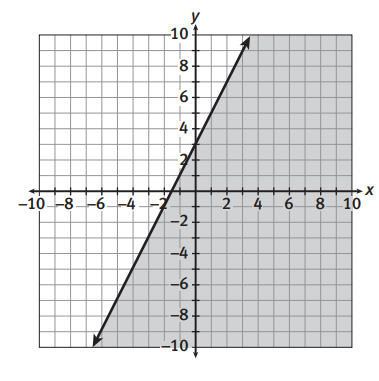
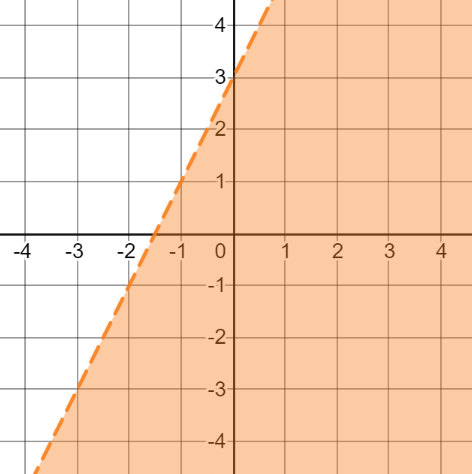
For example, graph the inequality
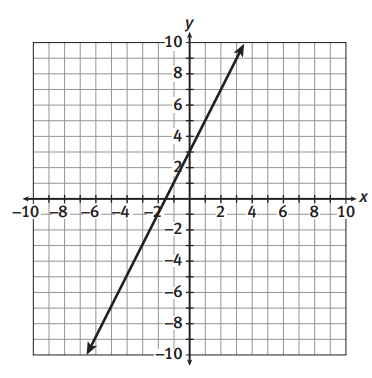
We first graph the line for y=2x+3 to form the boundary line of our inequality as shown below. Since the inequality is less than or equal to I made it a solid line.
Next we must determine which side of the graph must be shaded. Since our inequality is less than, we must shade below. A tip that I use to shading the correct area is by picking a point on the line I drew and since I shade below, I drag my pencil down. This is the area I shade and it shown below.
On Desmos
When given access to use desmos, you can simply type the entire inequality into desmos and it will graph it for you. Remember to keep in mind about dotted and solid lines.
Required
1 point
1
Question 8
8.
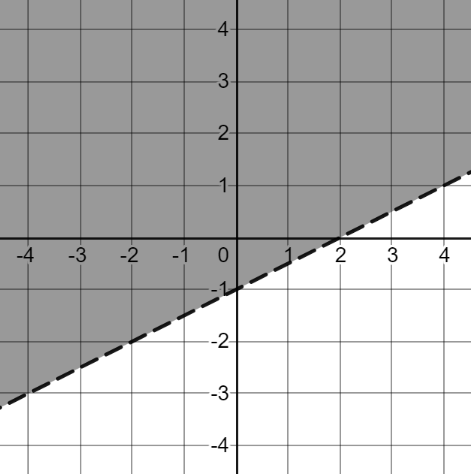
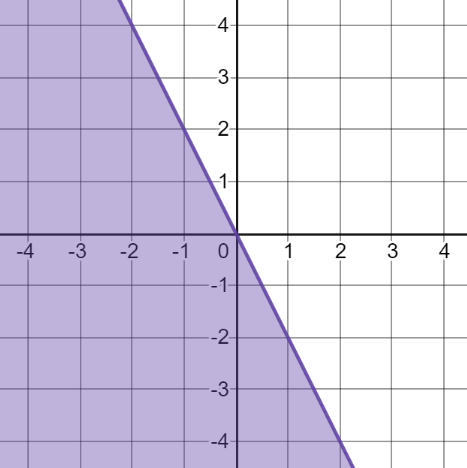
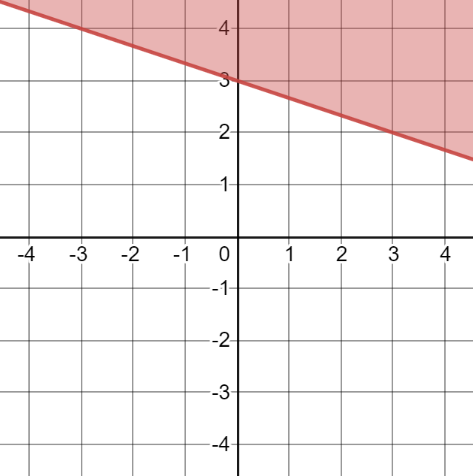
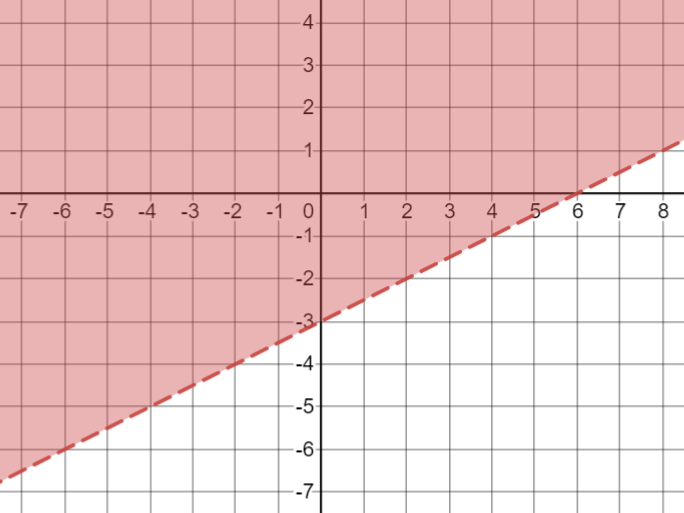
Which of the following graphs is
Required
1 point
1
Question 9
9.
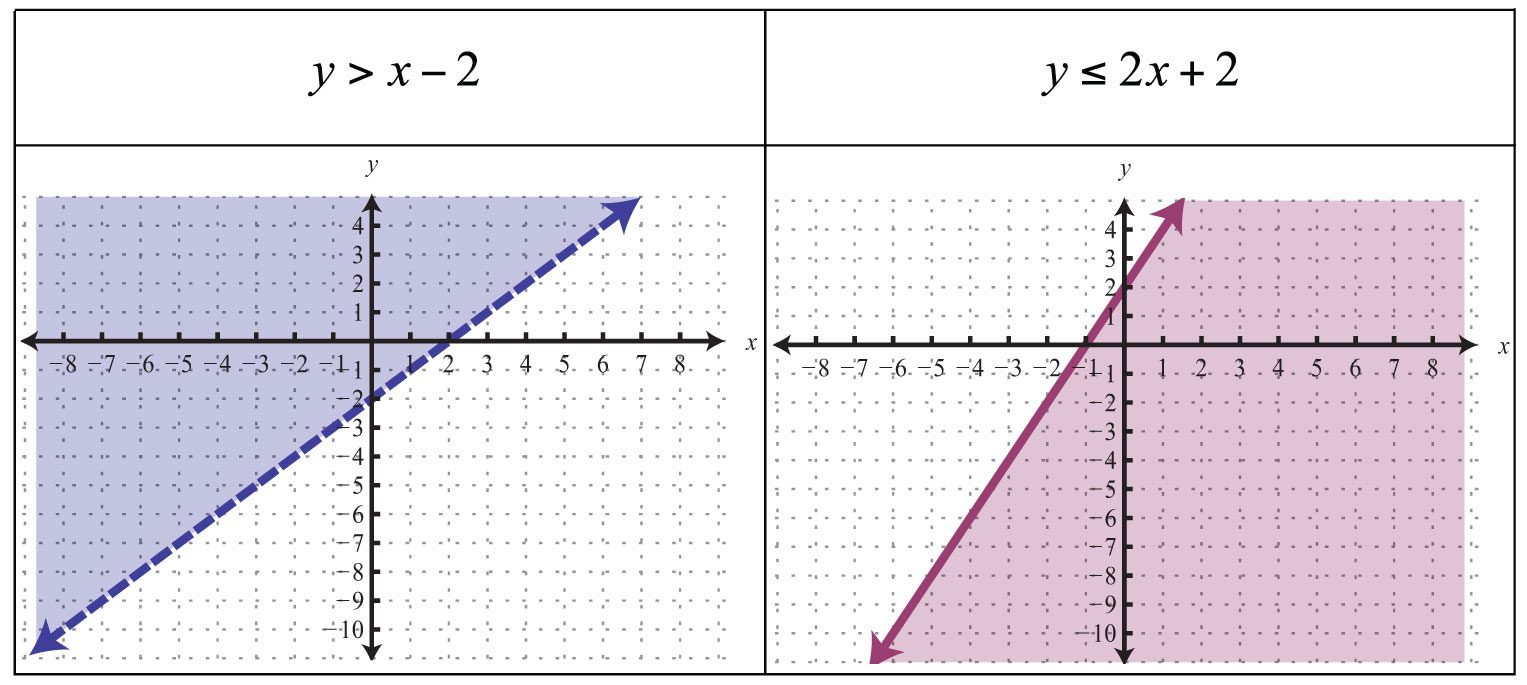
Match the inequality to the correct graph.
Draggable item
arrow_right_alt
Corresponding Item
arrow_right_alt
arrow_right_alt
arrow_right_alt
arrow_right_alt
SOLUTIONS OF INEQUALITIES
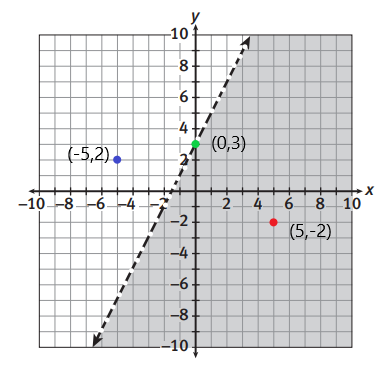
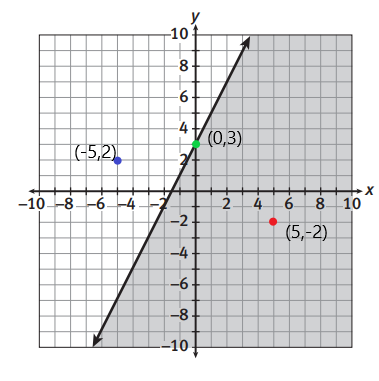
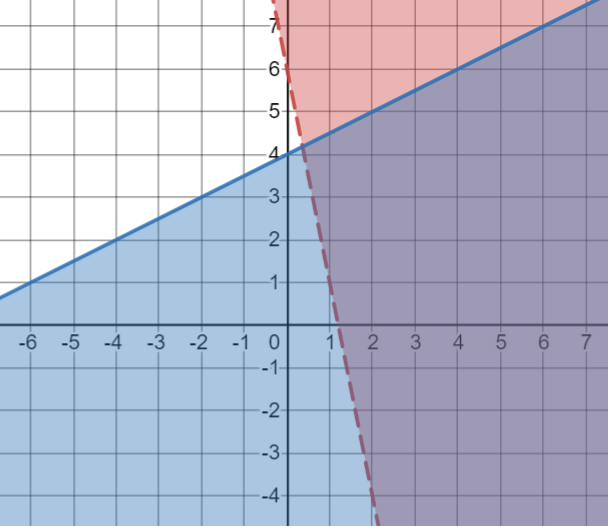
When discussing solutions of equations, we usually got one solution. Since we are now working with inequalities, inequalities have more than one solution. On the left, I have two graphs with three specific coordinates identified in blue, green, and red.
When we say solution, we mean that if I take that coordinate and subsitute it in the inequality, it will make a true statement. For example:
I want to check if (5,-2) is a solution. So I substitute it into the inequality.
Since -2 is less than or equal to 13, this is a true statement so (5,-2) is a solution.
Sometimes we might not be given an inequality and we may just be given a graph. For something to be a solution to an inquality, it must be in the shaded region or on the solid line that makes up the inequality. If the coordinate in question is in the unshaded region or on the dotted line, it is not a solution. Below I discuss the three colored coordinates on the graphs to the left.
The red coordinate is a solution for both since it is in the shaded region.
The blue coordinate is NOT a solution for both since it is not in the shaded region.
The green coordinate is a solution for the solid line graph however, it is not a solution for the dotted line graph.
Remember as a tip if you have access to DESMOS for anything related to coordinates, you can type a coordinate into desmos and it will plot if for you. I know there are still some students who struggly with plotting coordinates and this is one way to double check for yourself.
Required
3 points
3
Question 10
10.
Select all that ARE solutions to the graph on the left.
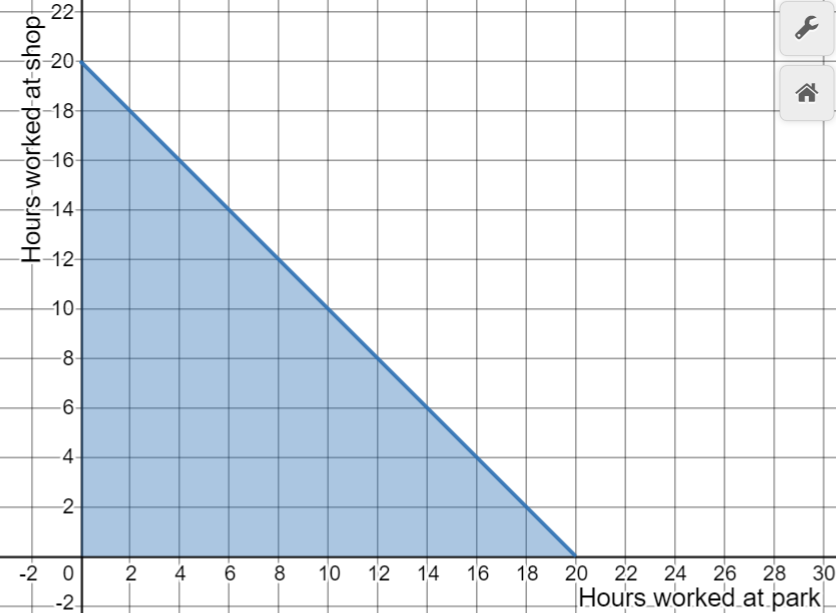
Sometimes we may also be given a word problem related to either an inequality or graph. On the left, I have an inequality graph that represents x number of hours he works at the park and y number of hours he works at the shop. He can not work over 20 hours.
Required
3 points
3
Question 11
11.
Select the responses that are solutions to this inequality.
SYSTEMS OF INEQUALITIES
When solving a system of inequalities, you are finding a solution that is true for all inequalities involved.
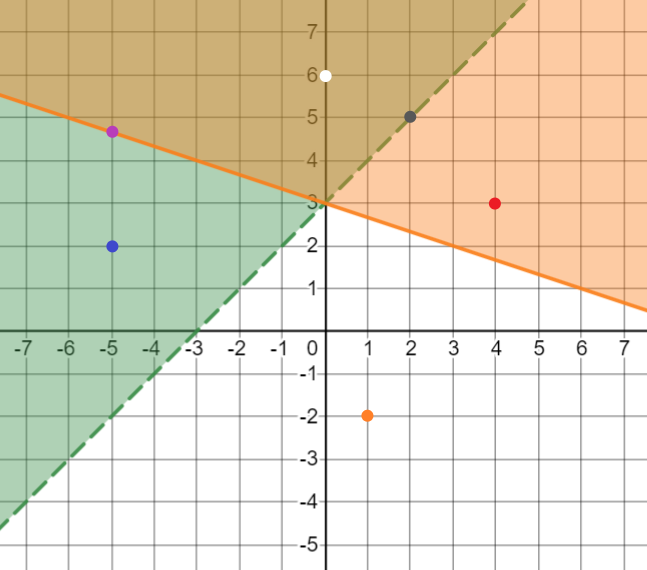
This follows the same logic as solutions of inequalities. It must be in the shaded region. In a system, it must be in both shaded regions or where the regions overlap to make the new color. I will go over each colored coordinate on the left.
The orange, blue, and red coordinates are not solution since they are not in both shaded regions.
The black coordinate is not a solution because even though it looks to be in both shaded regions, it is on a dotted line which does not make it a solution for both inequalities.
The purple coordinate is a solution since it is in both shaded regions and it's on the solid line.
The white coordinate is also a solution since it is in both shaded regions.
Required
1 point
1
Question 12
12.
Select the responses that are solutions to this system of inequalities
SYSTEMS OF LINEAR EQUATIONS
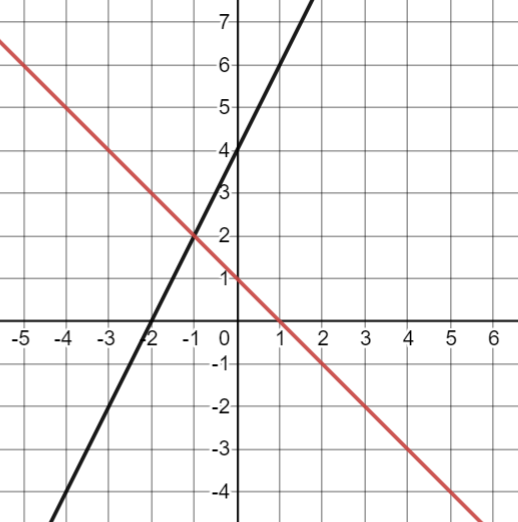
When solving a system of linear equations, we are looking for a coordinate that makes both equations true and on the graph, this is where to two lines intersect. When given access to Desmos, it's easy to find the solution since we can tell where they intersect. On the graph on the left, we can see that the two lines intersect at (-1,2).
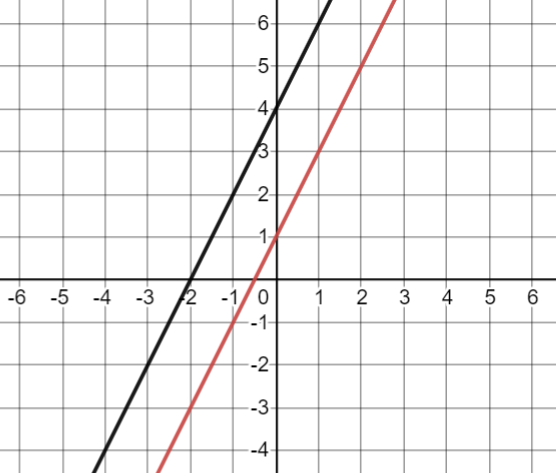
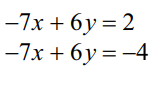
Sometimes when solving, we may get two other types of solutions. If ever you graph and the lines do not intersect, meaning they're parallel lines, you will have no solution. Graphs don't intersect, there is no answer. Here is what it might look like.
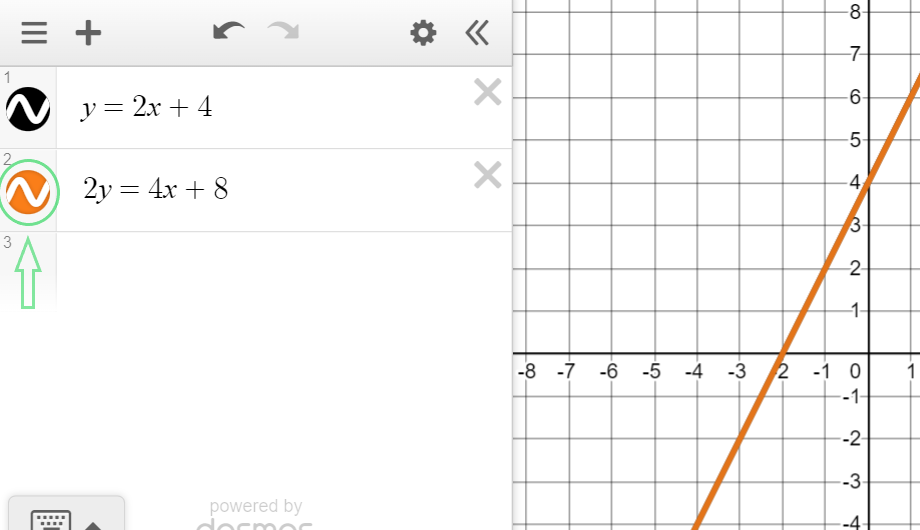
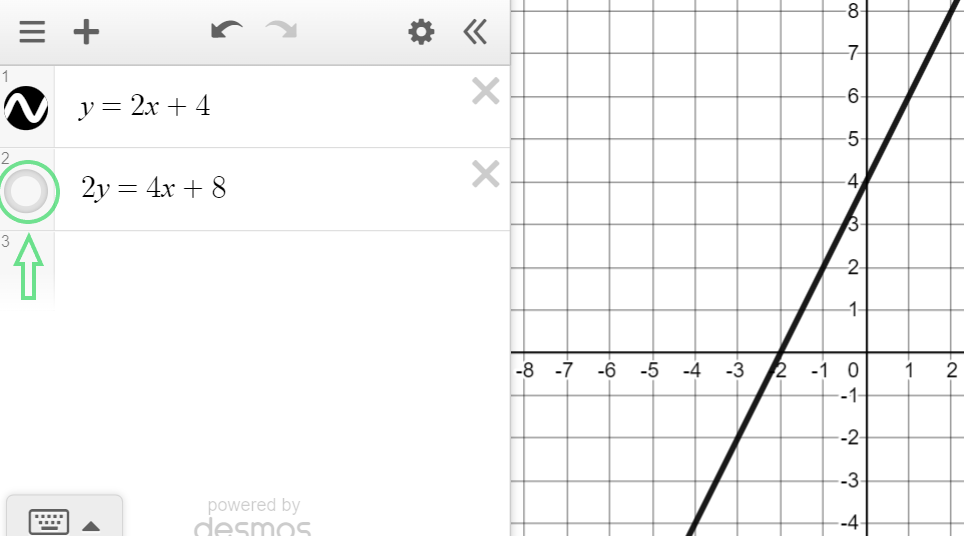
Sometimes when you graph both equations, you will only see one line. This is because both equations represent the same graph. On desmos, if you select the spot I circled in the picture below, it will reveal the other line. If this is the case, you have infinitely many solutions.
Substitution Method
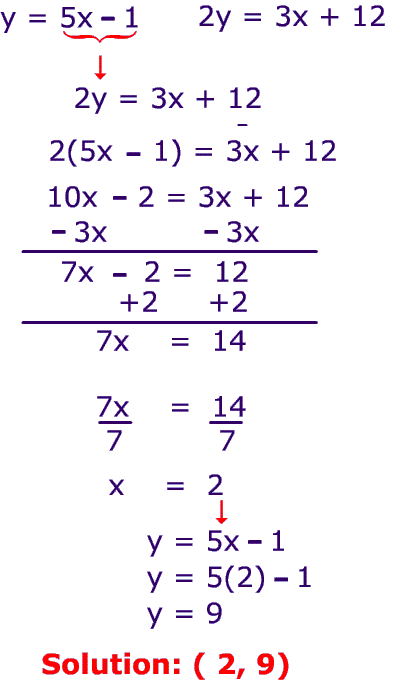
There are two other methods to solving a system. The first is the substitution method. The idea is to subsitute one equation in the other to find one variable. When you get the value for that variable, plug it back into one of the original equations to get the other variable. Here is an example.
Elimination Method
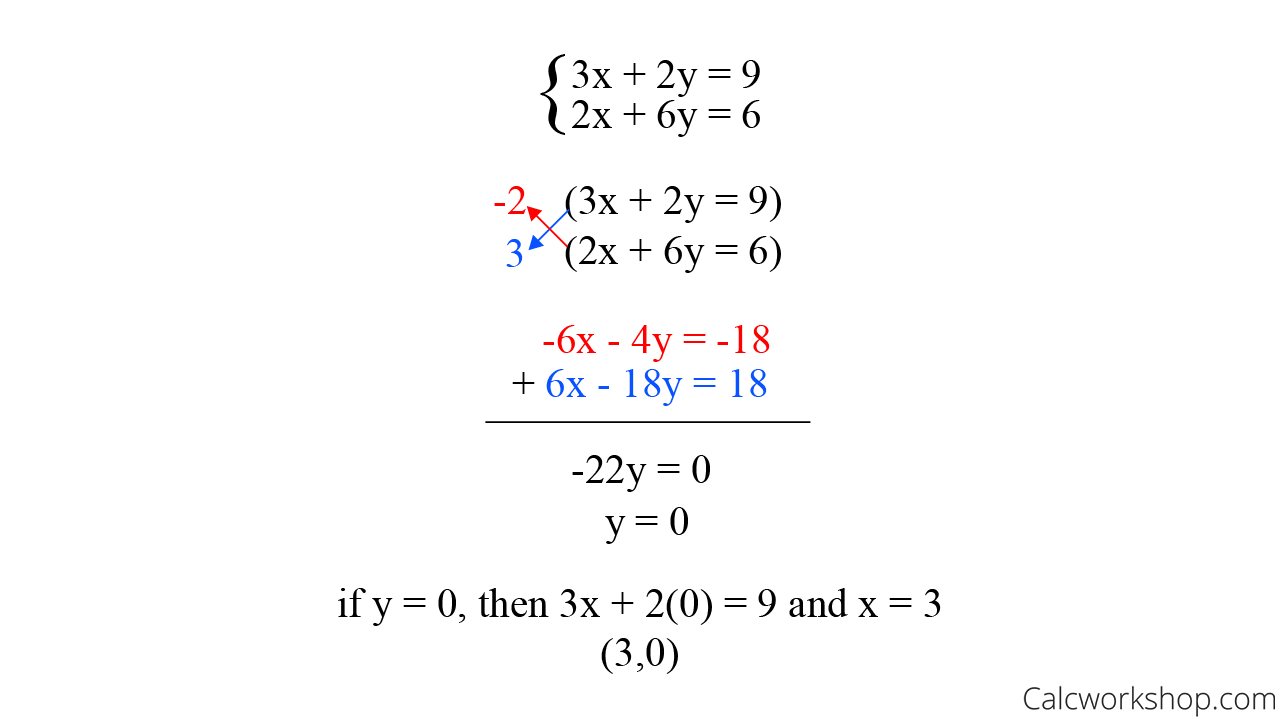
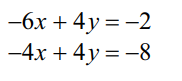
The other way of solving a system is elimination method. We use this method if both equations have the x, y, and constant values in the same order. We multiply the equations to "eliminate" one of the variables to solve for the other. After we get that value, we substitute it back into one of the originals to find the other variable. Here is an example.
At the end of the day, most of these questions you will have access to Desmos. Even if the LEAP test asks you to work substitution or elimination method, you can still get partial credit by finding the answer on the graph and explaining how you got that solution by graphing.
1 point
1
Question 13
13.
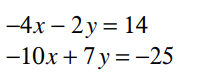
Solve this system using any method.
1 point
1
Question 14
14.
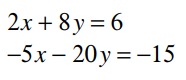
Solve this system using any method. Be sure that you type your answer as a coordinate.
1 point
1
Question 15
15.
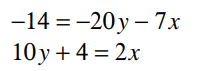
Solve this system using any method.
1 point
1
Question 16
16.
Solve this system using any method.
1 point
1
Question 17
17.
What is the x-value of the solution to this system?