La ardilla por Amado Nervo (Sp 1 U15, MP)
star
star
star
star
star
Last updated over 2 years ago
11 Nsɛmmisa
Ɛhia
1

Ɛhia
1
| Draggable item | arrow_right_alt | Corresponding Item |
|---|---|---|
La ardilla salta. | arrow_right_alt | The squirrel runs. |
una jaula | arrow_right_alt | The squirrel jumps. |
tronco | arrow_right_alt | school |
la escuela | arrow_right_alt | a cage |
La ardilla corre. | arrow_right_alt | tree trunk |
https://www.britannica.com/biography/Amado-Nervo
Amado Nervo, original name Juan Crisóstomo Ruiz De Nervo, (born August 27, 1870, Tepic, Mexico—died May 24, 1919, Montevideo, Uruguay), poet and diplomat, generally considered the most distinguished Mexican poet of the late 19th- and early 20th-century literary movement known as Modernismo. Nervo’s introspective poetry, characterized by deep religious feeling and simple forms, reflects his struggle for self-understanding and inner peace in an uncertain world.
Modernismo | Latin American art | Britannica
Modernismo, late 19th- and early 20th-century Spanish-language literary movement that emerged in the late 1880s and is perhaps most often associated with the Nicaraguan poet Rubén Darío, who was a central figure. A turning point in the movement was the publication of Azul (1888; “Blue”), Darío’s book of poems and short stories. While the movement had no manifesto or organized principles, it stemmed from a reaction against the literary naturalism of Émile Zola and against the wider bourgeois conformity and materialism of Western society. The poets of the Modernismo movement were influenced by the French Symbolists and Parnassians in their use of daring metaphors and innovative metres, and they used sensuous imagery to express their own highly individual spiritual values. The principal members of the movement were, besides Darío, the poets Antonio Machado and Juan Ramón Jiménez and the novelist and playwright Ramón María del Valle-Inclán.
Vocabulario
la ardilla - squirrel
corre - it runs
vuela - it flies
salta - it jumps
locuela - crazy
la escuela - school
una jaula - a cage
bonita - pretty
tronco - tree trunk
agujero - hole
Match the subject pronouns and the corresponding verb forms of "ir" in present tense.

| Draggable item | arrow_right_alt | Corresponding Item |
|---|---|---|
tú | arrow_right_alt | voy |
ellos, ellas, ustedes | arrow_right_alt | vas |
yo | arrow_right_alt | va |
él, ella, usted | arrow_right_alt | vamos |
nosotros, nosotras | arrow_right_alt | van |
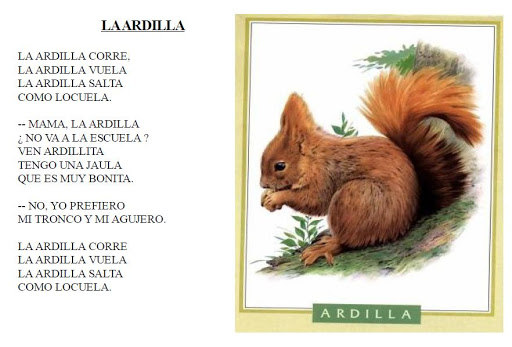
¿Cómo es la ardilla?
Answer in Spanish and in complete sentences. Y tú ¿cómo eres?
¿Qué hace la ardilla?
¿Qué le pregunta el niño a su mamá?
¿Qué tiene el niño para la ardilla?
A la ardilla, ¿dónde le gusta vivir?
Please answer in Spanish and in complete sentences. ¿Por qué crees que prefiera la ardilla el tronco de árbol a la jaula?
Sube una imagen de tu animal favorito.