Logarithmic & Exponential Review
star
star
star
star
star
Last updated about 3 years ago
26 Nsɛmmisa
1
1
1
1
1
1
1
1
1
1
1
1
1
1
1
1
1
1
1
1
1

1
1
1
1
1
Find the value of x.
Condense. Do not evaluate.
Solve for x.
Condense. Do not evaluate.
Condense and evaluate.
Solve for x.
Find the value of x.
Find the value of x.
Find the value of y.
Type your answer as a fraction.
Rewrite in log form.
Write in exponential form.
Solve.
Solve.
Solve.
Find the value of m.
Round to the nearest tenth.
Solve for x.
Solve & check for extraneous solutions.
Condense into a single logarithm:
Condense into a single logarithm:
Condense into a single logarithm:
Solve & round your answer to the nearest hundredth.
Solve & round your answer to the nearest hundredth.
If an initial population of 2,500 grows at a rate of 2.5% per year, how long would it take for the population to triple?
Round your answer to the nearest tenth of a year.
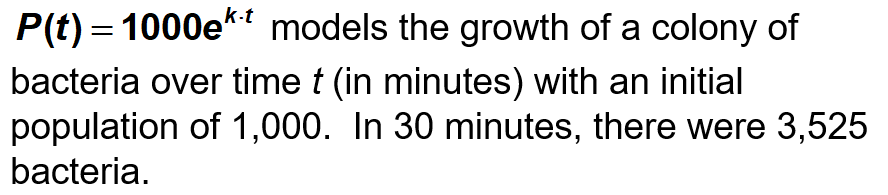
Solve for k. Round to the nearest thousandth (3 decimal places!)
After 1 hour, how many bacteria will there be in the colony?
*Use the k-value you found in #25. Round to the nearest whole.