Unit 4 Review Part 1

Last updated almost 3 years ago
27 questions
Note from the author:
Springboard Algebra 1 Unit 4
Below is a selection of types of questions you could see on the LEAP 2025 test for Algebra I. Be sure to read the directions for each set of questions and the tips/hints provided to get you through.
This section of Unit 4 will focus on exponents.
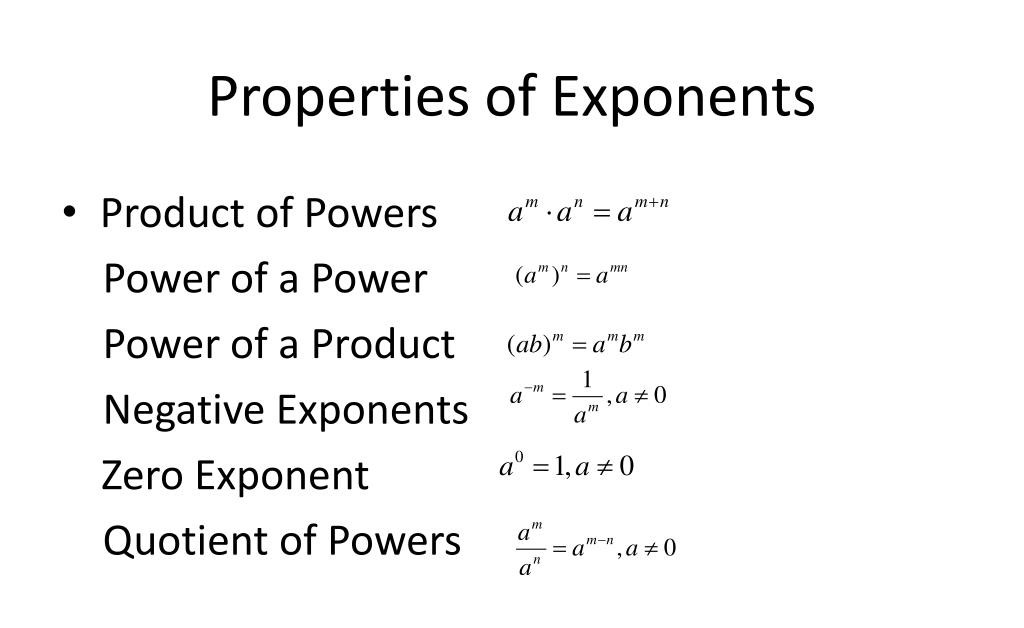
PROPERTIES OF EXPONENTS
You will not be told to use the properties. These properties will get used when doing future problems.

On the left you will see the name of the property and how it is used.

The product of powers tells us that if I multiply the same bases, I can add their exponents.

The power of a power tells us that if I have a base with an exponent raised to another exponent, you multiple the exponents.

The power of a product tells us that if I am multiplying two different bases and those are raised to a power outside of parentheses, I distribute the exponent to each and multiply.

The negative exponents tells us that if I have a negative exponent, I move it to the other side of a fraction and change the exponent to positive.

The zero exponent rule tells us that ANY value raised to the 0 power is 1.

The quotient of powers rule tells us that if I divide the same bases, I can subtract the exponents.

You won't necessarily use all of these but it is still important to recongize them.
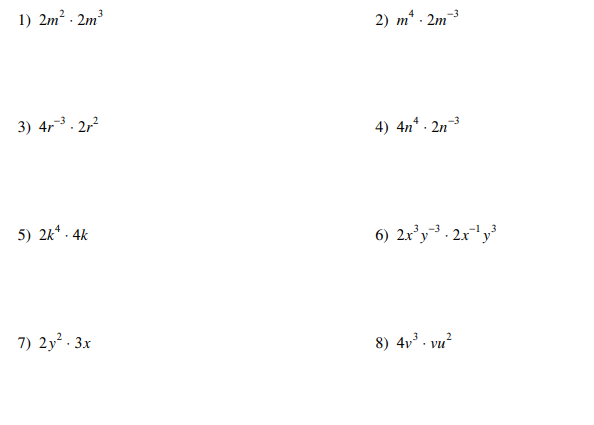
Simplify the following expressions using properties of exponents.
Required
1
Required
1
Required
1
Required
1
Required
1
Required
1
Required
1
Required
1
ARITHMETIC SEQUENCES

An arithmetic sequence is a sequence where each term increases by adding the same value (positive or negative). We consider these linear patterns.

For example: 5, 9, 13, 17,...
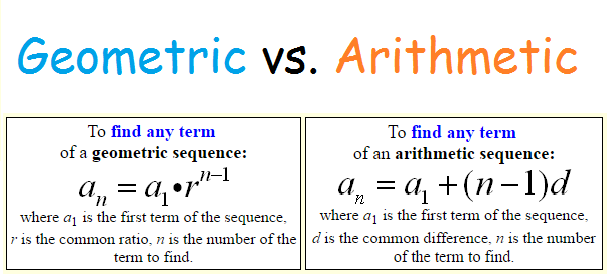
Above, you can see the arithemtic formula.
where a1 represents the starting value (first term of the sequence) and d represents the common difference. When given a sequence of values, we subtract consecutive terms to find the commond difference. So I pick two terms that are back to back in order to determine the common difference. 9 - 5 = 4. This value needs to be checked by adding it to determine the next terms in the sequence and it should match every term. 5+4=9. 9+4=13. 13+4=17 and after checking, this is our commond difference. We also see that it has a starting value of 5 since that is the first term of the sequence.

So our arithmetic formula would be
GEOMETRIC SEQUENCES

A geometric sequence is a sequence of non-zero numbers where each term after this first is found by multiplying by the common ratio. We consider these to be exponential.

For example: 2, 4, 8, 16,...
Above, you can see the geometric formula.

where a1 represents the starting value (first term of the sequence) and d represents the common ratio. When given a sequence of values, we can test to see if it is geometric by dividing consecutive terms to find the common ratio. So I pick twero terms that are back to back. 4 ÷ 2 = 2. This value needs to be checked by multiplying it to determine the next terms in the sequence and it should match every term. 2*2=4. 4*2=8. 8*2=16 and after checking, this is our common ratio. We also see that it has a starting value of 2 since that is the first term of the sequence.

So our geometric formula would be
Required
4.5

Determine if the sequences are arithmetic, geometric, or neither.

  • 5, 10, 20, 25,...
  • 1, 2, -1, -2,...
  • 1, 3, 5, 7,...
  • 20, 24, 28, 32,...
  • -2, -6, -18, -54,...
  • 5, 3, 1, -1, -3,...
  • 2, 10, 50, 250,...
  • 0, 6,19, 22, 50,...
  • 100, 50, 25, 12.5,...
  • Arithmetic
  • Geometric
  • Neither
Required
1

Identify the common difference OR the common ratio. If it's a common difference, d = #. If it's a common ratio, r = #.

100, 50, 25, 12.5,...

Required
1

Identify the common difference OR the common ratio.

1, 3, 5, 7,...

Required
1

Identify the common difference OR the common ratio.

2, 10, 50, 250,...

Required
1

Identify the common difference OR the common ratio.

5, 3, 1, -1, -3,...

Required
1

Write the formula for the following sequence.

5, -5, -15, -25,...

an = ?

Required
1

Write the formula for the following sequence.

4, 8, 16, 32,...

an = ?

For each of the following, I will be asking you to determine a term in the sequence. For example.

Given the formula
find the 5th term in the sequence.

What this means is I will replace n with 5 and simplify the right side. You do nothing with the left side since all that does is say the 5th term of the sequence.


This means that the 5th term in the sequence is -3.
Required
1

Give the formula below, find the 8th term in the sequence.

Required
1

Given the formula below, find the 3rd term in the sequence.

EXPONENTIAL GROWTH AND DECAY

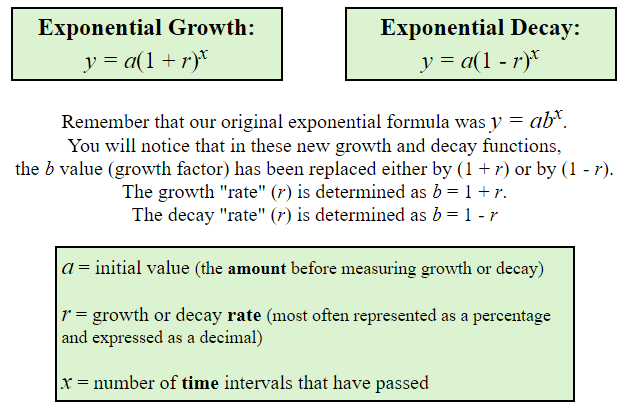
When covering exponential growth and decay, we need to understand that this is an extension of geometric sequence.

Looking at the formulas on the left side, we can the similarities between the two.

The a is the starting or initial value.

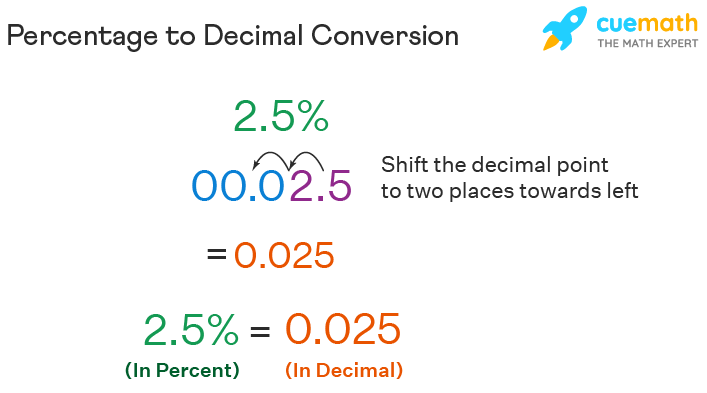
The r is the growth or decay rate. When covering this part, we have to understand that a rate is usually represented by a percent. The value in the formula must be represented as a decimal though, so to convert.


The x is the variable we use that will, in most problems, represent the time that passes by.

Here is an example problem. Timmy is gaining money in his bank account at a rate of 2% each month. Timmy started with $50. Write a formula to express the total y money that Timmy will have in his account after x months. After your write the formula, calculate how much money Timmy would have after 5 months of saving.

First, I change the percent to a decimal. 2% is 0.02. Since the key word with the percent is gaining, this means we have exponential growth. With this and the starting value, I can begin to write the formula.

a=50
r=0.02


Since this is our formula, now I can find how much for 5 months. I will replace x with 5 since x stands for the number of months.


So in 5 months, he saved about $55.20.
Required
1

Alexa is finding the total amount of bacteria left in a sample dish after a number of hours pass by. The dish started with 2000 bacteria and is decreasing at a rate of 25%. Write an equation to represent how many y bacteria is left after x hours.

Required
1

Harriet is discussing the population of a small rural town. The town starts with 500 people and grows at a rate of 10% each year. Write an equation that represent the total population y of the town after x years.

Required
1

Given the formula below, find the rate.

Required
1

Given the formula below, find the rate.

Required
1

Determine if each of the following are exponential growth or decay.

  • Growth
  • Decay
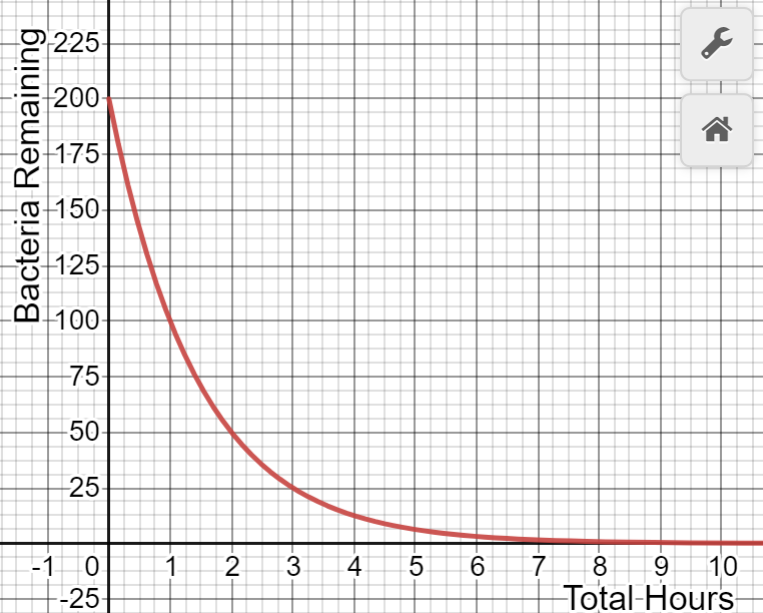
Jennifer is discovering the remaining bacteria in an organism after x hours. The graph is on the left.
Required
1

How much bacteria did the organism start with?

Required
1

How much bacteria was remaining after 3 hours?

Required
1

How much time passed by for there to be 100 bacteria left?

Required
1

After about 8 hours, what is a value the remaining bacteria is close to?

Required
1

Select all true statements.