Left Knee
Use the Raw Data image showing the reflection of ultrasound in the left knee to assign a number from 0 to 3 that matches the line and transit time for the echo.
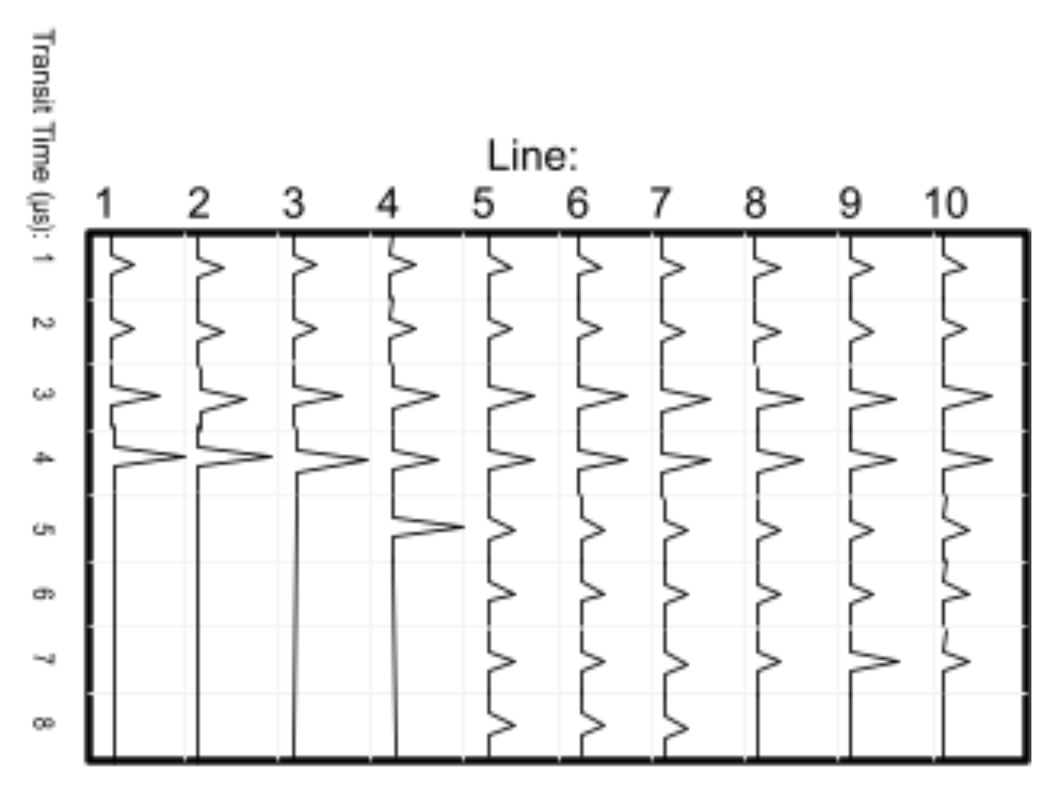
Choose the highlighted parts that are evidence the knee is injured.
Background on the patient: The patient,
μs= microsecond
There are 1,000,000 (one million) μs in 1 second.
Background on the ultrasound medical imager: The transducer has ten lines that are spaced 5 mm apart. Each line emits an ultrasound pulse at a frequency of 6 MHz (6 million waves/second or 6 waves/μs). These pulses travel at the speed of sound in the human body which has an approximate wave speed of 1.5 millimeter/microsecond (mm/μs). The diagrams below show the raw data of the transit time of the return signals to the transducer for each of the 10 lines.
What is the frequency of the ultrasound medical imager?
Sort the "Storyboard of our Code" steps into the correct order.
Computer colors each pixel based on their relative value (0, 1, 2, 3)
Transducer waits for reflections to come back (input → time)
Paste results back into Formative
Transducer emits signal (input → wave velocity = 1.5 mm/μs)
"Computer’s signal processor" digitizes the analog signal, (we convert the amplitude of the reflected wave into a number between 0 - 3)
Computer calculates what depth that reflection is from (depth = wave velocity * time travelled / 2) and puts the digitized amplitude value (number) there
4CW3- Starting Spreadsheet with Support for Coding Doing Most of the Good Stuff of an Ultrasound Medical Imager. If you need extra help, use the video below.
Use the Raw Data image showing the reflection of ultrasound in the left knee to assign a number from 0 to 3 that matches the line and transit time for the echo.
Add a screenshot of your Left Knee "Raw Line Data" results.
Add a screenshot of your Left Knee "Ultrasound" image results.
Use the Raw Data image showing the reflection of ultrasound in the right knee to assign a number from 0 to 3 that matches the line and transit time for the echo.
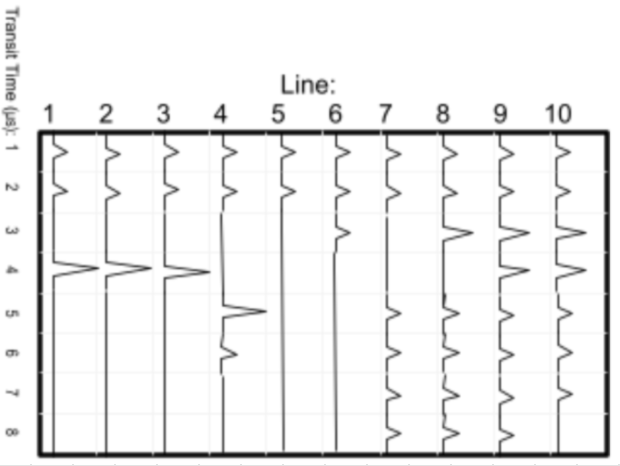
Add a screenshot of your Right Knee "Raw Line Data" results.
Add a screenshot of your Right Knee "Ultrasound" image results.
Explain how you used your sonograms to diagnose the health or injury of the patellar tendons in the right and left knees.
In your response, be sure to include specific evidence from your sonogram results compared to the anatomical diagram below and explain how the sonogram shows the injury or health of each knee.
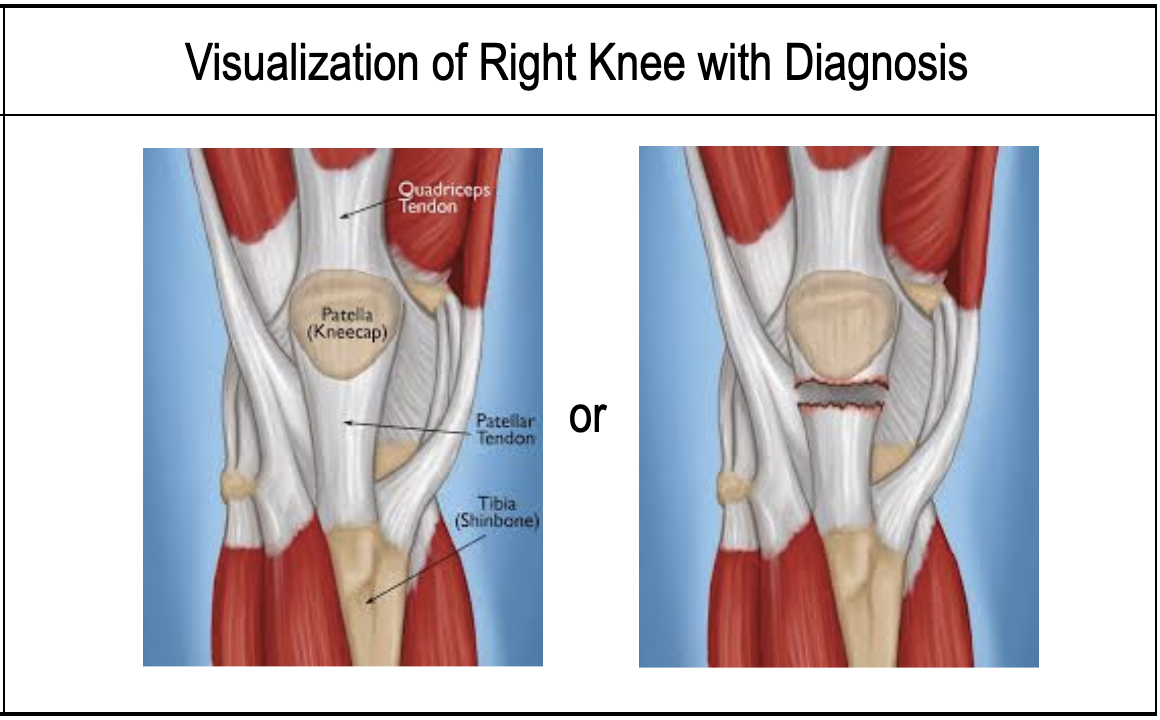
The left patellar tendon appears to be .
The right patellar tendon appears to be .
How close to the skin is the patellar tendon? (Hint: what is the smallest depth)
What is the deepest point on the kneecap?
Where was the largest reflection?
For your previous response, why was the reflection largest there?
Why do we need to use gel between the ultrasound wand (transducer) and the patient’s skin?
Different frequencies are used to image different parts of the body depending on the type of tissue, the presence of bones, and the desired resolution level. The resolution (the smallest object that can be seen clearly) is about the wavelength of the sound wave used.
With the information previously provided about the ultrasound machine, estimate the resolution of the ultrasound imager in this setting, including units of measurement.
What are two things you could do to increase the resolution of this ultrasound imager?
Hint: Resolution is about the wavelength of the sound wave used. Think about what a higher resolution means in terms of the resulting wavelength you calculated. Do you want that number to be smaller or larger? What can you change about the ultrasound imager to change that value?