DNA Discoveries: Chargaff, Franklin, Watson, Crick

Last updated about 3 years ago
25 questions
Chargaff Rules
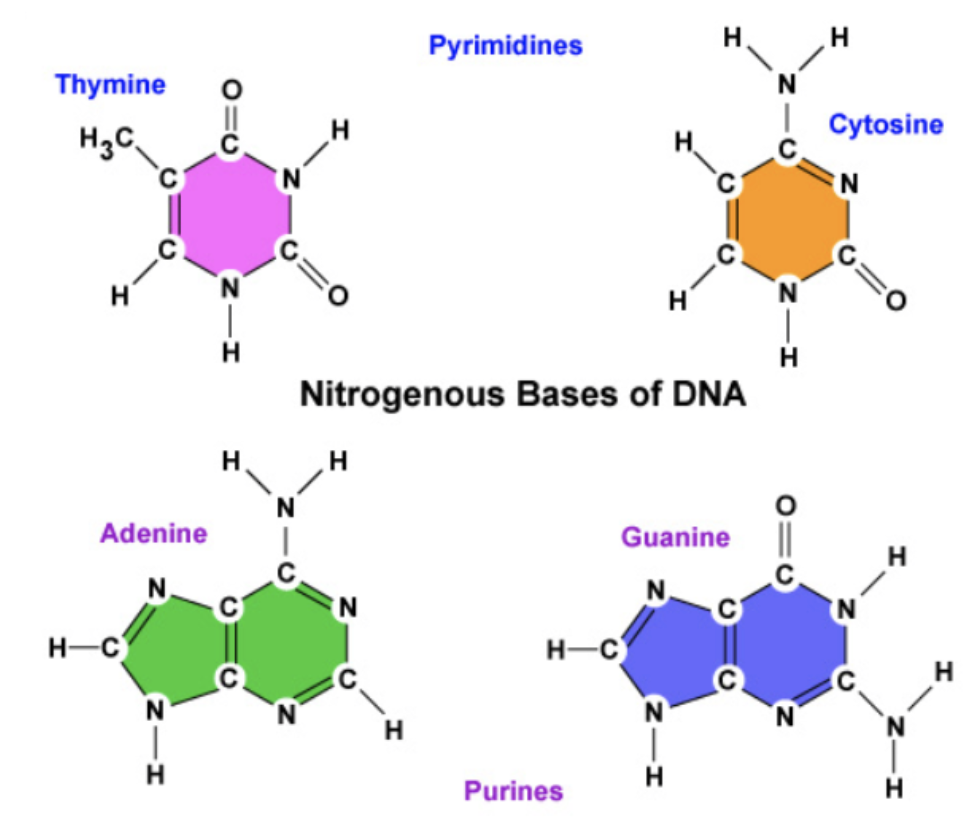
Introduction – DNA was first discovered in 1869, but not much was known about the molecule until the 1920s. Early researchers discovered that DNA was comprised of repeated units called nucleotides. Each nucleotide contains a part called a nitrogenous base. There are four different nitrogenous bases found in DNA: adenine (A), cytosine (C), guanine (G), and thymine (T).

In the 1920s it was believed that these nitrogenous bases occurred in all living things in the same repeated pattern, such as ATGC ATGC ATGC. If this were true, then DNA could not be the genetic material. With the same repeated pattern in all species, DNA could not provide the variety needed for a molecule containing the genetic code.

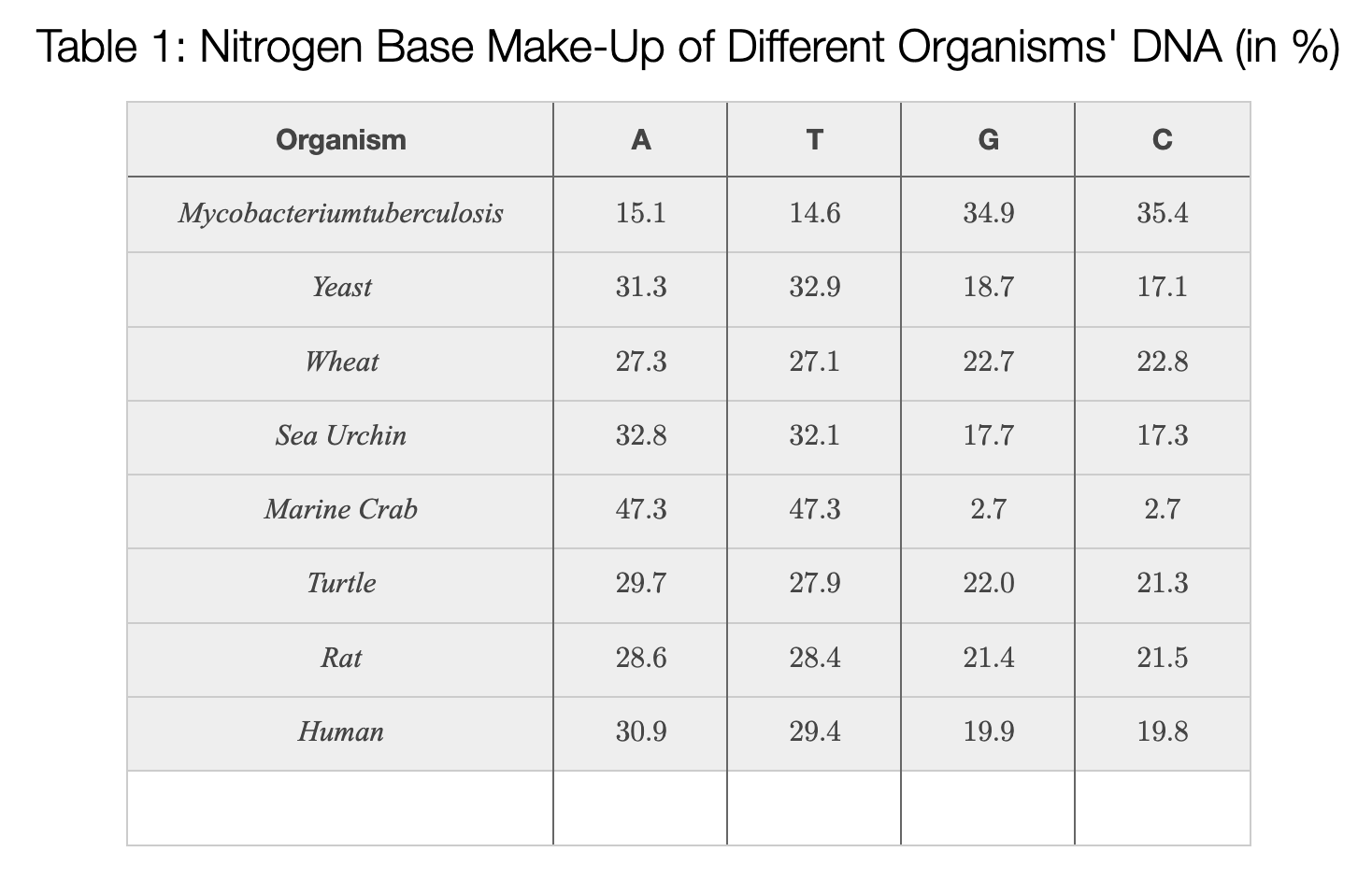
After World War II, the biochemist Erwin Chargaff made some major discoveries about the nitrogenous bases in DNA. His research revealed the percentage of each base (A, T, G, and C) found in an organism’s DNA.
1

What are the four nitrogenous bases of DNA?

1

Why did people in the 1920's initially dismiss these nitrogenous bases as being part of the genetic code?
1

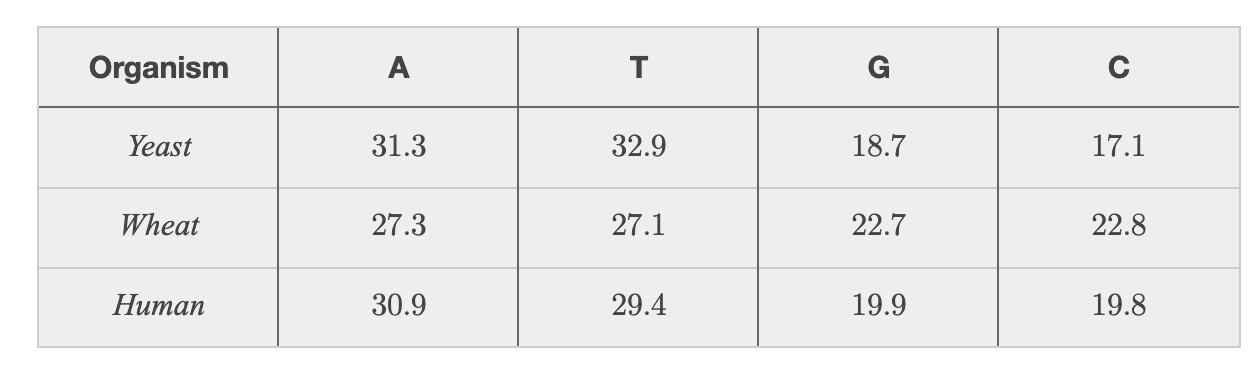
Table 1 below includes some of Chargaff’s data and some more recent additions. Look at Table 1, are there any patterns that you can see?

1

Graph the data for Yeast, Human, and Wheat

1

Purines & Pyrimidines


Look at the image of the pyrimidines (Thymine and Cytosine) and the Purines (Adenine and Guanine), do you see any similarities in their structure? Describe anything you notice below.

1

Through his experiments, Chargraff discovered that the ratio between cytosine: guanine and adenine: thymine were...

1

If you have 8 thymines, how many adenines will you have?

1

Explain Chargaff's first rule in your own words.

1

True or False: All species have the exact same percentages of adenine in their DNA.

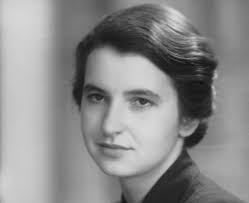
Rosalind Franklin
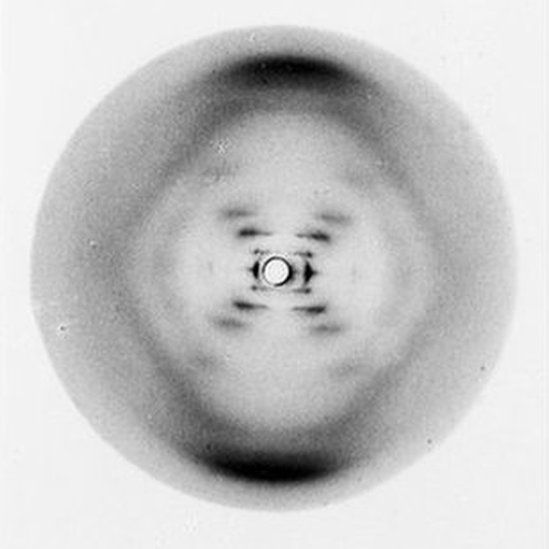
Photo 51

A photo taken by chemist and crystallographer Rosalind Franklin held the key to unravelling the structure of DNA. It is one of the most important photos ever taken. It gave Wilkins, Watson, and Crick the final clue they needed to determine the structure of DNA was shaped as a double helix.

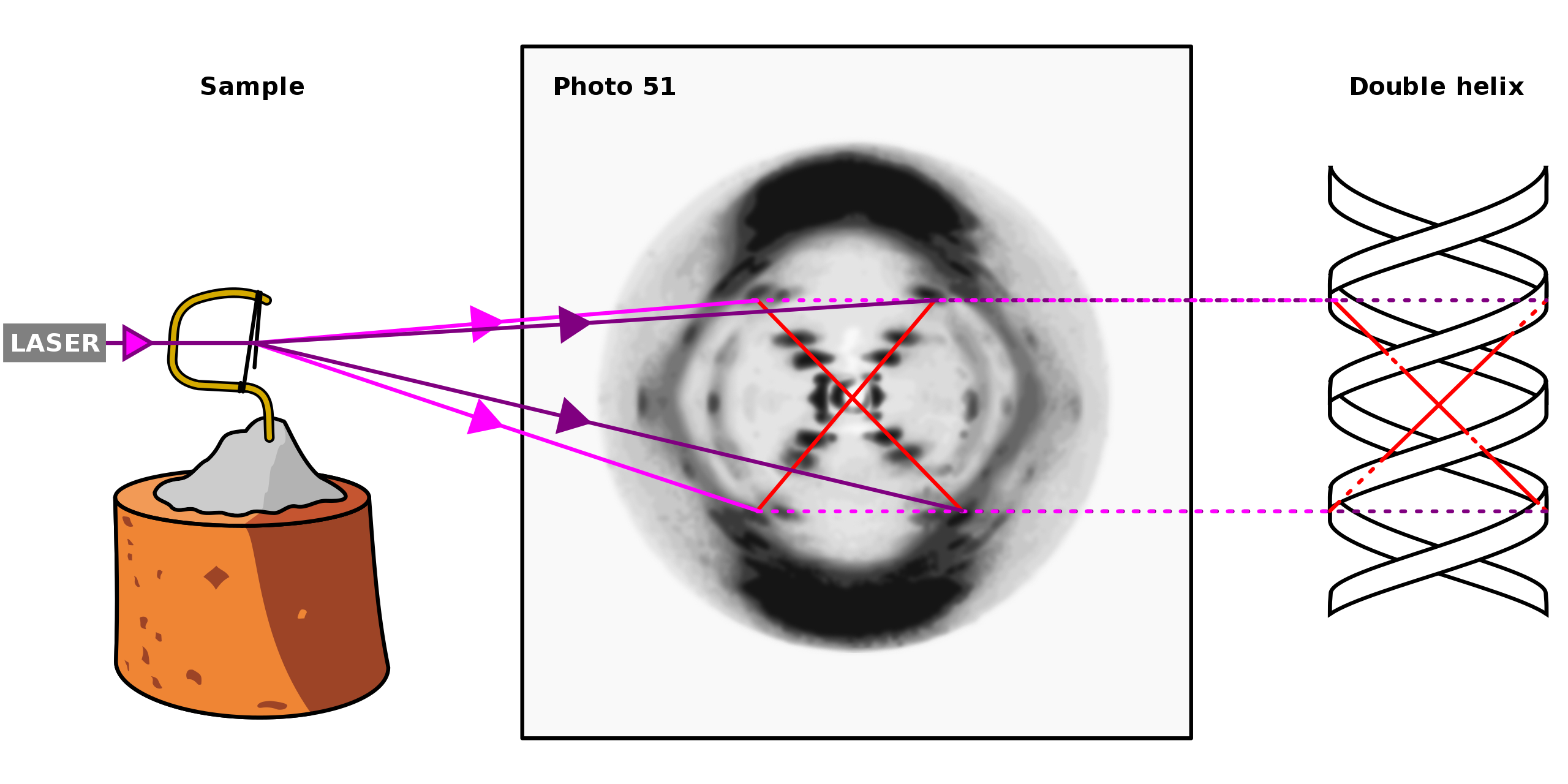
Rosalind Franklin's key experiment was a series of painstaking X-ray crystallography experiments with DNA samples containing different amounts of water. The most famous outcome of this is May 1952’s ‘Photo 51’, which revealed key details about the structure of DNA.

The more a feature is repeated within a structure, the more the film will be bombarded with X-rays diffracted in the same way, and the darker the corresponding patch in the image.
The large dark patches at the top and bottom of the picture represent DNA’s bases, and the X-shaped blobs indicate a helix. The arms of the cross represent the planes of symmetry in a helix viewed from the side; the ‘zig’ and the ‘zag’ of its turns.


There are 10 spots on each arm of the cross before you reach the large black patch at the top, which corresponds with 10 bases stacked one on top of the other in each turn of the helix. The fourth blob from the center is missing, which indicates that one strand of DNA is slightly offset against the other.

1

What technology was used to take one of the first photos of DNA?

1

What did photo 51 reveal about DNA?

1

Why did Rosalind Franklin join Kings College?

1

Who received the noble prize for their work on DNA? Select ALL that Apply.

Watson & Crick Letter
Letter Segment 1
Text:
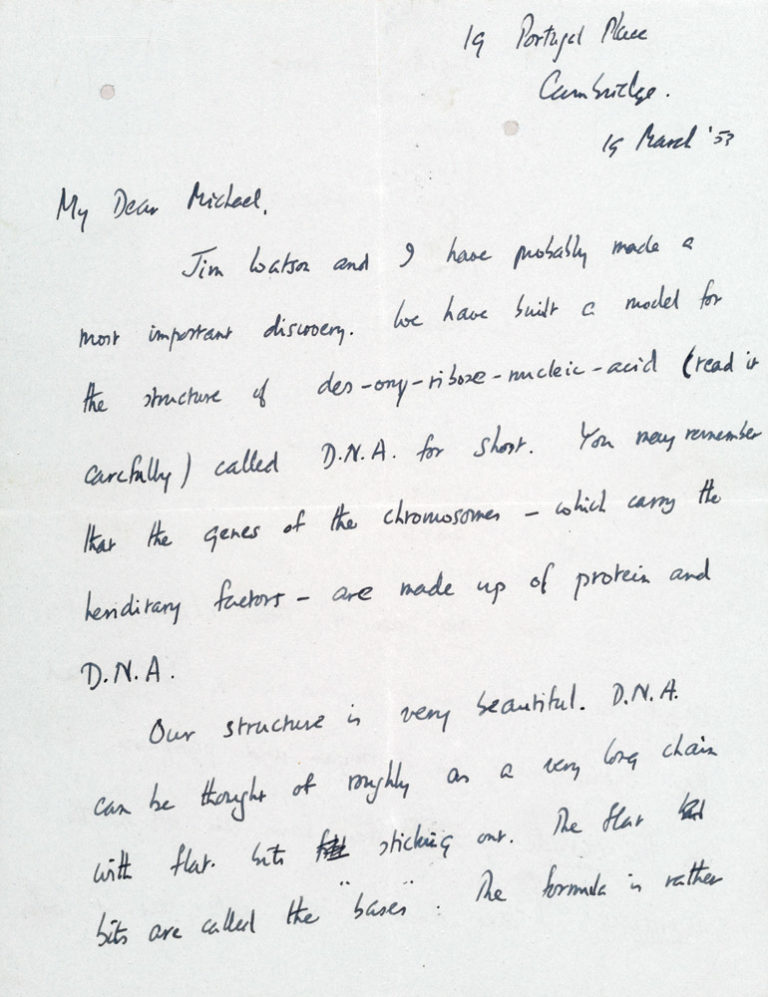
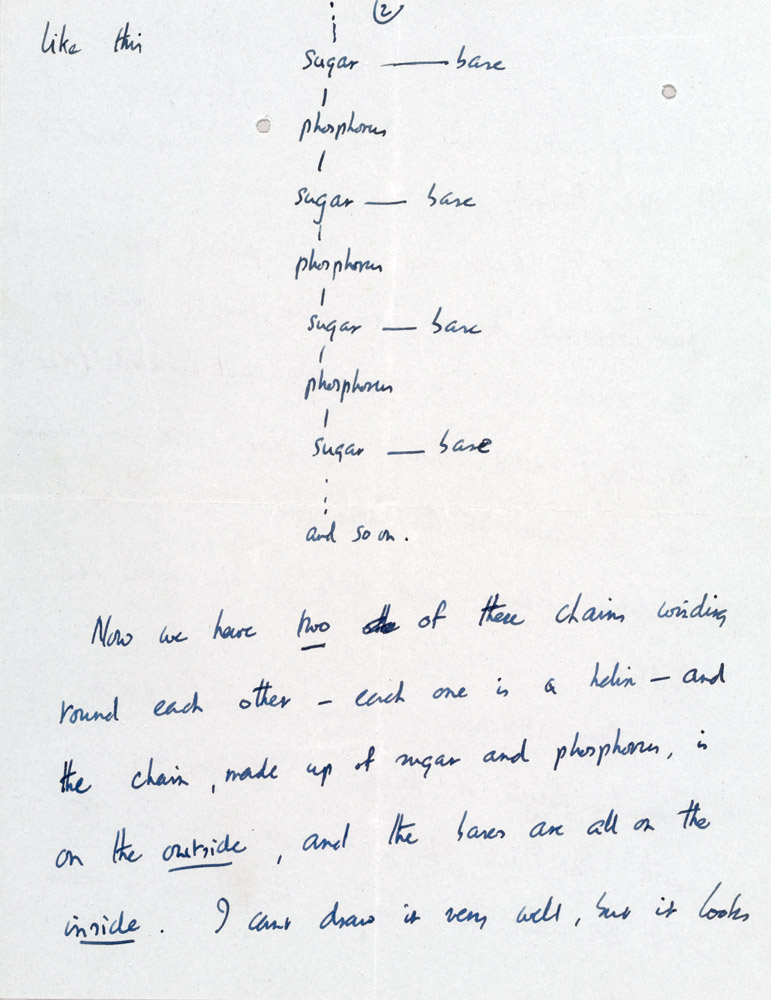
19 Portugal Place Cambridge 19 March ’53 My Dear Michael, Jim Watson and I have probably made a most important discovery. We have built a model for the structure of de-oxy-ribose-nucleic-acid (read it carefully) called D.N.A. for short. You may remember that the genes of the chromosomes — which carry the hereditary factors — are made up of protein and D.N.A. Our structure is very beautiful. D.N.A. can be thought of roughly as a very long chain with flat bits sticking out. The flat bits are called the “bases”. The formula is rather like this:
1

Who is writing this letter?

1

What did Crick say the heredity factors were made of?

Letter Segment 2

Text:
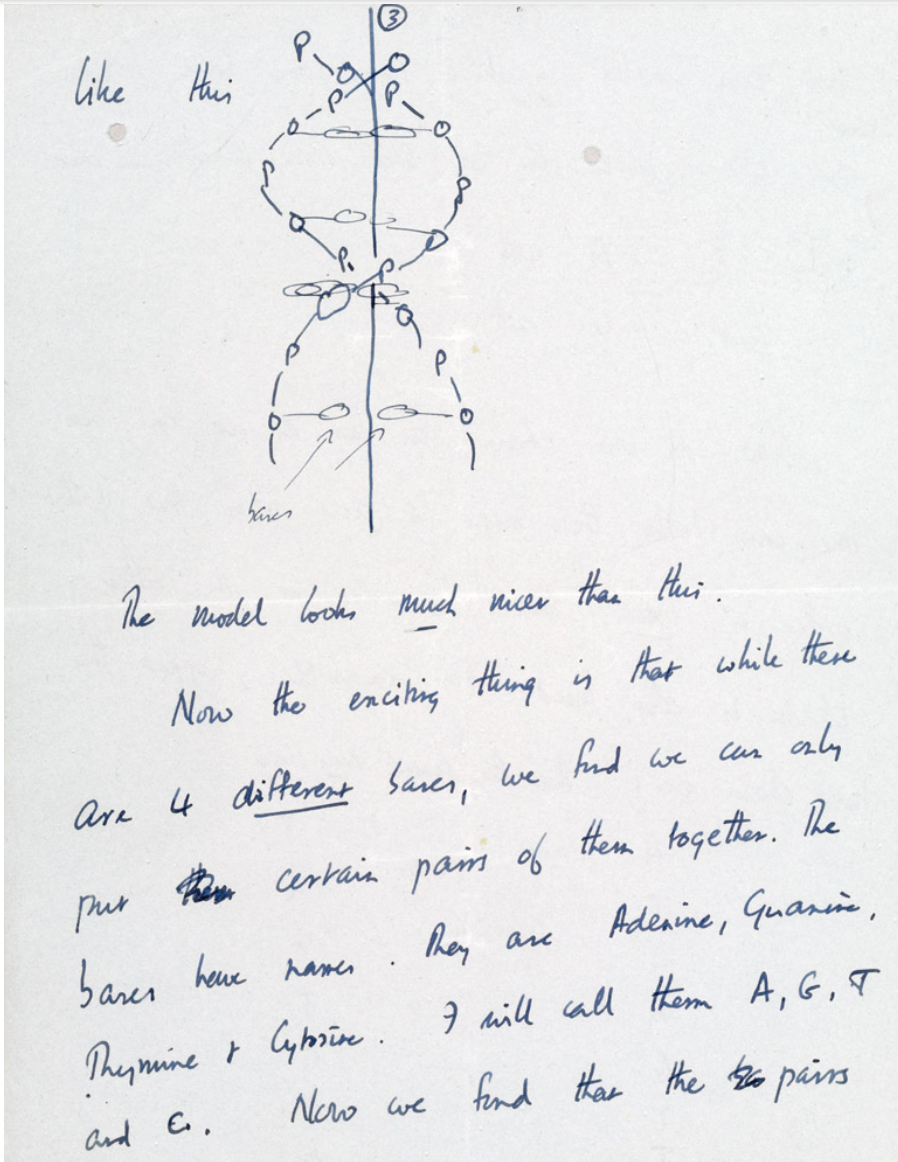
Now we have two of these chains winding round each other — each one is a helix — and the chain, made up of sugar and phosphorus, is on the outside, and the bases are all on the inside. I can’t draw it very well, but it looks like this
1

"Chains winding round each other" describes the ...

1

What is the "chain" backbone for DNA made of?

Letter Segment 3
Text:
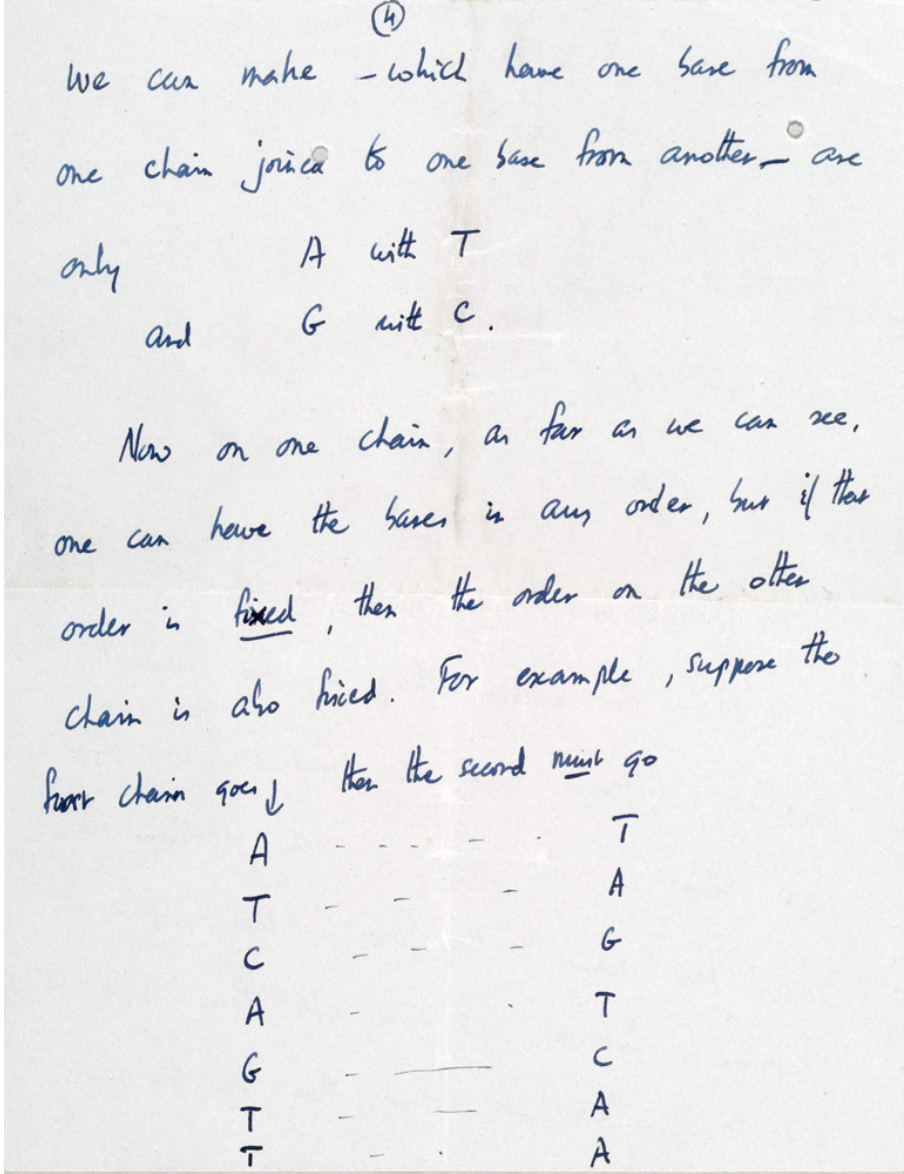
The model looks much nicer than this. Now the exciting thing is that while these are 4 different bases, we find we can only put certain pairs of them together. The bases have names. They are Adenine, Guanine, Thymine & Cytosine. I will call them A, G, T and C. Now we find that the pairs we can make — which have one base from one chain joined to one base from another — are only A with T and G with C. Now we find that the pairs
1

Which of the following is not one of the four bases for DNA?

1
Adenine pairs with __________ and guanine pairs with __________.
Letter Segment 4
Text:
we can make — which have one base from one chain joined to one base from another — are only A with T and G with C. Now on one chain, as far as we can see, one can have the bases in any order, but if their order is fixed, then the order on the other chain is also fixed. For example, suppose the first chain goes [points to string of letters on left], then the second must go [points to string of letters on right].
1

How many strands or chains make the DNA helix?

1

If your DNA sequence was...

C
A
G
T

Show the order of the sequence of the complementary second strand.

  1. T
  2. A
  3. C
  4. G
Letter Segment 5
Text:
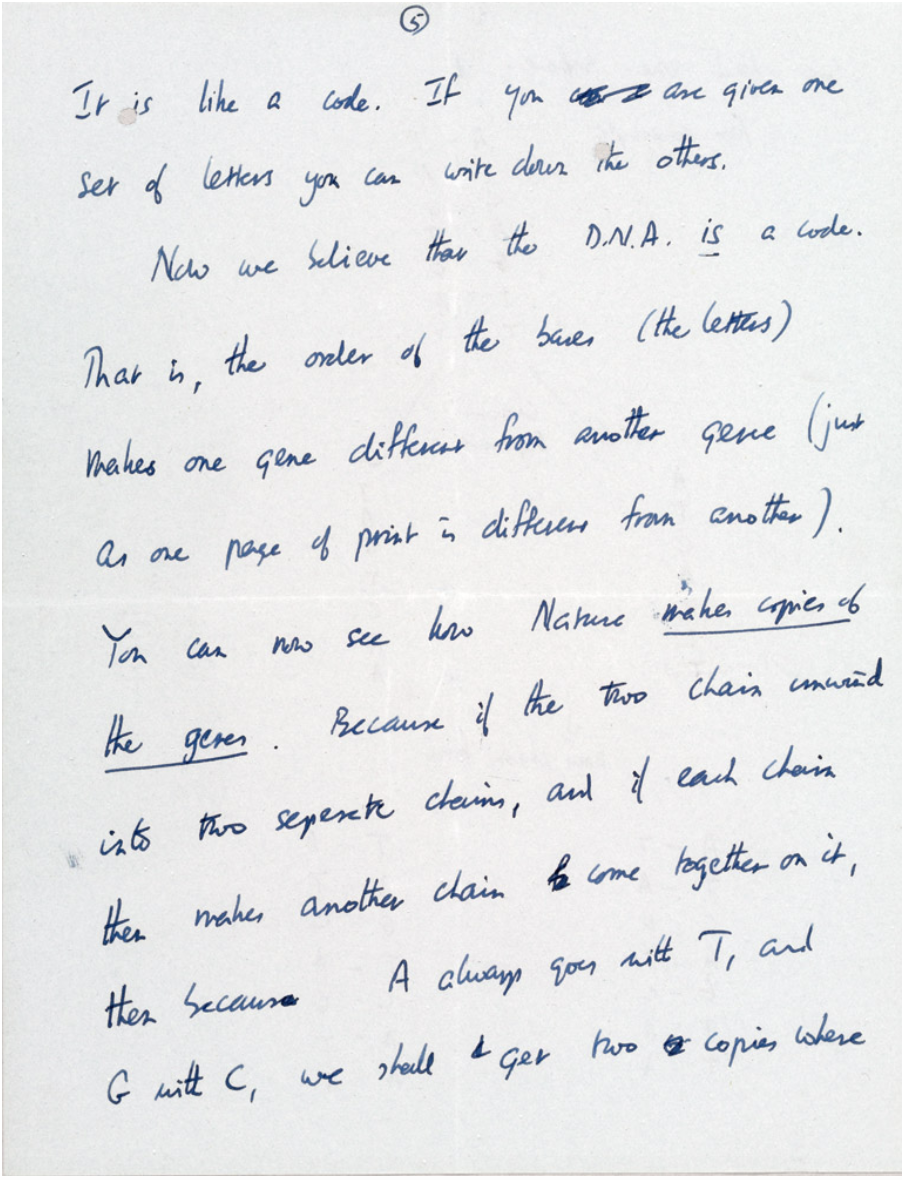
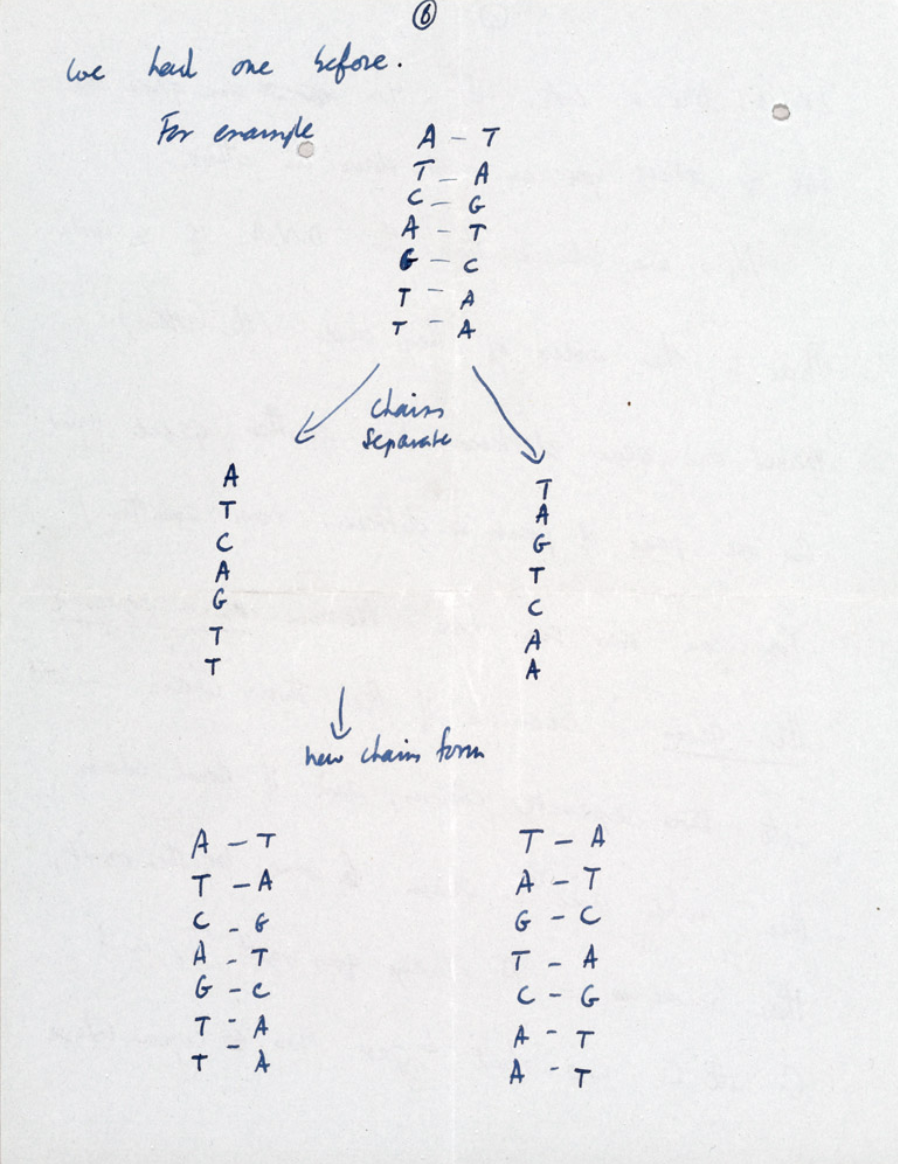
It is like a code. If you are given one set of letters you can write down the others. Now we believe that the D.N.A. is a code. That is, the order of the bases (the letters) makes one gene different from another gene (just as one page of print is different from another). You can now see how Nature makes copies of the genes. Because if the two chains unwind into two separate chains, and if each chain then makes another chain come together on it, then because A always goes with T, and G with C, we shall get two copies where we had one before. For example

Letter Segment 6
1

What makes the code for genes?

1

In your own words, explain how a new chain forms.

Letter Segment 7
Text:
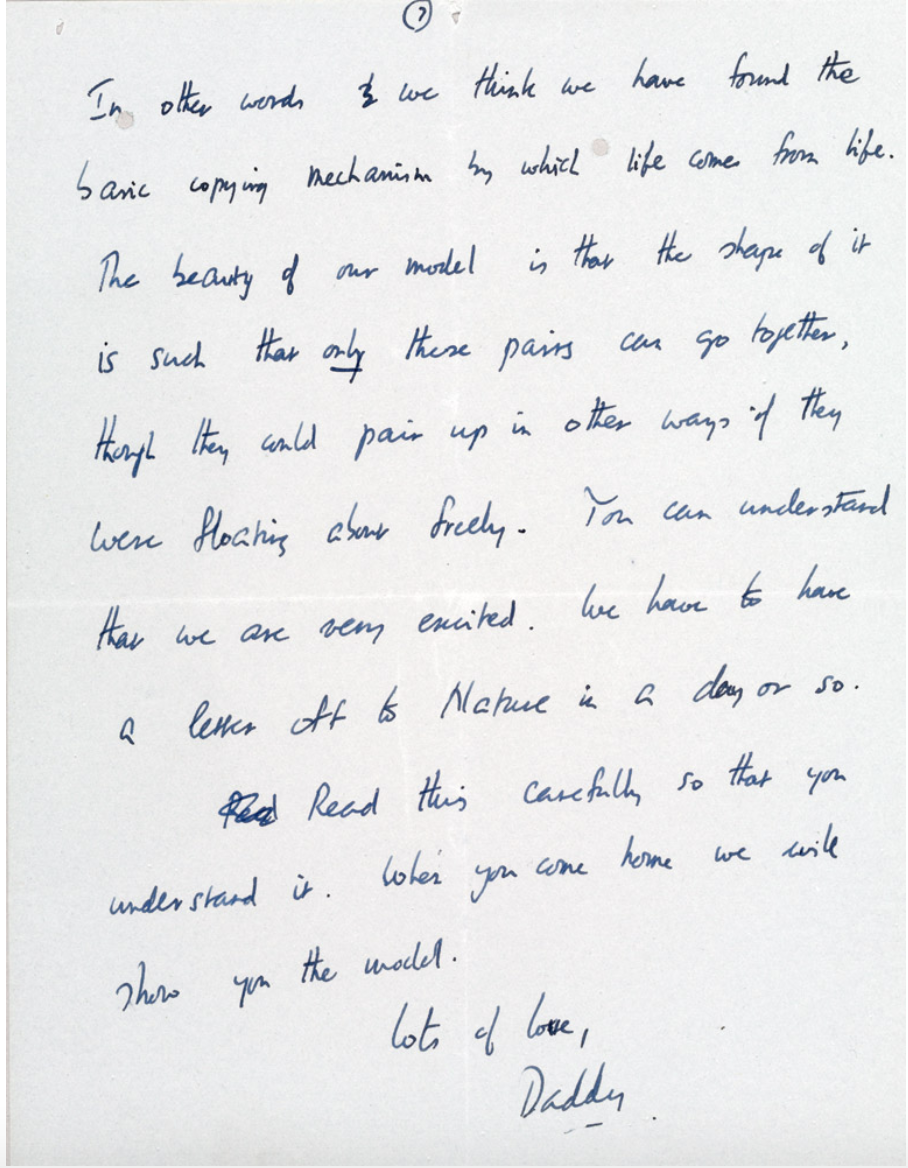
In other words & we think we have found the basic copying mechanism by which life comes from life. The beauty of our model is that the shape of it is such that only these pairs can go together, though they could pair up in other ways if they were floating about freely. You can understand that we are very excited. We have to have a letter off to Nature in a day or so. Read this carefully so that you understand it. When you come home we will show you the model. Lots of love, Daddy
1

What discovery is being explained in this portion of the letter?

1

What magazine did they send their findings to in a different letter?

Exit Ticket: Practice creating a Karyotype.