Log in
Sign up for FREE
arrow_back
Library

Biodiversity Redemption

star
star
star
star
star
Last updated 12 months ago
5 questions
1
1
1
1
1
Question 1
1.

Question 2
2.

Question 3
3.

Question 4
4.

Question 5
5.

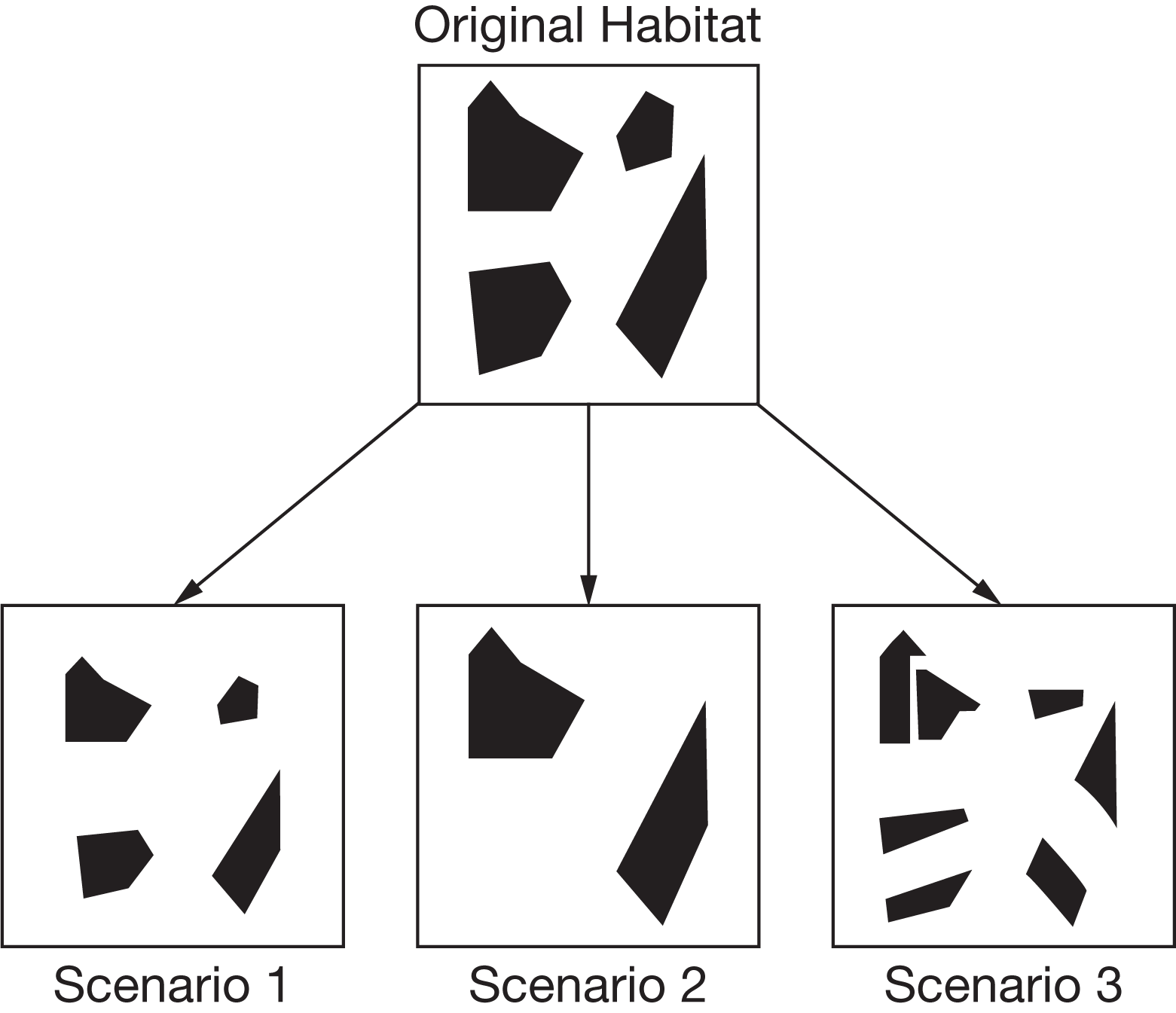
The diagram shows how a patch of habitat could possibly be altered.
Which of the following is a possible effect of global climate change as illustrated in Scenario 1?
Decreased precipitation would eliminate habitat patches.
Increased sea level would reduce the size of the habitat patches.
Decreased temperatures would cause unsuitable abiotic conditions.
Increased carbon dioxide availability spurs plant growth, which would increase habitat size.
The diagram shows how a patch of habitat could possibly be altered.
Which of the following would be most likely to occur in the scenarios that have experienced habitat loss and/or fragmentation in the diagram?
Increase in territory size of large mammals
Increase in genetic diversity of native species
Decrease in the number of specialist species
Decrease in the abundance of invasive species
The diagram shows how a patch of habitat could possibly be altered.
Which of the following would be the most likely explanation for the changes shown in Scenario 3?
Habitat corridors were built to allow individuals between populations to mate, which helped to prevent inbreeding and reduce the genetic diversity often found in isolated populations.
The increased edge-to-interior ratio resulted in habitat fragmentation and the formation of smaller, more manageable parcels of land.
Native species were replanted in the areas, which led to fewer niches.
Roads and electric power lines subdivided the landscape into smaller pieces and decreased the amount of available habitat.
The diagram shows how a patch of habitat could possibly be altered.
Which of the following correctly identifies the type of habitat change(s) shown within each potential scenario in the diagram?
All scenarios experienced habitat loss, but only Scenario 3 experienced habitat fragmentation.
Scenario 1 experienced habitat fragmentation, while Scenarios 2 and 3 experienced habitat loss only.
Scenarios 1 and 2 experienced habitat loss, while Scenarios 3 experienced habitat fragmentation only.
All scenarios experienced habitat fragmentation, but only Scenario 2 experienced habitat loss.
The spotted lanternfly is a herbivorous insect that is native to Asia and feeds on over 70 species of plants. The feeding behavior of the spotted lanternfly damages plants, and the nymph and adult lanternflies secrete sticky residues that exacerbate the damage to native plant species by promoting mold growth. The spotted lanternfly reproduces once during its lifetime by laying between 30 and 50 eggs, and the eggs hatch after a short amount of time. The range of the spotted lanternfly is increasing because the insects are transported to new environments by the movements of animals and people, and it is now found in many parts of the United States.

Which of the following best describes the spotted lanternfly in the United States?
The spotted lanternfly is an r-selected and invasive species.
The spotted lanternfly is a K-selected and endangered species.
The spotted lanternfly is a K-selected and invasive species.
The spotted lanternfly is anrr-selected and endangered species.