Log in
Sign up for FREE
arrow_back
Library

Unit 09 - Waves Test

star
star
star
star
star
Last updated over 3 years ago
18 questions
2
2
2
2
4
4
4
4
10
2
2
2
4
8
4
2
2
8
Question 1
1.

Question 2
2.

Question 3
3.

Question 4
4.

Question 5
5.

Question 6
6.

Question 7
7.

Question 8
8.

Question 9
9.

Question 10
10.

Question 11
11.

Question 12
12.

Question 13
13.

Question 14
14.

Pictured here is the formula we used in our resonance lab with the PVC pipes:


Explain each part of the formula and its purpose.

Question 15
15.

A blue light wave approaches a mirror at 40degrees, which means that the light wave will reflect off the mirror at _____ degrees.

Question 16
16.

Question 17
17.

Where is the lowest frequency in this spectrum?

Question 18
18.

Explain why a piece of paper would appear reddish-orange when hit with ROYGBIV light.

As a transverse wave travels through a rope from left to right, the parts of the rope _____.
move along a line from left to right
oscillate back and forth about a fixed location
move along a sine-wave like path from left to right
For a longitudinal wave, the particles of the medium move ______ to the direction that the wave moves.
diagonal
perpendicular
in no way
parallel
The frequency of a wave describes _____.
how often particles of the medium oscillate back and forth
how far particles move away from their normal resting position
how fast a point on the wave moves along the medium
The amplitude of a wave describes _____.
how often particles of the medium oscillate back and forth
how far particles move away from their normal resting position
how fast a point on the wave moves along the medium
The wavelength of a wave increases if the ______.
amplitude speed decreases
speed decreases
frequency increases
speed increases
frequency decreases
amplitude speed increases
A sound wave is a pressure wave; regions of high (compressions) and low pressure (rarefactions) are established as the result of the vibrations of the sound source. These compressions and rarefactions result because sound
is able to reflect off fixed ends and interfere with incident waves
is like all waves; it is able to bend into the regions of space behind obstacles.
vibrates longitudinally; the longitudinal movement of air produces pressure fluctuations.
waves have a speed that is dependent only upon the properties of the medium.
is more dense than air and thus has more inertia, causing the bunching up of sound.
A sound wave is different than a light wave in that a sound wave is
capable of existing with a variety of frequencies and a light wave has a single frequency.
not capable of traveling through a vacuum.
produced by an oscillating medium and a light wave is not.
not capable of diffracting and a light wave is.
Two musical notes that have a frequency ratio of 2:1 are said to be separated by an octave. A musical note that is separated by an octave from middle C (256 Hz) has a frequency of _____.
128 Hz
345 Hz
258 Hz
254 Hz
none of these
Drag and drop each of the following items to the correct category.
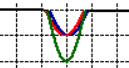
two downward pulses traveling in the same direction within a medium
considered 'nodal'
an upward and downward pulse traveling in the same direction within a medium
considered 'anti-nodal'
two upward pulses traveling in opposite directions within a medium
an upward and downward pulse traveling in opposite directions within a medium
Constructive Interference
Destructive Interference
Neither

Sound is not a transverse wave, but it can still interfere because...
...the pitch of two waves will always be percevied to be quiet and loud in different areas.
...the change in pressure of the particles is converted into waves so that we can see them, and they interfere because that's how our interpretation of transverse waves works.
...when two or more sound waves occupy the same space, their pressures affect one another. The waves do not bounce off of each, but they move through each other.
...we can measure it with a loudspeaker, convert it into electromagnetic representations of compressions and rarefactions, and see them interfereing with it ourselves.
The frequency or frequencies at which an object tends to vibrate with when hit, struck, plucked, strummed or somehow disturbed.
Octave
Timbre
Scale
Music
Noise
Natural frequency
What seperates noise from music?
it's a generational thing, in that anyone older than you always thinks your music is noise
a mathematical relationship between frequencies produced by the obect
whether or not there was a forced vibration
there is no separation; everything can be and have musical qualities
A harmonic ...
is created at specific frequencies within an object
can be represented as a standing wave
is created at any frequency within an object
has a pattern of nodal and anti-nodal meeting at the same spots in the standing wave
Where could you find all of the visible light in the EM Spectrum?
500nm - 800nm
400nm - 700nm
300nm - 600nm
700nm - 1100nm
100nm - 300nm