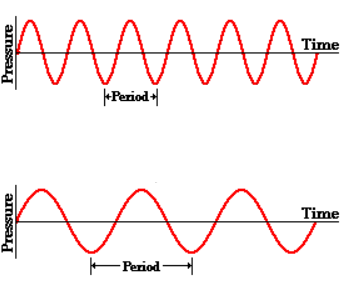
Which of these has a 'Higher' frequency?
Which of these has a 'Higher' frequency?
As a transverse wave travels through a rope from left to right, the parts of the rope _____.
The frequency of a wave describes _____.
The wavelength of a wave increases if the ______.
A sound wave is a pressure wave; regions of high (compressions) and low pressure (rarefactions) are established as the result of the vibrations of the sound source. These compressions and rarefactions result because sound
A sound wave is different than a light wave in that a sound wave is
Which of these has a 'Higher' frequency?
Which of these has a 'Higher' period?
Two musical notes that have a frequency ratio of 2:1 are said to be separated by an octave. A musical note that is separated by an octave from middle C (256 Hz) has a frequency of _____.
Drag and drop each of the following items to the correct category.
two downward pulses traveling in the same direction within a medium
an upward and downward pulse traveling in the same direction within a medium
considered 'nodal'

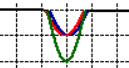
considered 'anti-nodal'
two upward pulses traveling in opposite directions within a medium

an upward and downward pulse traveling in opposite directions within a medium
Constructive Interference
Destructive Interference
Neither
Sound is not a transverse wave, but it can still interfere because...
The frequency or frequencies at which an object tends to vibrate with when hit, struck, plucked, strummed or somehow disturbed.
A harmonic ...
What seperates noise from music?
Pictured here is the formula we used in our resonance lab with the PVC pipes:
Explain each part of the formula, and why it was needed.
A blue light wave approaches a mirror at 30degrees, which means that the light wave will reflect off the mirror at _____ degrees.
Describe light Diffraction.
What did the Double Slit Experiment demonstrate about electrons?
Where could you find all of the visible light in the EM Spectrum?
Where is the longest wavelength in this spectrum?

Explain why a sticky note would appear blueish green when hit with ROYGBIV light.