Log in
Sign up for FREE
arrow_back
Library

9.2 - Nature of a Sound Wave

star
star
star
star
star
Last updated over 3 years ago
7 questions
4
4
4
2
2
4
4
Question 1
1.

Question 2
2.

Describe the picture using:

Particles
Disturbance
Parallel
Energy

Question 3
3.

Question 4
4.

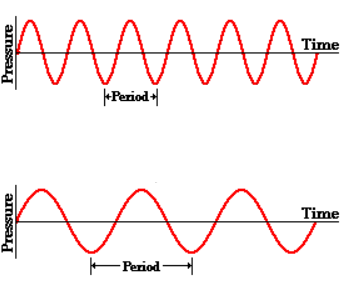
Which of these has a 'Higher' frequency?
Question 5
5.

Which of these has a 'Higher' period?

Question 6
6.

Question 7
7.

A sound wave is a pressure wave; regions of high (compressions) and low pressure (rarefactions) are established as the result of the vibrations of the sound source. These compressions and rarefactions result because sound
vibrates longitudinally; the longitudinal movement of air produces pressure fluctuations.
is able to reflect off fixed ends and interfere with incident waves
is like all waves; it is able to bend into the regions of space behind obstacles.
waves have a speed that is dependent only upon the properties of the medium.
is more dense than air and thus has more inertia, causing the bunching up of sound.
A sound wave is different than a light wave in that a sound wave is
produced by an oscillating object and a light wave is not.
capable of existing with a variety of frequencies and a light wave has a single frequency.
not capable of diffracting and a light wave is.
not capable of traveling through a vacuum.
Humans can hear which of the following?
40,000 Hz
30,000Hz
20,000Hz
10,000Hz
5,000Hz
2,500Hz
2,000Hz
1,000Hz
500Hz
250Hz
100Hz
50Hz
35Hz
15Hz
5Hz
Two musical notes that have a frequency ratio of 2:1 are said to be separated by an octave. A musical note that is separated by an octave from middle C (256 Hz) has a frequency of _____.
128 Hz
none of these
254 Hz
345 Hz
258 Hz