Reteach PS2-1 (5/4) Version B
star
star
star
star
star
Last updated about 3 years ago
8 Nsɛmmisa

0

0
0
0
0
0
2
1


Scott and James work at a grocery store. They crashed the skateboard and the shopping cart two times. The shopping cart had more mass in Crash 2 than it did in Crash 1. Use the information in the diagram to answer.
In which crash did the skateboard experience a stronger force? Why?
Complete the guided notes below
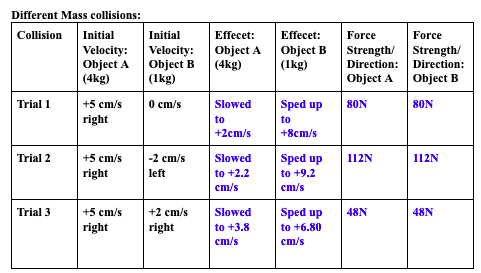
Which trial caused Object B to move the fastest after the collision? Why do you think this is?
CFS:
accurately describes the relationship between force, mass and velocity
describes the changes caused in an object
Which trial caused Object B to move the slowest after the collision? Why do you think this is?
CFS:
accurately describes the relationship between force, mass and velocity
describes the changes caused in an object
How does mass impact the velocity after a collision?
CFS:
accurately describes the relationship between force, mass and velocity
describes the changes caused in an object
How does increasing or decreasing the mass impact the force of a collision?
CFS:
accurately describes the relationship between force, mass and velocity
describes the changes caused in an object

Which crash experiences a greater force causing the motion for the satellite?
CFS:
accurately describes the relationship between force, mass and velocity
describes the changes caused in an object
Explain the forces on each object in a collision.