1. Introduction to supply-side policies cloned 4/15/2022
star
star
star
star
star
Last updated over 4 years ago
9 Nsɛmmisa
1

1
1
1
1
1

1

1
1
If it sometimes seems that aggregate demand (AD) gets all the attention, this is with good reason. From the 1940s onwards, Keynesian demand-management policies dominated the macroeconomic management schemes of finance ministers. These policies put heavy emphasis on the use of government spending to stimulate the economy, spending that often required increases in either taxes or government debt to finance the resulting deficits. Until well into the 1960s, healthy growth rates among many rich and developing countries appeared to validate the Keynesian demand-management approach.
However, by the late 1960s and early 1970s, as rich economies sputtered and inflation grew more serious, the protests of neo-classical scholars were gaining a wider audience. What followed, in the macroeconomic debates of the 1980s and beyond, emphasized a variety of new perspectives, including an emphasis on money and inflation control (evident in the work of the monetarist school), as well as a renewed focus on creating a healthier environment for business to flourish. This emphasis on the supply side of the macroeconomic equation would eventually shake, if not reorient, the centrality of the Keynesian paradigm.
What is the main difference between demand-side and supply-side policies?
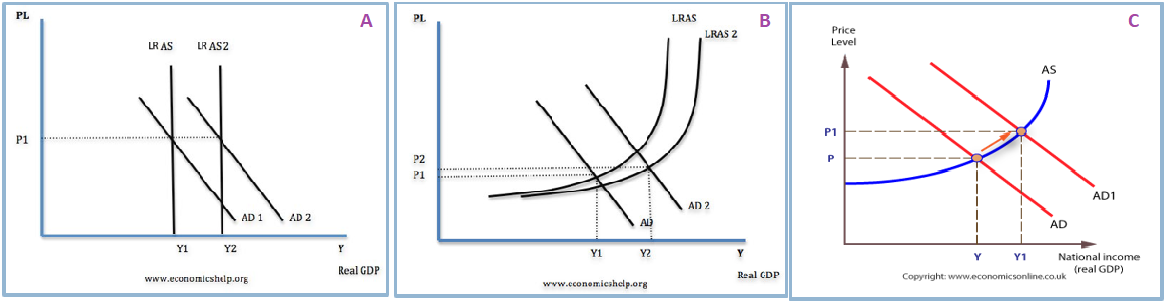
Inspect the diagrams above. Which diagram presents the goal of a supply-side policy?
Describe the diagram.
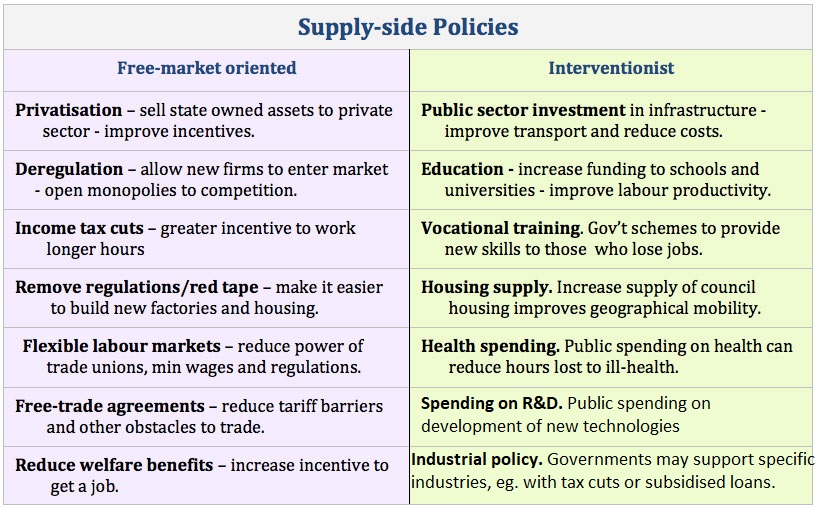
Supply-side policies aim to improve quality of factors of production. Name four of them.
In theory, supply-side policies are especially desirable because they improve the overall macroeconomic environment in which individual actors operate. Good policies would encourage productivity as well as create more and better factors of production. Furthermore, increasing LRAS manages to expand the economy without generating inflation, a typical problem with expansionary demand-side policies.
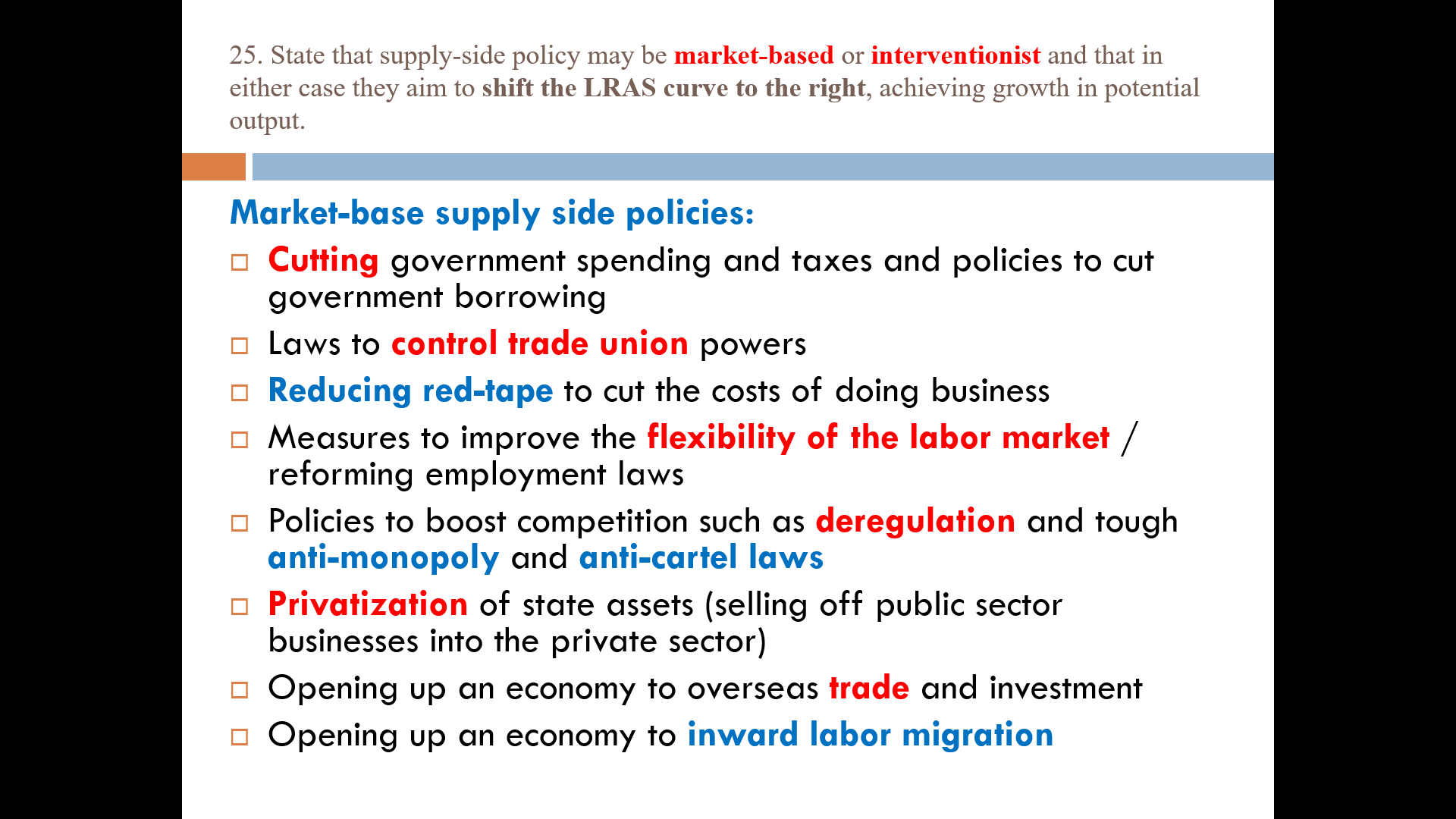
Pick two market-based supply side policies and explain how they could improve productivity.
If you need any help, take a look at this handout.
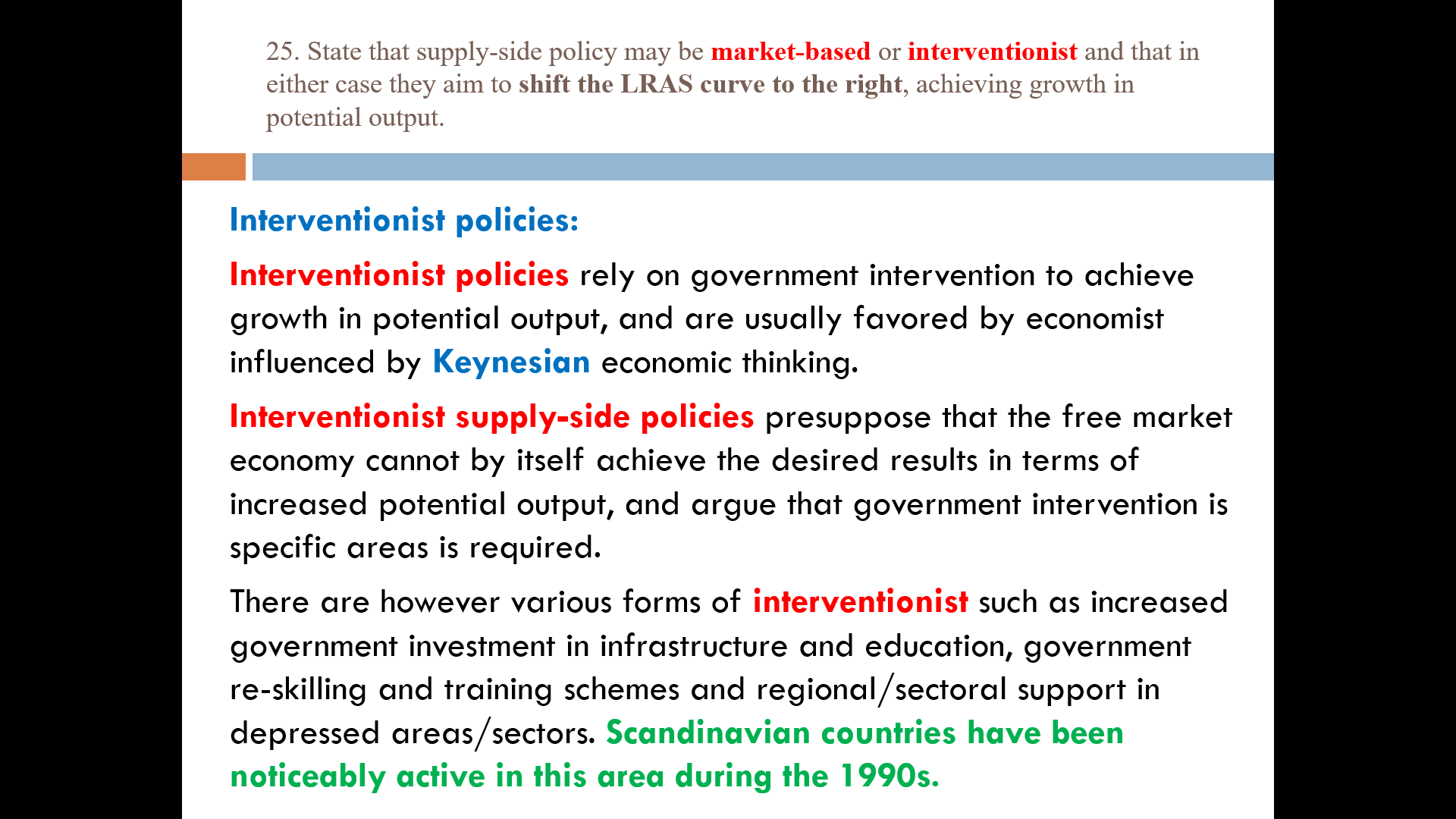
Pick two interventionist supply side policies and explain how they could improve productivity.
If you need any help, take a look at this handout.
Try to indentify the shared assumption of most of the market-based supply-side policies.
Interventionist and market-based policies often seem contradictory. For example, interventionists may argue for higher wages or stronger regulation of financial industry or nationalization of some industries while proponents of free market will argue for felxible (ie: lower) wages, less regulation and privatization of public firms.
Where do these differences come from?
Categorize the following supply-side policies:
POLAND, 2009: Lowering top marginal personal income tax rate from 40 to 32 percent
USA, 2018: Lowering corporate income tax from 35 to 21 percent
USA, 1987: Lowering corporate income tax from 46 to 34 percent
POLAND, 2014-2020: PLN60 bln PLN worth of investment in railways across the country
USA, 2011: $18 bln investment in broadband internet
UK, 1948: Nationalization of British Rail
UK, 1994-7: Privatisation of British Rail
Interventionist Supply Side Policy
Market Based Supply Side Policy