Partner A
Partner B
What do you notice in the diagrams and equations? Discuss with your partner.
Complete this sentence based on your observations: Dividing by a whole number a produces the same result as multiplying by
For each division expression, complete the diagram using the same interpretation of division as Elena’s. Then, write the value of the expression. Think about how to find that value without counting the pieces in the diagram.
6 ÷ 1/3
For each division expression, complete the diagram using the same interpretation of division as Elena’s. Then, write the value of the expression. Think about how to find that value without counting the pieces in the diagram.
6 ÷ 1/4
For each division expression, complete the diagram using the same interpretation of division as Elena’s. Then, write the value of the expression. Think about how to find that value without counting the pieces in the diagram.
6 ÷ 1/6
Analyze the expressions and your answers. Look for a pattern. How did you find how many 1/2s, 1/3s, 1/4s, or 1/6s were in 6 without counting? Explain your reasoning.
Use your observations from previous questions to find the values of the following expressions. If you get stuck, you can draw diagrams.
6 ÷ 1/8
Use your observations from previous questions to find the values of the following expressions. If you get stuck, you can draw diagrams.
6 ÷ 1/10
Use your observations from previous questions to find the values of the following expressions. If you get stuck, you can draw diagrams.
6 ÷ 1/25
Use your observations from previous questions to find the values of the following expressions. If you get stuck, you can draw diagrams.
6 ÷ 1/b
Use her diagram to find out how many 2/3s are in 6. Adjust and label the diagram as needed.
She says, “To find 6 ÷ 2/3, I can just take the value of 6 ÷ 1/3 then either multiply it by 1/2 or divide it by 2.” Do you agree with her? Explain why or why not.
For each division expression, complete the diagram using the same interpretation of division that Elena did. Then, write the value of the expression. Think about how you could find the value of each expression without counting the equal pieces in your diagram.
For each division expression, complete the diagram using the same interpretation of division that Elena did. Then, write the value of the expression. Think about how you could find the value of each expression without counting the equal pieces in your diagram.
For each division expression, complete the diagram using the same interpretation of division that Elena did. Then, write the value of the expression. Think about how you could find the value of each expression without counting the equal pieces in your diagram.
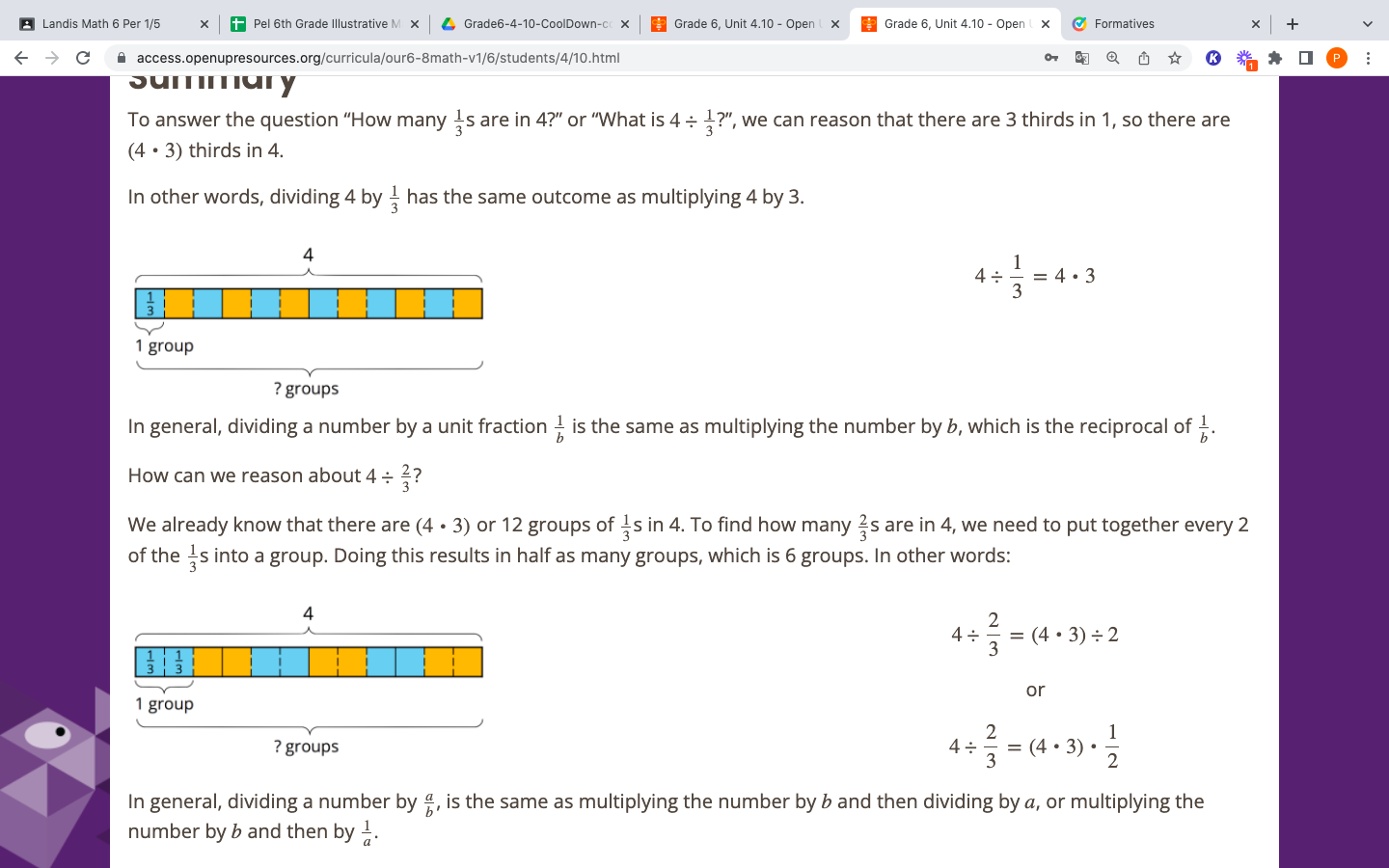
Elena studied her diagrams and noticed that she always took the same two steps to represent division by a fraction on a tape diagram. She said:
“My first step was to partition each 1 whole into as many parts as the number in the denominator. So if the expression is 6÷3/4, I would partition each 1 whole into 4 parts. Now I have 4 times as many parts.
My second step was to put a certain number of those parts into one group, and that number is the numerator of the divisor. So if the fraction is 3/4, I would put 3 of the 1/4s into one group. I could then tell how many 3/4s are in 6.”
Which expression represents how many 3/4s Elena would have after these two steps? Be prepared to explain your reasoning.
Find the missing value
Find
Try not to draw a diagram if possible. Show your reasoning.