CAST PREP 2: MS-PS2-2/ SEP 4 Version B
star
star
star
star
star
Last updated over 2 years ago
10 questions
Untitled Section
Data collection:
- Amplify Science
- Unit 2: Force and Motion
- Activity: Simulation (open explore)
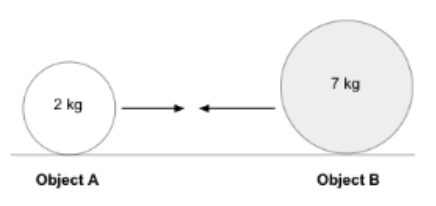
Go to the Force and Motion simulation. Collect data on Object A and Object B. For the purpose of this data collection we will have to round slightly to date data that matches the image above, however we can use two objects that are roughly 3 to 4-times different. Complete the data table below.
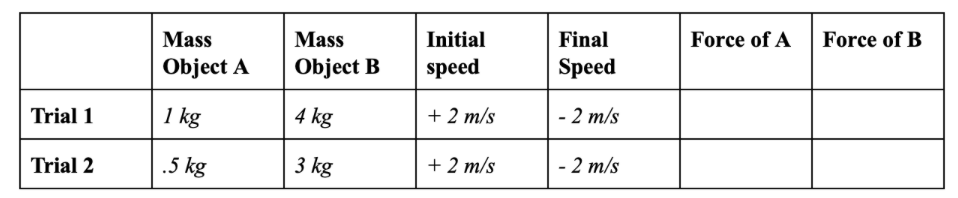
0
What relationship do you notice about the force on Object A and Object B?
0
What is the relationship/is there a relationship between mass and acceleration between object A and B?
Untitled Section
Object A and B move towards each other at equal speeds, collide, then move in opposite directions.
0
Which of the following statements accurately describes the forces and accelerations of the objects?
Untitled Section
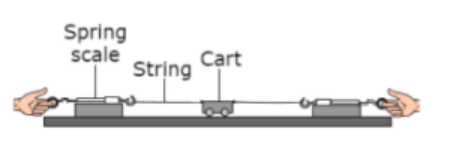
Two students are investigating how balanced and unbalanced forces affect the motion of a small cart with freely rolling wheels. The students want to determine three cases of motion:
- acceleration to the right
- acceleration to the left
- no acceleration
The students use string to attach two spring scales to the cart so that forces exerted on it can be measured in newtons (N), as shown in the figure. The cart is then released from rest.
0
Which set of forces will allow the students to demonstrate all three cases of motion? (order does not matter)
Untitled Section
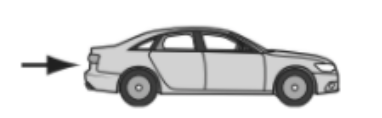
The model shows a force acting on a car. The amount of the force is represented by the size of the arrow.
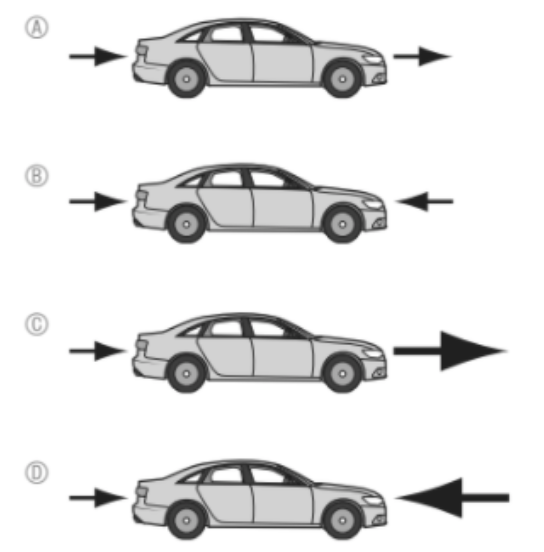
A second force is applied to the car. As a result the car's motion stops changing.
0
Which of the following models best represents the forces acting on the car as the second force was applied?
0
0
What would happen to the car's motion in scenario A based on the second applied force?CFS:- accurately identifies the changes to each object in a collision
- accurately describes the relationship between mass, acceleration, and force
What would happen to the car's motion in scenario A based on the second applied force?
CFS:
- accurately identifies the changes to each object in a collision
- accurately describes the relationship between mass, acceleration, and force
0
What would happen to the car's motion in scenario B based on the second applied force?CFS:- accurately identifies the changes to each object in a collision
- accurately describes the relationship between mass, acceleration, and force
What would happen to the car's motion in scenario B based on the second applied force?
CFS:
- accurately identifies the changes to each object in a collision
- accurately describes the relationship between mass, acceleration, and force
0
What would happen to the car's motion in scenario C based on the second applied force?CFS:- accurately identifies the changes to each object in a collision
- accurately describes the relationship between mass, acceleration, and force
What would happen to the car's motion in scenario C based on the second applied force?
CFS:
- accurately identifies the changes to each object in a collision
- accurately describes the relationship between mass, acceleration, and force
0
What would happen to the car's motion in scenario D based on the second applied force?CFS:- accurately identifies the changes to each object in a collision
- accurately describes the relationship between mass, acceleration, and force
What would happen to the car's motion in scenario D based on the second applied force?
CFS:
- accurately identifies the changes to each object in a collision
- accurately describes the relationship between mass, acceleration, and force