The start of the compare and contrast career research paper.
We are starting our final essay of the year. This is a compare and contrast research essay. This essay will be worth a combined total of 1,000 points. It is the cumulative final of what you have learned about writing this school year. Here are the standards that will be assessed:
Write informative/explanatory texts to examine and convey complex ideas, concepts, and information clearly and accurately through the effective selection, organization, and analysis of content.
Conduct short as well as more sustained research projects to answer a question (including a self-generated question) or solve a problem; narrow or broaden the inquiry when appropriate; synthesize multiple sources on the subject, demonstrating understanding of the subject under investigation.
Gather relevant information from multiple authoritative print and digital sources, using advanced searches effectively; assess the usefulness of each source in answering the research question; integrate information into the text selectively to maintain the flow of ideas, avoiding plagiarism and following a standard format for citation.
You are in the point of your life where decisions are becoming more important than they have been before. In two short school years, you will come upon the forced decision of “What is next in my life?” It is time to start thinking about your future. For this project, you will need to research two possible careers that you want to pursue upon graduation. And, you need to think about what happens if you do nothing at all. You will need to write a compare and contrast research paper.
Figuring out what to do for a career can be a challenge. Our guide helps you identify skills and interests, allows you to consider your future lifestyle, and aids you in using a variety of tools to figure out the best career for you.
High school is a time of rapid change and personal exploration for many students. It's also a great time to start thinking carefully about potential future careers and taking steps to work toward those careers. While considering a career might seem daunting, career exploration for high school students doesn't need to be stressful. By breaking the process down into easily manageable steps, students can consider their options and start preparing for future opportunities.
It is also important to keep in mind that while career preparation in high school can be highly valuable, not everyone chooses and then pursues a single career starting in adolescence, and that's okay too. This article is about how to consider your options, learn about your interests, and get a head start on your future.
The first thing to consider when engaging in career exploration is your skills and interests. What do you enjoy? What do you want to learn more about? There are lots of ways to go about this process, but the most important thing is to ask yourself questions about your interests and desires with an open mind. Consider the following questions to get started:
What school subjects do you enjoy? Why?
What extracurricular activities do you enjoy? Why?
What are you passionate about?
What kind of lifestyle do you want to have in the future?
What major goals do you have for your life and career?
Take a little time to brainstorm potential answers to these questions before moving on to the next sections, which will go into more detail about your skills, interests, and lifestyle goals. Taking a personality test can also help you work through these questions.
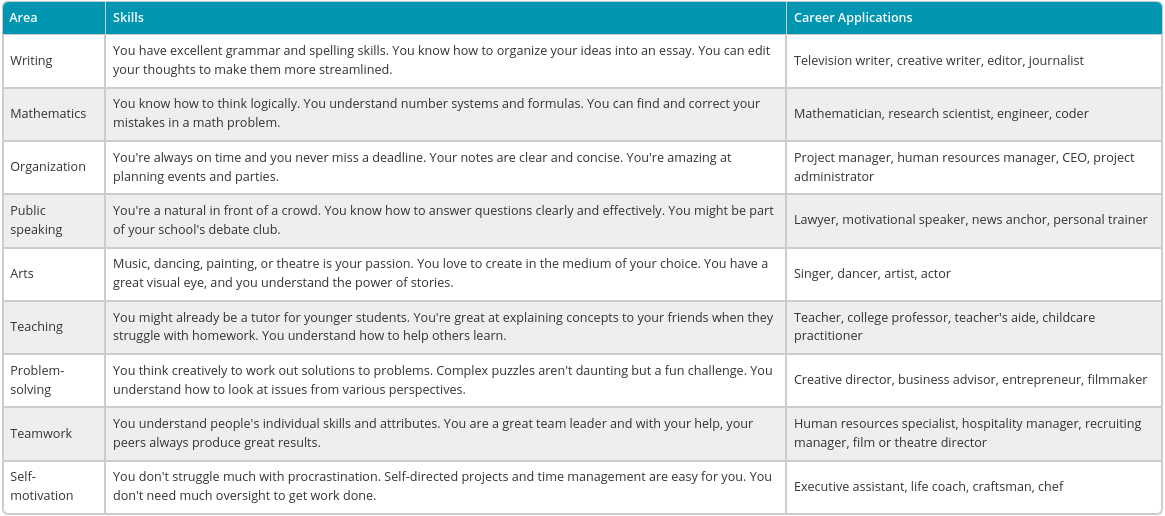
Any career assessment for high school students worth its salt is likely to start by discussing skills. Simply asking yourself, 'What am I good at?' might be somewhat helpful, but that's a limited line of inquiry. Instead of asking such a broad question, consider different kinds of skill sets and how they connect to each other. It is important to think outside the box and consider skills that are not just academic in nature. Check out the following list and evaluate where you think your own skills lie. Refer to chart 1 for more information.
Understanding where your interests and passions lie is at least as important as your skills. Your career is going to take up an enormous portion of your life, so finding a career that matches up with your interests can make a big difference to your overall happiness later in life. Just like with your skillset, your interests do not have to be academic in nature for them to be valuable to your career planning. Some questions you can ask yourself about your interests include:
What do you most enjoy doing in your spare time?
What subjects or concepts make you light up?
When do you feel your curiosity sparked?
What are your favorite movies or books? What are they about?
What questions do you wonder about?
Maybe your favorite school subject is chemistry. Maybe you love knitting in your spare time. Or you never feel alive like you do when you learn about bugs. Several of your favorite books are poetry collections. You've always wanted to learn more about black holes. You love to play video games. All of these interests are valuable, and they can lead you toward different careers (even video games). Consider researching careers or college degrees that focus on your interests to see what kinds of opportunities are available.
Lifestyle
Different careers come with different lifestyles and align with different goals. While having a career that interests you is important, taking on a career that gives you the lifestyle you want can be just as rewarding (if not more rewarding) in the long term. Think of the following lifestyles and potential careers. Refer to chart 2 for more information.
You will need to seriously consider education. What kind of education is required for your career of choice? You will need to start planning for college before the end of your high school career. That might mean taking the right kinds of courses in high school; many colleges will expect certain math or science courses for applications to certain faculties, for instance. If your career requires you to apply to college, make sure that you make your application as good as it can be.
It is important to think carefully about which colleges to apply to. You will need a school that meets not only your career and academic needs but also your personal needs. You might also have chosen a career that does not require a college degree; such careers can be lucrative, stable, and interesting for many people. In that case, you may want to look at applications to trade and vocational programs.
No matter what education your chosen career requires, make sure that you are prepared for the application process. If you feel you need it, consider pursuing career counseling for high school students through your school or community center.
There are many types of jobs and careers to consider. Each one will have its own skillset and educational requirements. This guide will discuss a few general groupings of jobs that can help you refine your search and get a better sense of what a career might entail. Major job types include:
Education and teaching
Health care
Property development
STEM (science, technology, engineering, and mathematics)
Business
Arts
Environment
Law
There are other kinds of jobs not listed here, because there are hundreds of thousands of potential jobs, so make sure to get creative in your search to find what works best for you.
Figuring out what to do for a career can be a challenge. Our guide helps you identify skills and interests, allows you to consider your future lifestyle, and aids you in using a variety of tools to figure out the best career for you.
High school is a time of rapid change and personal exploration for many students. It's also a great time to start thinking carefully about potential future careers and taking
While considering a career might seem daunting, career exploration for high school students doesn't need to be stressful. By breaking the process down into easily manageable steps, students can consider their options and start preparing for future opportunities.
It is also important to keep in mind that while career preparation in high school can be highly valuable, not everyone chooses and then pursues a single career starting in adolescence, and that's okay too. This article is about how to consider your
The first thing to consider when engaging in career exploration is your
What school subjects do you enjoy? Why?
What extracurricular activities do you enjoy? Why?
What are you passionate about?
What kind of lifestyle do you want to have in the future?
What major goals do you have for your life and career?
Take a little time to
Any career assessment for high school students worth its salt is likely to start by discussing skills. Simply asking yourself, 'What am I good at?' might be somewhat helpful, but that's a limited line of inquiry. Instead of asking such a broad question, consider different kinds of
Understanding where your interests and passions lie is at least as
What do you most enjoy doing in your spare time?
What subjects or concepts make you light up?
When do you feel your curiosity sparked?
What are your favorite movies or books? What are they about?
What questions do you wonder about?
Maybe your favorite school subject is chemistry. Maybe you love knitting in your spare time. Or you never feel alive like you do when you learn about bugs. Several of your favorite books are poetry collections. You've always wanted to learn more about black holes. You love to play video games. All of these interests are valuable, and they can lead you toward different careers (even video games). Consider
Lifestyle
Different careers come with different lifestyles and align with different goals. While having a career that interests you is important, taking on a career that gives you the
You will need to seriously consider
It is important to think carefully about which colleges to apply to. You will need a school that meets not only your career and academic needs but also your personal needs. You might also have chosen a career that does not require a college degree; such careers can be lucrative, stable, and interesting for many people. In that case, you may want to look at applications to trade and vocational programs.
No matter what education your chosen career requires, make sure that you are prepared for the application process. If you feel you need it, consider pursuing career counseling for high school students through your school or community center.
There are many types of jobs and careers to consider. Each one will have its own skillset and educational requirements. This guide will discuss a few general groupings of jobs that can help you refine your search and get a better sense of what a career might entail. Major job types include:
Education and teaching
Health care
Property development
STEM (science, technology, engineering, and mathematics)
Business
Arts
Environment
Law
There are other kinds of jobs not listed here, because there are hundreds of thousands of potential jobs, so make sure to get
What do you most enjoy doing in your spare time?
What subjects or concepts make you light up?
When do you feel your curiosity sparked?
What are your favorite movies or books? What are they about?
What questions do you wonder about?
After completing this activity, what is your first career interest? WHY?
After completing this activity, what is your second career interest? WHY?
What school subjects do you enjoy? Why?
What extracurricular activities do you enjoy? Why?
What are you passionate about?
What kind of lifestyle do you want to have in the future?
What major goals do you have for your life and career?