
The basic outline of the career research paper.
When a writer wants to educate readers on a topic or a concept, they have two similar choices in how to approach the subject. If a writer chooses to present information to the reader in general, an informational essay would be an ideal approach. If, however, the writer wants to educate the reader with facts and evidence that supports a topic or thesis argument, they would choose an expository essay.
The Expository writing definition is to present information to the reader while also sharing concepts and ideas that are backed up by facts and evidence. One of the best ways to think about expository writing is a neutral journalist writing on a particular topic that has multiple points of view. If the journalist presents all the information and evidence in a neutral way without picking a side, then they have written an expository piece.
What is expository writing?
There are six major types of expository essays. Each type focuses on a specific style of argument delivery and defense. Descriptive essays focus on painting a holistic picture of a subject. It is through this development in writing that a reader is convinced of the writer's point of view, and how they understand what is being discussed. Alternatively, in compare and contrast essays, the writer explores the pros and cons of a particular topic. By establishing the pros and cons, the writer ultimately makes a case for how the topic should be perceived. Readers of this essay are, ideally, also convinced of this opinion.
The six major types of essays are:
Descriptive or Definition Essays
Example topic: Define "holistic education" and explain why it should be used in kindergarten classrooms
Cause and Effect Essays
Example topic: How has the COVID-19 pandemic impacted Americans' social skills?
Problem and Solution Essays
Example topic: How has increased screen time impacted teen mental health, and how can those impacts be addressed
Compare and Contrast Essays
Example topic: What are the pros and cons of following a vegetarian diet?
Process Essays
Example topic: A step-by-step guide to baking bread.
Classification Essays
Example topic: Discuss the three most significant themes from the novel Pride and Prejudice.
How many types of expository essay are there?
A descriptive essay is a form of expository essay that allows for the most creativity. Through descriptions that help readers experience what is being written (what is being tasted, smelled, felt, heard, or seen), writers describe specific events, places, or things. While factual data is an essential part of these essays, descriptive expository essays also paint a mental portrait for readers that helps them envision what is being described just as the writer envisions it themselves.
Example topic: What are Reform Jewish weddings like in the United States?
A descriptive essay is a form of expository essay that allows for the most
Cause and effect essays outline an event or impact (a "cause") and what results from it (the "effects"). In these essays, writers can defend opinions about causal relationships, grounding their arguments in facts. The intent is to convince readers of the relationship between the cause and effect from the writer's point of view.
Example topic: Explore the cause and effect relationship between heavy rain and mudslides in the Pacific Northwest.
Cause and effect essays outline an event or
Process essays (also known as how-to essays) detail the step-by-step process of completing a task. These essays can explore a simple task, such as making a sandwich in a home kitchen, or a sizable procedure, such as the steps taken to launch a rocket from initial sketching of a shuttle to its ultimate takeoff from a launchpad.
Example topic: How to brush a dog's teeth.
Process essays (also known as
Problem and Solution Essays
Problem and solution essays explore both an issue and how it might best be resolved. The intent is to convince readers that the proposed solution is the best solution, and provide support for this solution.
Example topic: Responding to an oil spill.
What types of essays explore both an issue and how it might best be resolved?
Compare and contrast essays allow writers to juxtapose - or compare - two or more things, and assess their similarities and differences. This juxtaposition can be of characters in a book, ingredients used in a recipe, or any number of things.
Example topic: Compare and contrast the health benefits of jogging versus swimming.
What essays allow writers to juxtapose - or compare - two or more things?
An expository essay traditionally has a three-part structure: an introduction, body paragraphs, and a conclusion. The introduction is anchored by a thesis statement, which establishes what the author's argument is, as well as how they plan to go about defending and supporting that argument. Over the course of the body paragraphs (oftentimes, there are three, but there can be more), facts are presented in support of the argument. It is the evidence included in these paragraphs that supports the writers' argument.
In the conclusion paragraph, the points made over the course of the essay are summarized in alignment with the original thesis statement, and final comments are made by the writer about their argument.
_________ are the three parts of an expository essay.
_________ is what the introduction is anchored by.
What supports a writers argument in an expository essay?
An essay that goes into great detail about your summer vacation in Maine would be an example of what type of expository essay?
Which expository essay allows for the most creativity?
What is the main objective of an expository essay?
Which of the following is not an example of an expository essay?
Which of the following is untrue of expository essays?
According to the Purdue Online Writing Lab, an essay is a shorter piece of writing that often requires students to hone skills, such as close reading, analysis, comparison and contrast, persuasion, conciseness, clarity and exposition. Students will often be asked to write about something they read, something they studied or something they experienced.
Now that we know what an essay is, let's discuss the parts of an essay and how to put it all together. To take the journey, let's think of an essay as a sandwich being made in one of the best sandwich shops in the world. How does one make a world-class sandwich?
While this may not be the first step you complete, it's a step that's often missed by many students. Imagine we have created the best sandwich in the world in our sandwich shop, and on the menu is nothing but a blank line followed by a price. Who's going to order that? Even worse, we wouldn't want to call it something that was misleading. Why call it a peanut butter and jelly sandwich if it doesn't have peanut butter or jelly? Just like item names in delis and sandwich and sub shops found all over the world, the title of your essay should be either descriptive of the contents of your essay or engaging to the point where the curiosity of individuals will compel them to read more. Go for the compelling title only when you have an audience that can choose to read your essay or not. An assigned essay that will be read only by a instructor should use a descriptive title, while one being published in a magazine may best benefit from a compelling title.
[T]he title of your essay should be either
The purpose of the introductory paragraph is to present the argument to the reader and provide an overall idea of the purpose of the paper. This paragraph is placed as the first paragraph in the essay and will be the basis of what the paper will be about.
The introduction paragraph starts with a hook statement that grabs the reader's attention. It might be a rhetorical question or an interesting statistic that sets up the purpose of the essay.
After the hook, the introduction paragraph will state the main purpose of the paper. What is the paper about? That question will be answered in this portion of the introduction paragraph. It will give context to the paper and will set the reader up for the thesis statement.
The introductory paragraph has a thesis statement. The thesis statement is a single sentence that presents the point the essay is trying to make and the main ideas of the three body paragraphs. This may be the most important sentence in the essay and it provides a significant amount of information. It must be well written. The thesis statement is the last sentence in the introductory paragraph.
What is the purpose of the introductory paragraph?
What will the introduction paragraph state after the hook statement?
What is the last sentence in the introductory paragraph?
How to Write a Body Paragraph
Every writer needs to know how to write a body paragraph. The three basic steps are:
Write a topic sentence.
Provide evidence.
Provide commentary
Write a concluding sentence.
These steps can be remembered by the mnemonic TECC (topic/evidence/commentary/conclusion).
The Topic Sentence
A body paragraph topic sentence introduces the main idea of the paragraph and tells the reader what to expect. For example, if an essay is laying out an argument, the topic sentence of the body paragraph should reveal which point in the argument will be discussed in that paragraph.
Weak topic sentence: One reason to visit Montana is its beauty.
Stronger topic sentence: Visit Montana to experience its unsurpassed beauty.
Be sure your topic sentences are both informative and precise. Present the paragraph's main idea and set the stage for the rest of the paragraph.
A topic sentence needs to be both informative and precise?
The middle section of a body paragraph consists of evidence or supporting details. If the topic sentence is a claim, then the following sentences should provide evidence of that claim. Present your evidence in a logical sequence. Transition words for body paragraphs can help to clarify the flow of ideas. Some transition words include:
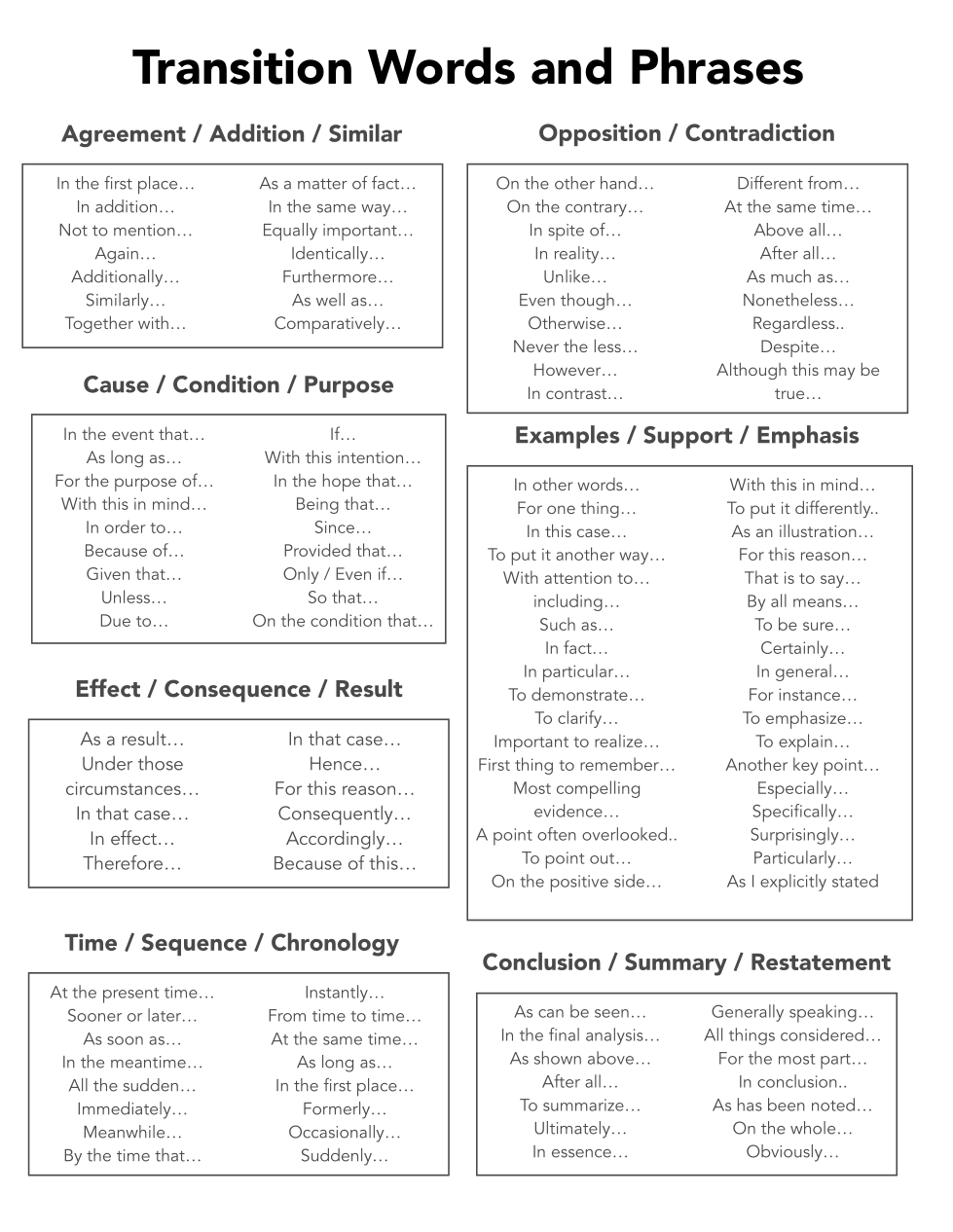
Knowing how to end a body paragraph is crucial. The concluding sentence needs to summarize the main point of the paragraph without repeating the topic sentence verbatim. It can emphasize the importance of the supporting details used or comment on connections between the details. The concluding sentence should also provide a bridge to the following paragraph.
The middle section of a body paragraph consists of
Commentary is where you
Knowing how to
A conclusion paragraph has some key components that make it a successful end of an academic paper. The characteristics of a good conclusion paragraph depend in part on the purpose of the conclusion. Summary concluding paragraphs do not include any new information. A solution concluding paragraph will explain why a solution to the problem is feasible.
An effective conclusion paragraph has the following characteristics:
simple language
rephrase the thesis statement
not introducing new concepts
summarizing the main points of the paper
explain the importance of the argument
state what the purpose of the paper is
bring closure to the reader
refer to the themes of the introductory paragraph
appears at the end of the essay
A conclusion paragraph is the author's last chance to leave a lasting impression on the reader and wrap up their argument. It is used to reiterate prior points and set the final tone for the essay. It is salient that the author provides an effective ending to produce a strong essay.
A conclusion paragraph is the author's last chance to leave a lasting impression on the reader and wrap up their argument.


Peter is creating an outline for a paper on ecotourism and decides to use a formal outline format. You would expect Peter's outline to _____.
You can draw many of the points for your outline from _____.
One should focus on _____ during the outlining process.
Which of the following is true regarding topic sentences?
Why is it a good idea to develop your thesis statement before writing your outline?
Title Your Essay
Outline Your Introduction Below. You will need the following in your introduction:
1. Attention getter (hook)
2. Introduction of topic
3. Narrow down/specifics
4. Thesis Statement
Outline your first body paragrph and include the following:
1. Topic Sentence
2. Evidence with TAG
3. Commentary
4. Evidence with TAG (from different source)
5. Commentary
6. Closing Sentence
Outline your second body paragrph and include the following:
1. Topic Sentence
2. Evidence with TAG
3. Commentary
4. Evidence with TAG (from different source)
5. Commentary
6. Closing Sentence
Outline your third body paragrph and include the following:
1. Topic Sentence
2. Evidence with TAG
3. Commentary
4. Evidence with TAG (from different source)
5. Commentary
6. Closing Sentence
Outline your conclusion here. Be sure to include the following:
1. Restated thesis
2. Summary of career
3. Recommendation
4. Call to action