PS1-5 Factors that Change the Rates of Chemical Reactions
2 points
2
Question 1
1.
Take or upload your notice and wonder T-charts from your notebook for the videos and readings from lessons 6.1 and 6.2.
2 points
2
Question 2
2.
Take or upload a picture of your initial model of in your notebook for how carbon dioxide affects ocean acidification and what could be happening at the moleculear level to the oyster shells. This is from lesson 6.2 slides 7 and 8.
1 point
1
Question 3
3.
Rate your level of interest in continuing to explore the oyster phenomenon this unit?
1 point
1
Question 4
4.
How important do you think it is for students to learn about how a species such as oysters contributes to human effects of climate change?
0 points
0
Question 5
5.
Move the topics around based on how interested you were or are in learning the phenomenon. 1- most interested and 6- least interested (Note: your interest level in learning about the phenomenon and not necessarily the chemistry content)
Flooding in different parts of the world- Sea level rise
Oyster dieoffs- ocean acidification
Where stuff comes from- Elements in the Earth
Fast fasion- clothing dyes
Greenhouse gases affect on climate change - methane vs. carbon dioxide
HF acid spills
2 points
2
Question 6
6.
Take or upload a picture of your6.2 pre-lab (connect, extend, question) chart.
4 points
4
Question 7
7.
Take or upload pictures of 6.2 lab HYPOTHESIS, PROCEDURE & DATA TABLE
Click here to get lab data if you were absent.
4 points
4
Question 8
8.
Take or upload pictures of 6.2 lab DATA ANALYSIS
2 points
2
Question 9
9.
Take pictures or add the document for the unit 6 progress tracker for lessons 6.1 -6.3.
Remember if choose to add a link, to check that the document is shared with Mrs. Mayorga and Profe so we can open it.
6.3-6.6 Exit Tickets
ESS2-6: Carbon Cycle and Effects
0 points
0
Question 10
10.
Take or upload a picture of your 6.4 data table and analysis questions.
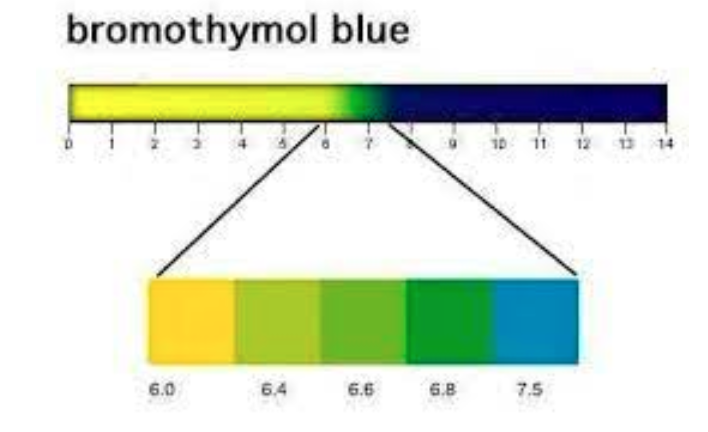
If you don't have lab data, we reacted baking soda and vinegar in a cup to produce CO2. We then used an indicator which turned color to give us a pH value. The pH was initially blue and gradually turned greenish yellow as the reaction occurred in the beaker.
4 points
4
Question 11
11.
Take or upload a picture of your revised carbon cycle and ocean acidity model. The revisions that should be on the model are on slides 8-9 on 6.4 slide deck
0 points
0
Question 12
12.
OPTIONAL EXTRA CREDIT: Take or upload picture(s) of your lab hypothesis, procedure and completed data table from slides 2-5 for your 6.5 neutralization lab.
SOME CLASSES WERE NOT ABLE TO DO THIS BECAUSE IT DIDN'T WORK. IF YOU HAVE IT, THEN YOU CAN UPLOAD FOR EXTRA CREDIT
10 points
10
Question 13
13.
Take a picture of your CER poster from lesson 6.5 slide deck slides 12-15. REMEMBER TO ADD TO THIS POSTER USING THE DRAWING TOOLS OR UPLOAD A GOOGLE DOCUMENT TO FINISH YOUR CER IF NOT FINISHED ON GROUP POSTER.
2 points
2
Question 14
14.
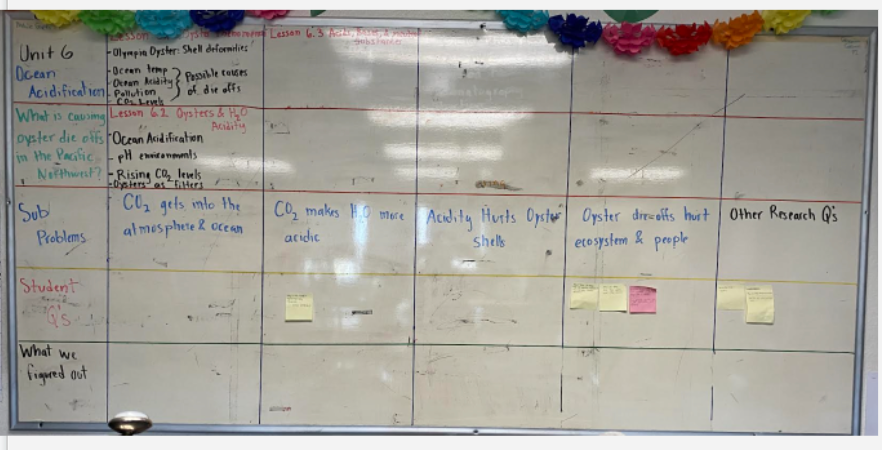
Take a pciture or upload your unit 6 progress tracker. You should be up to lesson 6.5 on this now.
Go back to your notes and slides 6.1-6.6 on the chemistry calendar to remind you about what we learned to fill this out.
The subproblems are in blue in the picture below:
Remember if choose to add a link, to check that the document is shared with Mrs. Mayorga and Profe so we can open it.
1 point
1
Question 15
15.
This unit is taught in the form of a story about what is happening to the oysters and why is that something we should pay attention.
In what way do you think that learning science concepts through a story helps you understand the content better?
1 point
1
Question 16
16.
Which type(s) of lesson experiences have been MOST helpful to your understanding of science concepts in this unit?
0 points
0
Question 17
17.
Optional Extra Credit:
Take a picture of your netlego simulation question responses from slide 3 on the 6.5 slide deck.
OR
Add in 2 things you learned and 1 question you have after listening to the climate podcast
6.7-6.9 Exit Tickets
PS1-7: Measuring Mass and Matter in Chemical Reactions
4 points
4
Question 18
18.
Take a picture of your responses to the 6.7 acid/base slides 5-7 neutralization lab data, observations and analysis questions.
If you were absent: Check the slides for the lab we did and here's data you can use:
Initial pH of H2C2O4= 1
Final pH after NaOH was added H2C2O4 = 10
3 points
3
Question 19
19.
Take a picture of your responses to the 6.7 acid/base slides 10-15 question responses.
If you were absent. Check the slides for the paper clips mini lab and use this data to answer the questions:
Mass of 1 paperclip= .3g
Mass of empty bag= 2.6g
Mass of bag + paperclips= 32.6g
1 point
1
Question 20
20.
Take a picture or upload your responses to questions 1 and 2 from the mole video on slide 2 from 6.8.
4 points
4
Question 21
21.
Take pictures or upload your responses to the 6.8 Moles and Mass Practice Problems worksheet REMEMBER YOU MUST SHOW WORK TO RECEIVE CREDIT FOR THIS.
Here's a help video showing how to convert between moles and mass.
2 points
2
Question 22
22.
Take a picture or upload your unit 6 progress tracker. You should be up to lesson 6.9 on this now.
Go back to your notes and slides 6.7-6.8 on the chemistry calendar to remind you about what we learned to fill this out.
The subproblems are in blue in the picture below:
Remember if choose to add a link, to check that the document is shared with Mrs. Mayorga and Profe so we can open it.
4 points
4
Question 23
23.
Take pictures or upload your responses to the 6.9 mole ratio packet REMEMBER YOU MUST SHOW WORK TO RECEIVE CREDIT FOR THIS.
Here's a help video showing how to convert between moles ratios. Here is an answer key to check answers.
Remember you only receive credit if you show your work.
4 points
4
Question 24
24.
Take a picture and upload your 6.9 Moles, Mass and Neutralization packet with investigation 2