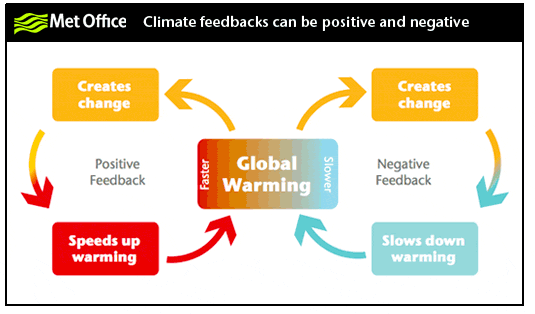
Feedback Mechanisms
star
star
star
star
star
Last updated about 4 years ago
7 Nsɛmmisa
Is ocean acidification a positive or negative feedback loop?
Draw a model to explain the ocean acidification feedback loop.
Part 2: Ice/Albedo Feedback
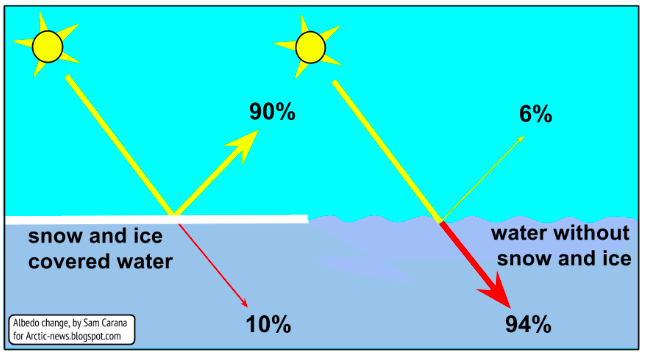
Another important positive climate feedback is the so-called ice albedo feedback. This feedback arises from the simple fact that ice is more reflective (that is, has a higher albedo) than land or water surfaces. Therefore, as global ice cover decreases, the reflectivity of Earth’s surface decreases, more incoming solar radiation is absorbed by the surface, and the surface warms. This feedback is considerably more important when there is relatively extensive global ice cover, such as during the height of the last ice age, roughly 25,000 years ago. On a global scale the importance of ice albedo feedback decreases as Earth’s surface warms and there is relatively less ice available to be melted.
Is the ice/albedo feedback loop a positive or negative feedback loop?
Draw a model to explain the ice/albedo feedback loop.
Part 3: Permafrost Feedback
Read this article and answer the questions.
Is the permafrost feedback loop a positive or negative feedback loop?
Draw a model to explain the permafrost feedback loop.
Part 4: Evaporative Cooling Feedback
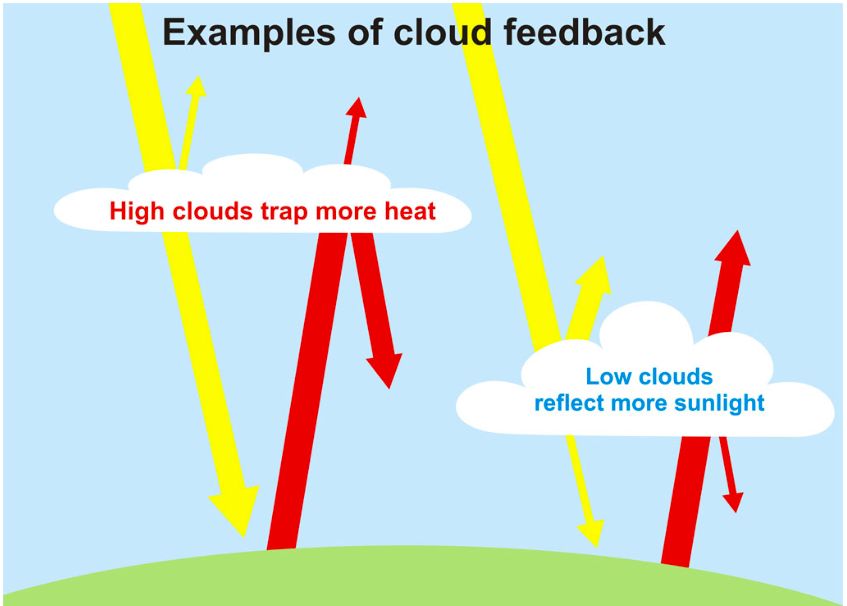
Evaporative cooling is expected to increase with higher temperatures, because warmer water evaporates faster, accelerating the Water Cycle.
An increase in evaporation causes more clouds to form through condensation. Clouds reflect sunlight back into space but they also trap some heat.
Is evaporative cooling a positive or negative feedback loop?