Log in
Sign up for FREE
arrow_back
Library

Tuesday Classification A Brief History: Amoeba Sisters

star
star
star
star
star
Last updated about 1 year ago
45 questions
One of the earliest known classification systems was created by Aristotle, a Greek philosopher who lived from 384–322 BC. He classified more than 500 species of animals in a book, separating them on the basis of if they had blood (vertebrates) or no blood (invertebrates). His pupil, Theophrastus, wrote a similar piece of work classifying plants.
1
1
1
Question 2
2.

Based on the reading, which characteristics did Aristotle use to separate the animals into groups?

Sentence Starter: Aristotle separated on animals on the basis of..

Question 3
3.

What were the names of the groups in the two kindom system?

Many years later, the Swedish botanist Carl Linnaeus (1707–1778) described a 2-kingdom system of living things: animalia and plantae (he also described a third, non-living kingdom of minerals). Linnaeus devised a nested hierarchical system for classifying groups of organisms based on their similarities. He had five levels of classification: Kingdom, Class, Order, Genera and Species.
1
1
Question 5
5.

Carl Linnaeus many years later, created 5 levels of classification. List them below in order. The first one is done for you.

1. Kingdom
2.
3.
4.
5.

This system has been modified over the years, with additional levels of classification added. There have since been 3, 4, 5, 6, 7 and 8 kingdom systems proposed. There is still not consensus within the scientific community on which system to use (most modern textbooks refer to the 5 or 6 kingdom system).
1
1
Question 8 | 01:07
Question 9 | 01:40
Question 10 | 02:13
Question 11 | 02:22
Question 12 | 02:31
Question 13 | 02:56
Question 14 | 03:04
Question 15 | 03:21
Question 16 | 03:31
Question 17 | 03:48
Question 18 | 04:24
Question 19 | 04:49
Question 20 | 05:26
Question 21 | 05:41
Question 22 | 05:59
Question 23 | 06:12
Question 24 | 06:37
Question 25 | 06:51
Question 26 | 07:16
00:00/00:00
Question 8
01:07
keyboard_arrow_down
1
Question 9
01:40
keyboard_arrow_down
1
Question 10
02:13
keyboard_arrow_down
1
Question 11
02:22
keyboard_arrow_down
1
Question 12
02:31
keyboard_arrow_down
1
Question 13
02:56
keyboard_arrow_down
1
Question 14
03:04
keyboard_arrow_down
1
Question 15
03:21
keyboard_arrow_down
1
Question 16
03:31
keyboard_arrow_down
1
Question 17
03:48
keyboard_arrow_down
1
Question 18
04:24
keyboard_arrow_down
1
Question 19
04:49
keyboard_arrow_down
1
Question 20
05:26
keyboard_arrow_down
1
Question 21
05:41
keyboard_arrow_down
1
Question 22
05:59
keyboard_arrow_down
1
Question 23
06:12
keyboard_arrow_down
1
Question 24
06:37
keyboard_arrow_down
1
Question 25
06:51
keyboard_arrow_down
1
Question 26
07:16
keyboard_arrow_down
1
Question 27 | 01:07
Question 28 | 01:40
Question 29 | 02:13
Question 30 | 02:22
Question 31 | 02:31
Question 32 | 02:56
Question 33 | 03:03
Question 34 | 03:15
Question 35 | 03:31
Question 36 | 03:48
Question 37 | 04:24
Question 38 | 04:49
Question 39 | 05:26
Question 40 | 05:41
Question 41 | 05:59
Question 42 | 06:12
Question 43 | 06:37
Question 44 | 06:49
Question 45 | 07:12
00:00/00:00
Question 27
01:07
keyboard_arrow_down
1
Question 28
01:40
keyboard_arrow_down
1
Question 29
02:13
keyboard_arrow_down
1
Question 30
02:22
keyboard_arrow_down
1
Question 31
02:31
keyboard_arrow_down
1
Question 32
02:56
keyboard_arrow_down
1
Question 33
03:03
keyboard_arrow_down
1
Question 34
03:15
keyboard_arrow_down
1
Question 35
03:31
keyboard_arrow_down
1
Question 36
03:48
keyboard_arrow_down
1
Question 37
04:24
keyboard_arrow_down
1
Question 38
04:49
keyboard_arrow_down
1
Question 39
05:26
keyboard_arrow_down
1
Question 40
05:41
keyboard_arrow_down
1
Question 41
05:59
keyboard_arrow_down
1
Question 42
06:12
keyboard_arrow_down
1
Question 43
06:37
keyboard_arrow_down
1
Question 44
06:49
keyboard_arrow_down
1
Question 45
07:12
keyboard_arrow_down
1
Question 8
8.
Taxonomy includes the _______ and classification of species.
Question 9
9.

As we learn more about _______, how we classify organisms continues to change.

Question 10
10.

With the correct spelling what are the three major Domains that all life is separated into?

1.
2.
3.

Question 11
11.

Pause the video here and write down what you see in the video as the main characteristics of prokaryotes.

1.
2.
3.

Question 12
12.
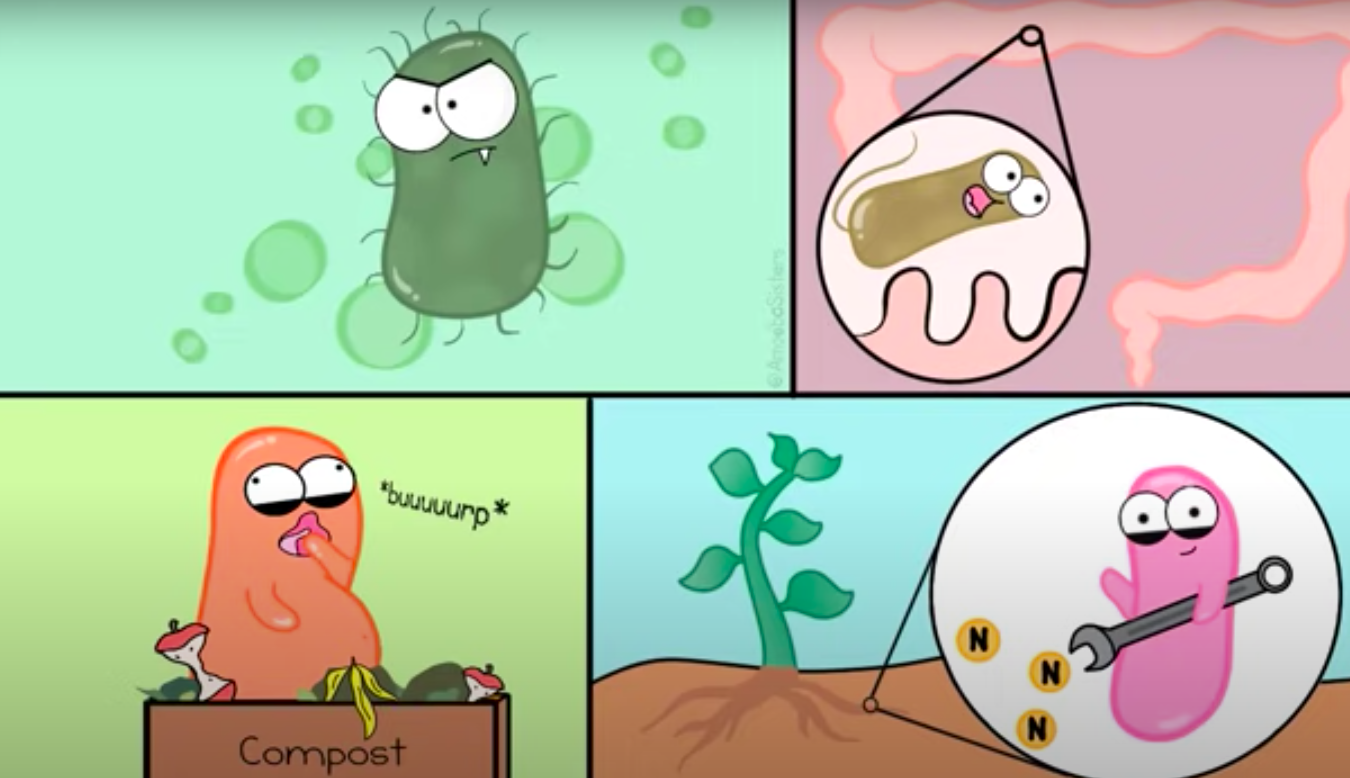
Bacteria are both ____________ and harmful to us. For example, harmful bacteria can make us _________ . Helpful bacteria include ones that help us ___________ food. There is also bacteria that helps fix nitrogen for uptake by ___________ .
Word Bank: plants sick digest helpful
Other Answer Choices:
stick
rude
pungent
plants
digest
crude
sick
helpful
Question 13
13.

Archaea are _____________ meaning that they like extremes

Question 14
14.

Halophiles are archaea that like

Question 15
15.

Methanogens can live where there is...

Question 16
16.

Thermophile archaea live where there are..

Question 17
17.

Pause the video and write down the characteristics that all eukaryotes have.

1.
2.
3.

Question 18
18.

Pause the video and record the 5 kingdoms of eukaryotes.

1.
2.
3.
4.
5.

Question 19
19.
Protista include ones that are _______ meaning that they make their own food. They also include _______ which consume other animals for energy.

Word Bank:
lopinotes
heterotrophs
autotrophs
artichokes
Question 20
20.
All fungi are _______ meaning they get their energy from feeding on other organisms. Fungi have _______ made up of chitin, which is a carbohydrate that protects them. Fungi may be _______ or unicellular.

Word bank:
plots
multicellular
heterotrophs
cell walls
crusty
Question 21
21.
Plants are _______ because they make their own energy from the Sun. Most plants are _______ as they have many cells. Both plants and fungi have cell walls; however, fungi cell walls are made of _______ and plants cell walls are made of _______ .

Word Bank:
really fross
chitin
cellulose
multicellular
autotrophs
polite
Question 22
22.

As we move down the hierarchy levels, the characteristics in the groups become..

Question 23
23.

Because the species level is the most specific you can get, it is the...

Question 24
24.
The first word in the scientific name of an animal is the _______ . Notice that the first letter is _______ . The genus name is written in _______ .

Word bank:
genus
capitalized
italics
lowercase
bold
normal
Question 25
25.
The second word in an animals scientific name is the _______ (or specific epithet). It starts with a _______ letter. It is also written in _______ .

Word Bank:
lowercase
species
italics
uppercase
bold
normal
Question 26
26.

There are many common names for animals like puma, mountain lion, cougar, texas panther. But the scientific name (Puma concolar) of an animal is specific and recognized...

Question 27
27.
Taxonomy includes the _______ and classification of species.
Question 28
28.

As we learn more about _______ our classification of organisms continues to change.

Question 29
29.

With the correct spelling what are the three major Domains that all life is separated into?

1.
2.
3.

Question 30
30.

Pause the video here and write down what you see in the video as the main characteristics of prokaryotes.

1.
2.
3.

Question 31
31.
Bacteria are both _______ and harmful to us. For example, harmful bacteria can make us _______. Helpful bacteria include ones that help us _______ food. There is also bacteria that helps fix nitrogen for uptake by _______.


Word Bank: plants sick digest helpful
Question 32
32.

Archaea are _____________ meaning that they like extremes

Question 33
33.

Halophiles are archaea that like

Question 34
34.

Methanogens can live where there is

Question 35
35.

Thermophile archaea live where there are

Question 36
36.

Pause the video and write down the characteristics that all eukaryotes have.

1.
2.
3.

Question 37
37.

Pause the video and record the 5 kingdoms of eukaryotes.

1.
2.
3.
4.
5.

Question 38
38.
Protista include ones that are _______ meaning that they make their own food. They also include _______ which consume other animals for enegry.

Word Bank: heterotrophs autotrophs
Question 39
39.
All fungi are _______ meaning they get their energy from feeding on other organisms. Fungi have _______ made up of chitin, which is a carbohydrate that protects them. Fungi may be _______ or unicellular.

Word bank: multicellular heterotrophs cell walls
Question 40
40.
Plants are _______ because they make their own energy from the Sun. Most plants are _______ as they have many cells. Both plants and fungi have cell walls; however, fungi cell walls are made of _______ and plants cell walls are made of _______.

Word Bank: chitin cellulose multicellular autotrophs
Question 41
41.

As we move down the hierarchy levels, the characteristics in the groups become..

Question 42
42.

Because the species level is the most specific you can get, it is the

Question 43
43.
The first word in the scientific name of an animal is the_______. Notice that the first letter is _______. The genus name is written in _______.

Word bank: genus capitalized italics
Question 44
44.
The second word in an animals scientific name is the _______ (or specific epithet). It starts with a _______ letter. It is also written in _______.

Word Bank: lowercase species italics
Question 45
45.

There are many common names for animals like puma, mountain lion, cougar, texas panther. But the scientific name (Puma concolar) of an animal is specific and recognized...