What has the study of fossils allowed scientists to do?
1 point
1
Question 2
2.
Earth’s earliest atmosphere lacked which gas that is necessary for life as
1 point
1
Question 3
3.
The relative age of a rock is
1 point
1
Question 4
4.
Geologists use radioactive dating to
1 point
1
Question 5
5.
What are fossils?
1 point
1
Question 6
6.
The time it takes for half of the radioactive atoms in a sample of a radioactive element to decay is the element’s
1 point
1
Question 7
7.
What does the principle of uniformitarianism state?
1 point
1
Question 8
8.
What change in Earth's atmosphere allowed organisms to live on land.
1 point
1
Question 9
9.
Potassium-40 is useful for dating very old rocks because it has a(n)_______ of 1.3 billion years.
1 point
1
Question 10
10.
A(n) _______ is a gap in the geologic record where some rock layers have been lost because of erosion.
1 point
1
Question 11
11.
A(n) _______ fossil forms when dissolved minerals replace the remains of an organism and then harden to form rock.
1 point
1
Question 12
12.
A _______ is a scientist who studies fossils
1 point
1
Question 13
13.
The_______ is combined information about fossils collected by scientists throughout history.
1 point
1
Question 14
14.
In the process of _______ the atoms of one element break down to form atoms of another element.
1 point
1
Question 15
15.
Fossils usually occur in metamorphic rock.
1 point
1
Question 16
16.
The law of superposition helps geologists determine the absolute age of a rock layer.
1 point
1
Question 17
17.
Geologists divide Earth’s long history into smaller units called eras and periods that make up the geologic time scale.
1 point
1
Question 18
18.
Sometimes layers of rock are overturned so much that the youngest rock layer may appear on the bottom, which is the reverse of what is ordinarily expected.
1 point
1
Question 19
19.
Most fossils form from animals or plants that once lived in or near quiet water such as swamps, lakes or shallow seas where sediment builds up.
1 point
1
Question 20
20.
Extinction of a type of organism occurs when the environment changes and the organisms can not survive and reproduce in the changed environment.
1 point
1
Question 21
21.
Around 1896, Marie Curie was involved in the discovery of radioactivity.
1 point
1
Question 22
22.
Radioactive elements always decay at the same rate.
1 point
1
Question 23
23.
Carbon-14 is a non-radioactive form of carbon.
1 point
1
Question 24
24.
Scientists have determined that the Earth is about 4.6 billion years old.
1 point
1
Question 25
25.
Scientists developed the Geologic Time Scale by studying rock layers and index fossils.
1 point
1
Question 26
26.
Name the earliest form of life known on Earth.
2 points
2
Question 27
27.
Describe what scientists can learn about the past while studying fossils. Please use complete sentences.
3 points
3
Question 28
28.
Compare and contrast molds, casts, and trace fossils.
1 point
1
Question 29
29.
In the beginning, why was there no liquid water on Earth?
5 points
5
Question 30
30.
In detail, tell me how scientists think the Earth was formed. What processes happened? Please include the formation of oceans and continents in your answer as well. Please use complete sentences.
2 points
2
Question 31
31.
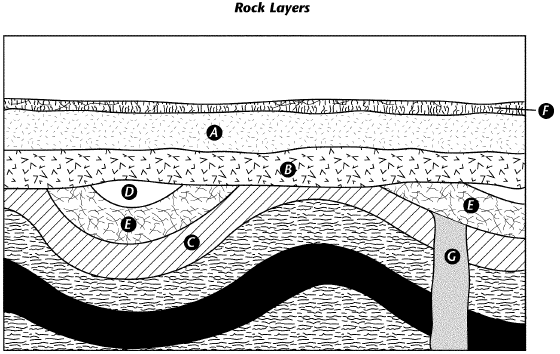
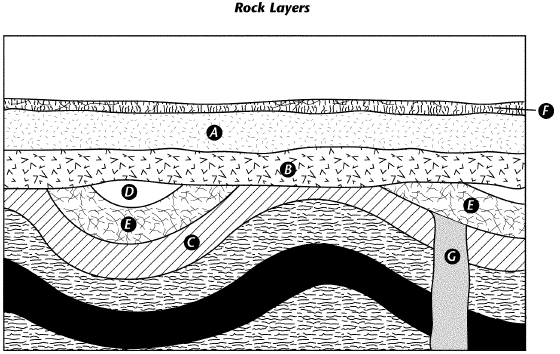
How do layers B and D compare in age? If rock layers between B and D have eroded away,
what is the boundary between B and D called?
1 point
1
Question 32
32.
Layer F is an igneous extrusion. How could a geologist use layer F to infer the age of layer A?