CAST Practice

Last updated over 3 years ago
9 questions
Required
1

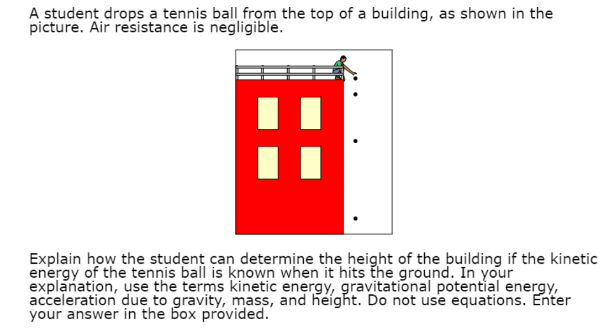
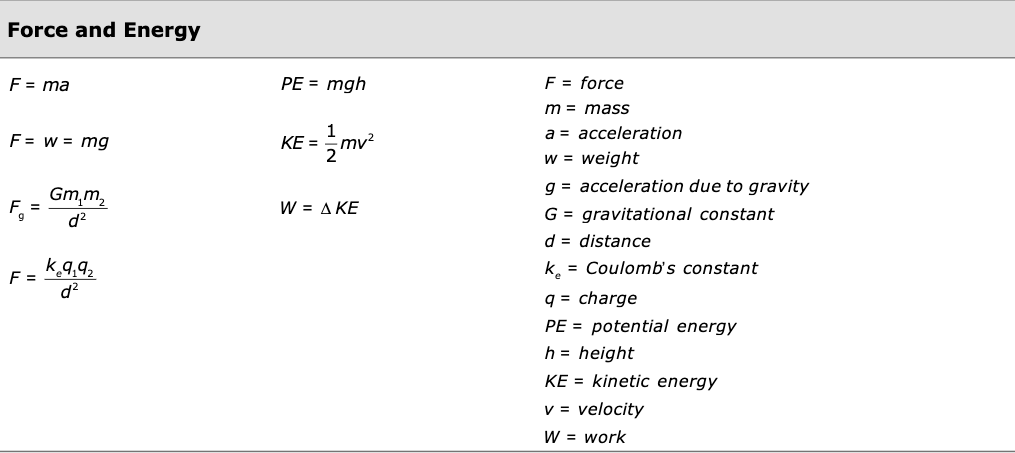
Explain how the student can determine the height of the building. If the kinetic energy of the tennis ball is known when it hits the ground. In your explanation, use the terms kinetic energy, gravitional potential energy, acceleration due to gravity, mass, and height. Do not use the equation. Enter your answer in the space provided.
Score Breakdown

Full Credit Sample Response (2 points):
The kinetic energy (KE) of ball at the bottom of the building is the same as the potential energy (PE) at the top of the building. AND If we know the potential energy and the mass of the tennis ball and the acceleration of gravity then we can simply find the height (h).
Half Credit Sample Reponse (1 point):
The kinetic energy (KE) of the ball at the bottom of the building is the same as the potential energy (PE) at the top of the building OR the potential energy needs to be divided by the known mass of the tennis ball to find the height (h).
No Credit Sample Response (0 points):
The kinetic energy (KE) of the tennis ball at the bottom is not the same as the potential energy of the ball at the top of the building OR time how long is takes for the ball at the top of the building OR measure the height of the building with a meterstick.
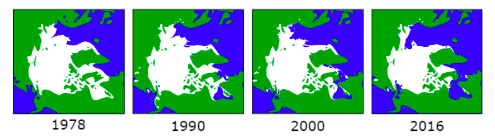
Scientists studided the extent of Arctic sea ice from 1978 to 2016. Observations from selected years are shown in the maps. The white areas show the extent of the sea ice in November of the indicated year. The dark blue areas are ice-free ocean and the green areas are continents (land) in all the maps.
Required
1

Based on the Arctic sea ice images from 1978 to 2016, what is most likely going to occur from 2017 to 2027?

Required
1
Melting Arctic sea ice contributes to a positive feedback loop in the Arctic. As Arctic sea ice melts,__________ sunlight is reflected and the temperature of the Arctic Ocean __________.
Required
1

In the space provided, explain the effect melting ice has on coastal areas that are found at sea level currently.

In this performance task, you will answer six questions.

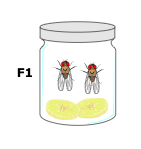
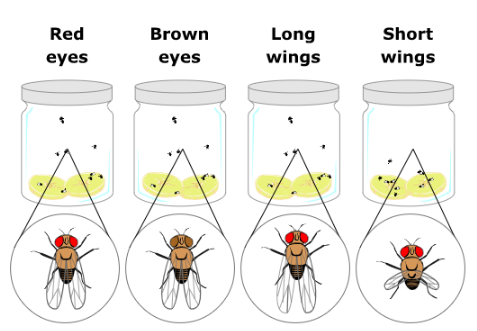
You will be using fruit flies, Drosophila melanogaster, to study genetics. Fruit flies are studied because they have a short life cycle and have only 4 pairs of chromosomes. The flies will be crossed to observe the inheritance pattern of eye color and wing shape. The fruit flies are kept in jars with pieces of banana to serve as a nutrient source. The fruit flies were ordered from a supply company, and each jar contains its own phenotype. You will use the jars containing different fruit flies to answer questions.
Required
1

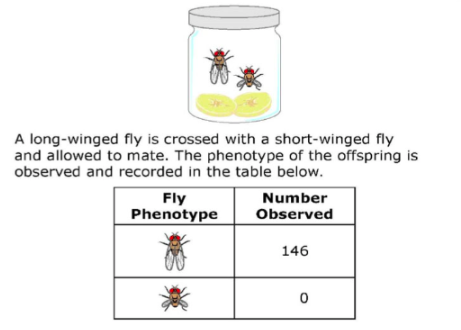
Based on the results in the data table, explain why there are no flies with short wings. Type your answer in the space provided.
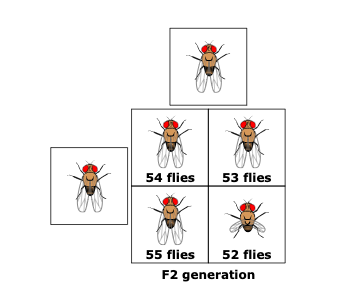
To further the study, two flies from the offsprings of the F1 generation are crossed and produce an F2 generation.


The number and phenotype of the offspring are shown below.

Required
1

What percent of the F2 generation is expected to be heterozygous for long wings?

Required
1
Using "A" to represent the dominant trait and "a" to represent the recessive trait, what are the genotypes of the parents in the F1 generation?

Parent #1: _______
Parent #2: _______
Required
1

Using the Punnett square provided, draw the correct parents that would be expected to produce approximately 50% homozygous brown-eyed offspring and 50% heterozygous offspring

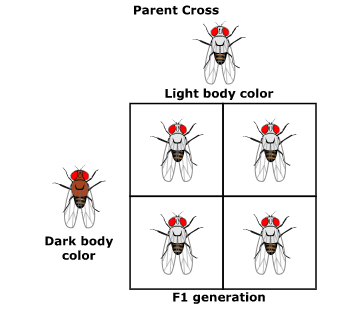
To allow the students to observe an additional trait, the teacher given them a fly with a darker body color than the other flies, which have a lighter body color. The students crossed the dark-body-colored fly with the light-body-colored fly. The cross is represented in the Punnett square below.

Required
1

The students then crossed two flies from the F1 generations and recorded the following results:
162 light-body-colored fruit flies
52 dark-body-colored fruit flies

Explain how the dark body color of the fruit flies remained in the gene pool.