Mole to Mole Set Up Practice

Last updated almost 2 years ago
65 questions
Stiochiometry
As we begin stoichiometry, I want to make sure you think about an overall plan.

Balanced chemical equations (recipes) only work with moles.

You cannot use a balanced chemical equation to compare grams of different reactants/products, unless you first convert to moles.

For that reason your "plan" for doing a stoichiometry problem, should always include converting to MOLES!


What if you were making "water" and you wanted to know how many liters (L) of water you could make if you started with 10.00 grams of water?

STOP! NO! You cannot just go from grams of hydrogen to L of water!!!


So, how will we compare grams of hydrogen to liters of water?
In short, the big fancy word......
Yay! We get to use the mole again! (I can hear you are groaning already, but yes, you will be a pro soon enough.)

Alright, back to the question: how will we convert grams of hydrogen to liters of water?


This MOLE ISLAND MAP comes back:
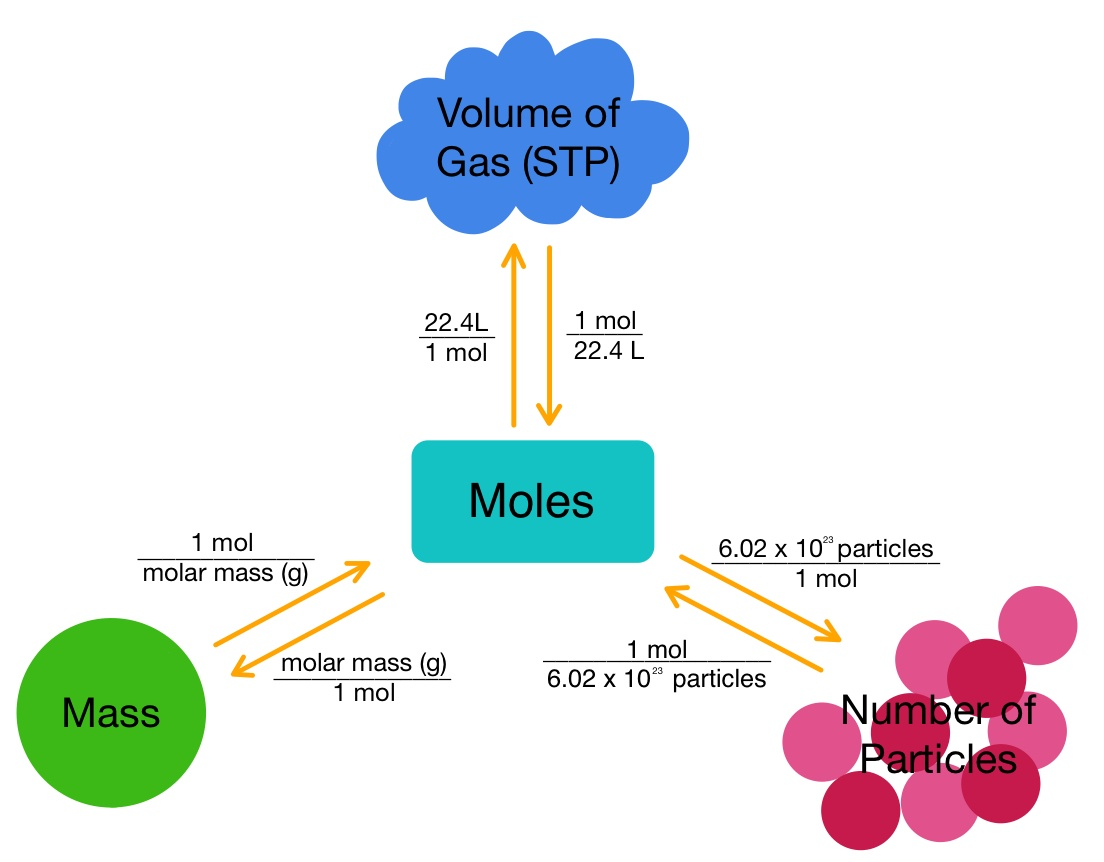
BUT LARGER and WITH MORE DESTINATIONS

because a BRIDGE was added...

a bridge to convert between moles of one thing (like hydrogen) and moles of another (like water).

Look below... trace the path with your finger/eyes...

For real, put your finger on the Mass of X on the Stoichiometry Road Map below.

Let's say X = hydrogen and Y = water

Now, let's find the answer to the question:
If you were making "water," how many L of water would you make if you started with 10.00 grams of water?

Start at Mass (g) of X and find a path to Volume of Y at STP.
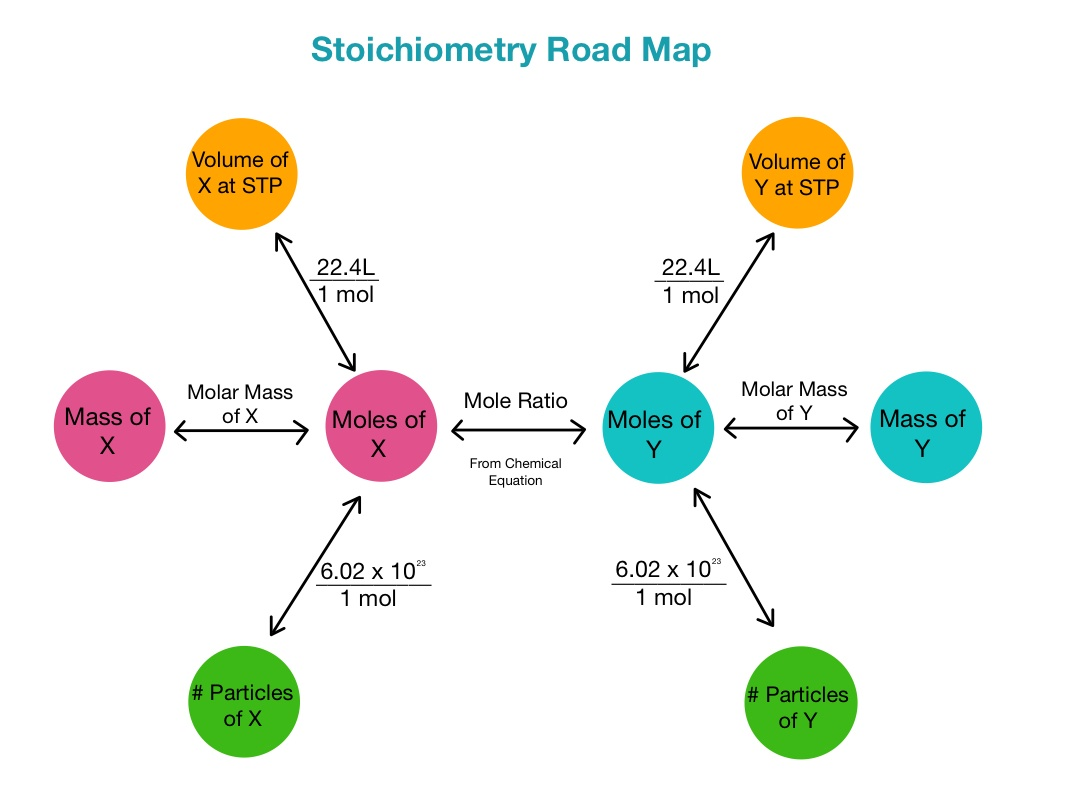
How many steps did it take you?

It should have taken 3 steps (bridges) to go from Mass (g) of X to Volume of Y (L).

Mass (g) of X --> Moles of X --> Moles of Y --> Volume of Y (L) at STP


Take A Deep Breath ... in... and out....
We are going to go v e r y s l o w.

For now, we will only focus on one-step stoichiometry problems, which means Moles of X to Moles of Y.

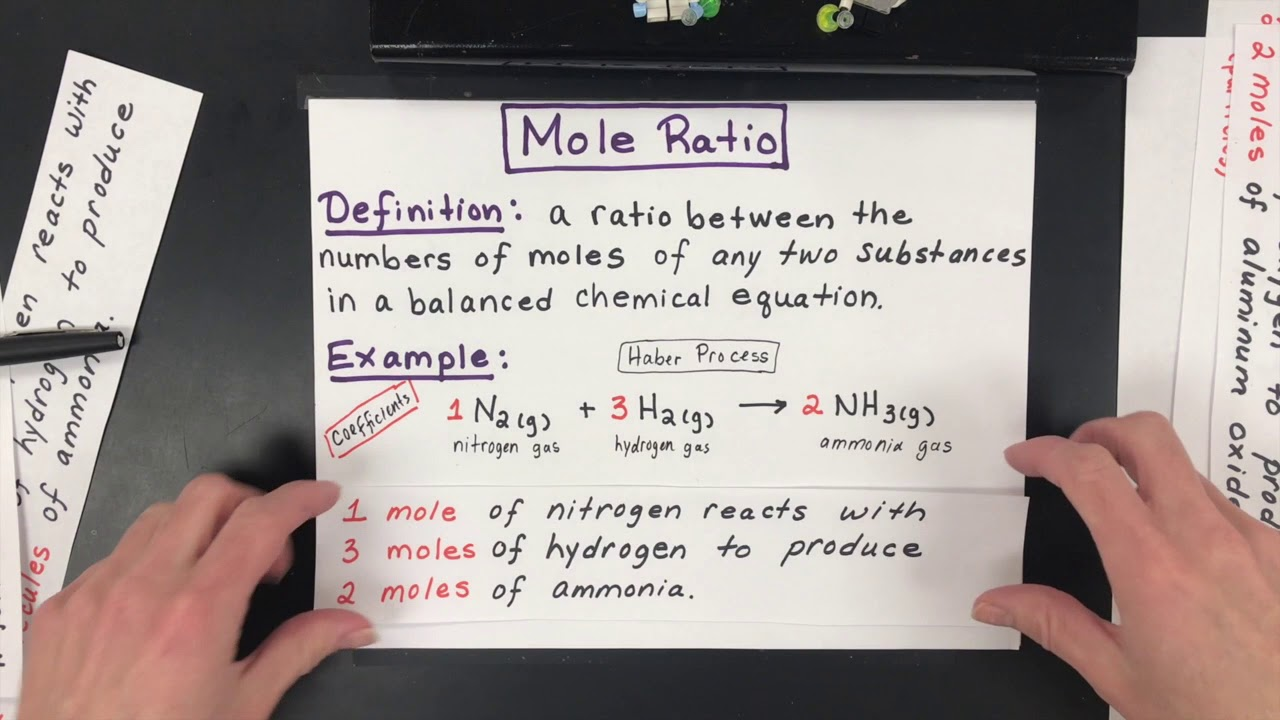
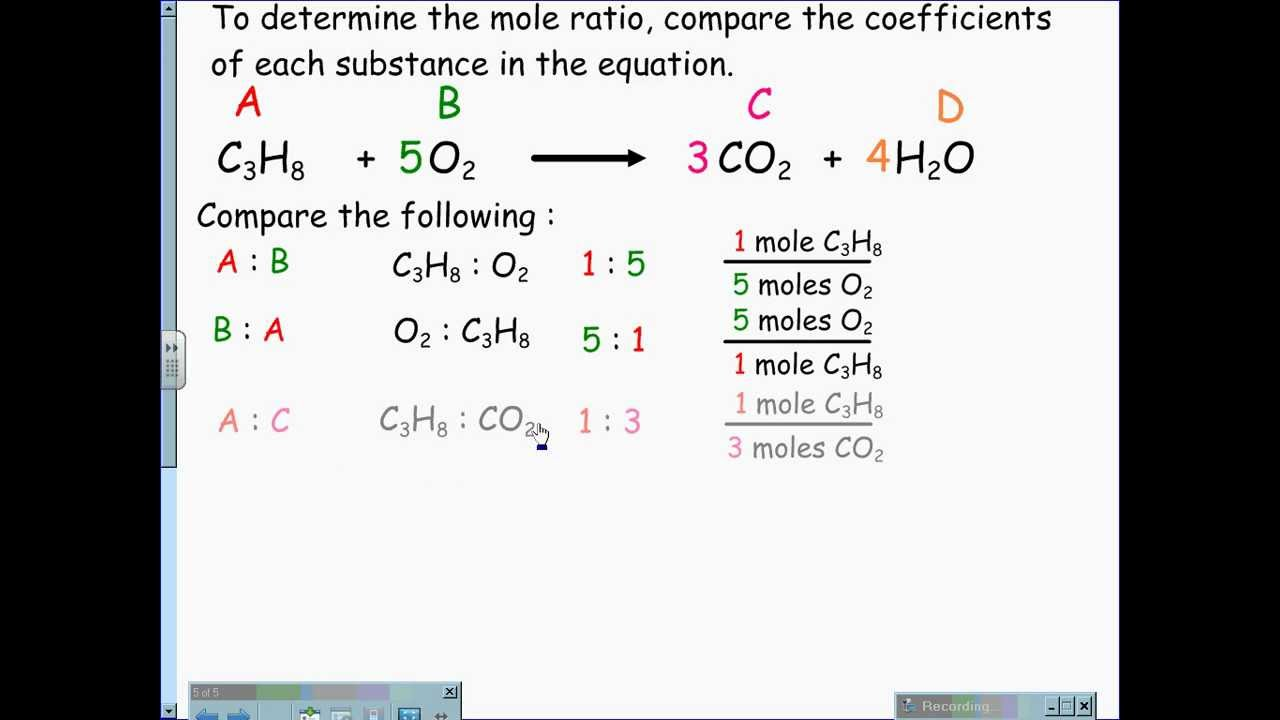
You must use the mole ratio to convert between moles of one compound and moles of another compound. The mole ratio is the ratio of the number of moles of A to the number of moles of B, and it is built using the coefficients of a balanced chemical equation.


For example:

1 N2 + 2 O2 --> 2 NO2
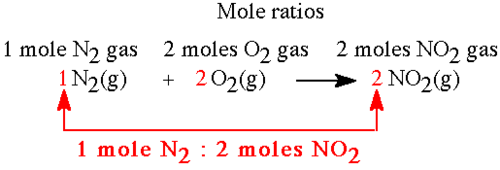
The MOLE RATIO of nitrogen gas (N2) to nitrogen dioxide gas (NO2) is

1 mole N2 to 2 moles NO2

or

1 to 2

or

1 : 2


It will be okay!


(((Breathe))) in
)))Breathe((( out


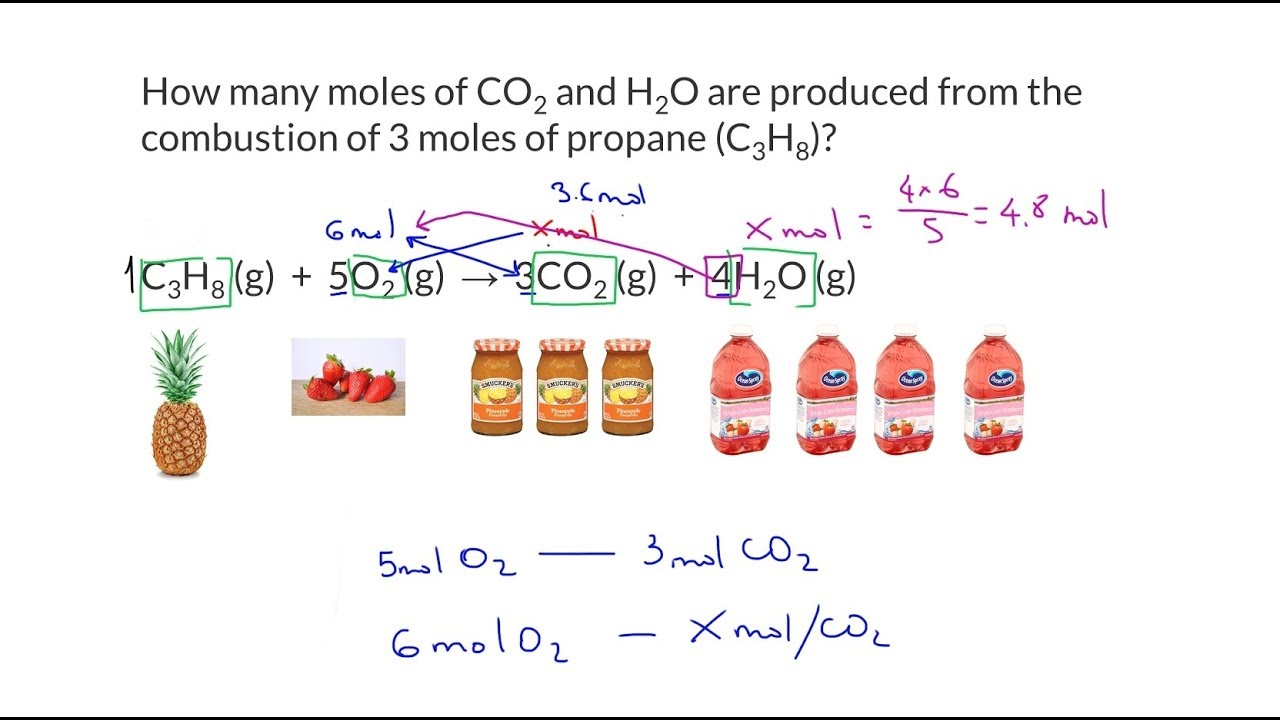
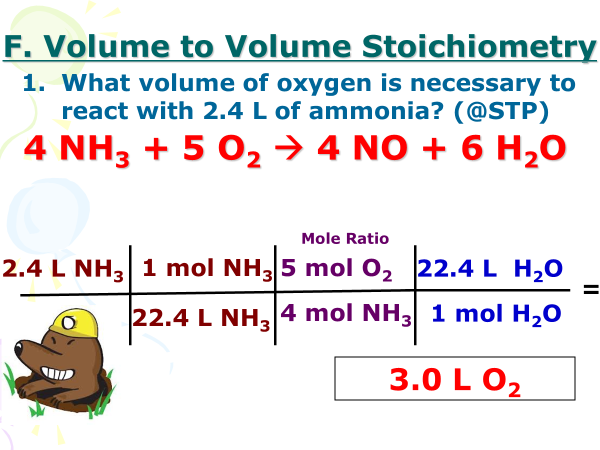
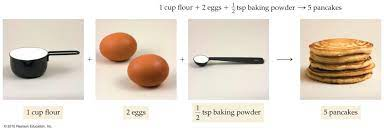
Other Visual Examples:
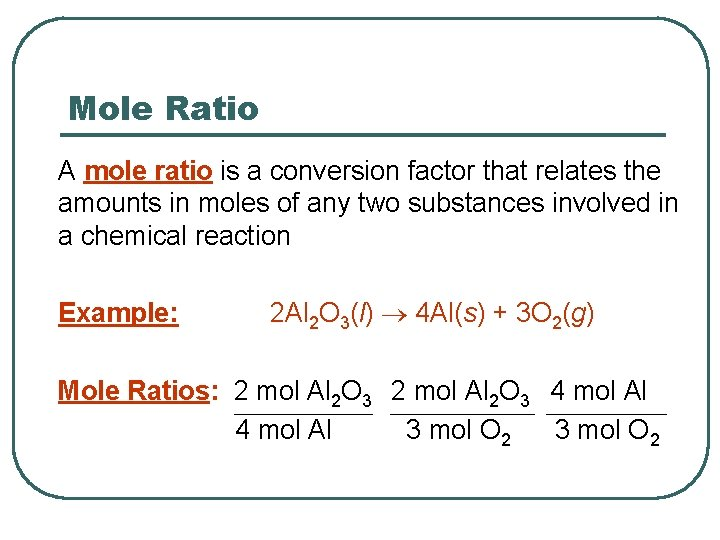

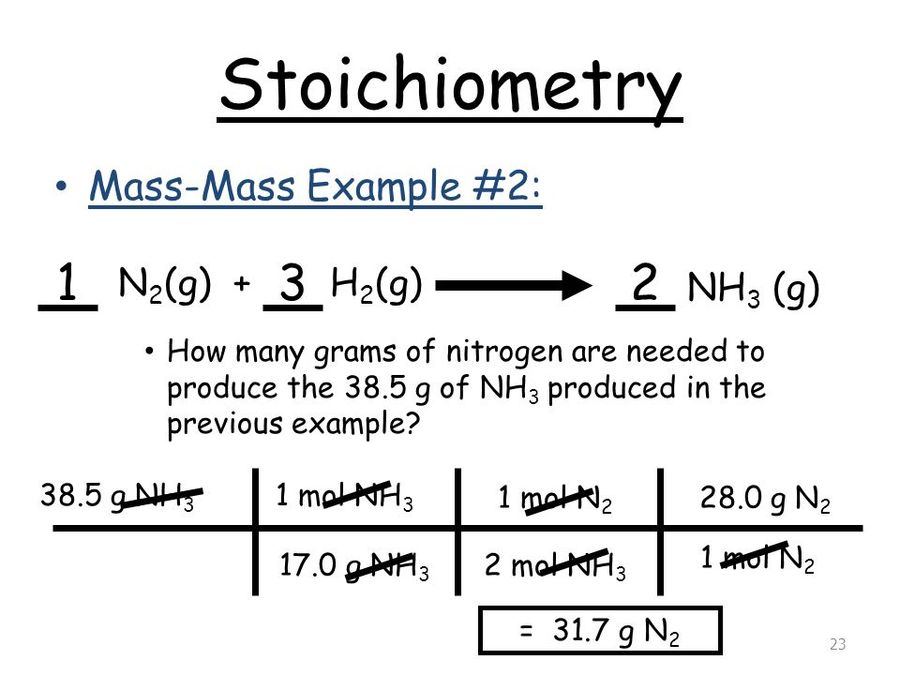
Here is what you will be able to do at the end of this unit (not today):
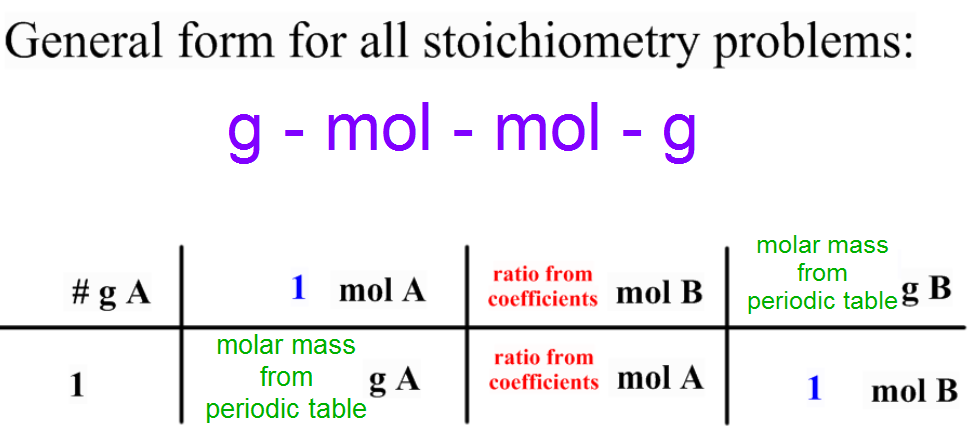


But for TODAY,

Good job reading all the above. Let me know if you have questions. :-) But ask three different groups/tables and then ask me.

Complete the next section, where you will apply this knowledge to actual problems.

1

Stoichiometry is like a recipe because... (choose the BEST answer; all answers below are correct)

1

You must always convert to...

1

In a balanced chemical equation, you use the _______ to convert from moles of X to moles of Y.

Now, let's take it up a notch!

mole ratio !!! (moles to moles)

A major part of stoichiometry is deciding what steps need to be taken to get from your given amount to your wanted amount.

Your template is designed to help you make those choices and to set up each conversion factor correctly.

We are going to start with just determining what steps need to be taken. Example: grams of given --> moles of given --> moles of wanted --> liters of wanted.

A conversion factor has to connect each of the steps, or your answer may be wrong.
Ex: How do you convert 23 inches to feet?
You use 12 in = 1 ft conversion factor.

Ex: How do you convert from 18.02 grams of water to moles?
You use 18.02 g of water = 1 mol of water conversion factor.

Ex: How do you convert from 5 moles of water to ? moles of hydrgoen?
You use a balanced chemcial eqaution to get the conversion factor:

2 H2 + 1 O2 --> 2 H2O

Conversion factor = mole ratio, which for water to hydrogen is 2:2 (2 mol H2O = 2 mol H2)

You pick out the steps that you will need to write out to reach your solution (answer).

Continue and see how you do. Watch below if you want a demo on how it works.

Note: answers progress from red, orange, yellow, green. It takes more than one correct placement to get it to orange, and it turns green before you get them all correct. Watch your points to see if you get each correct.

Stoichiometry (measurement of elements)


is a common science used daily.

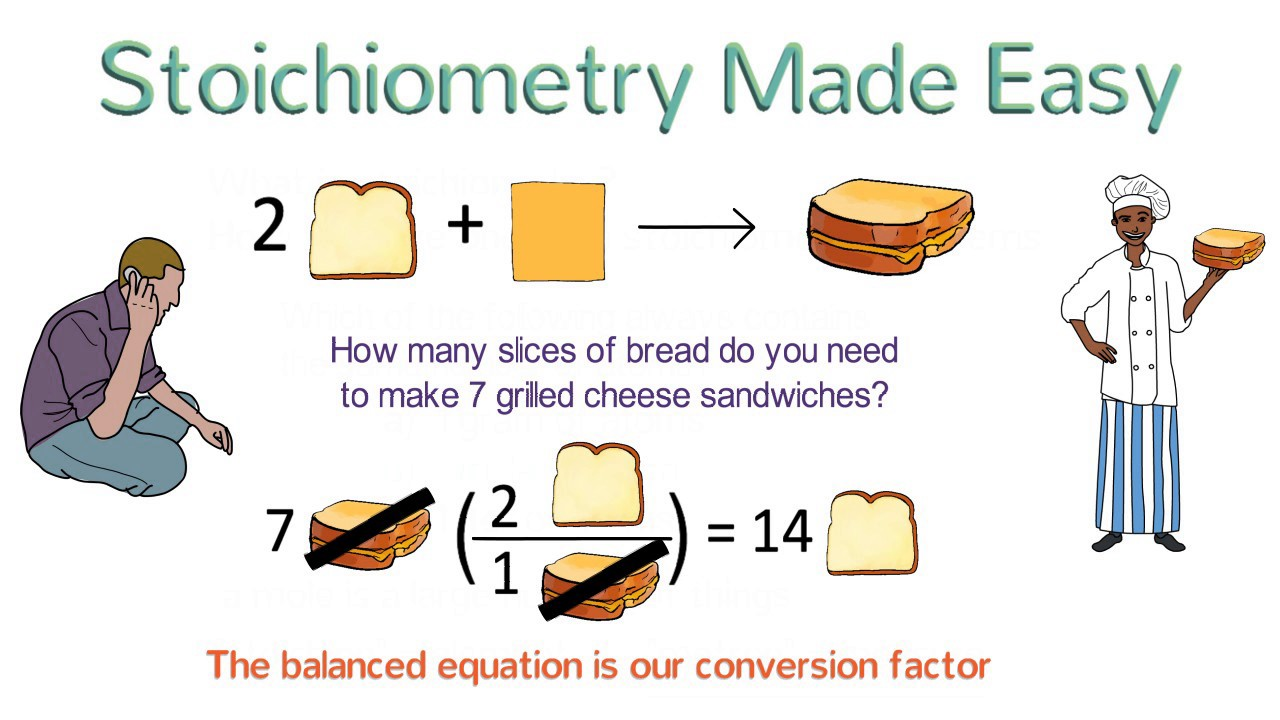
Stoichiometry uses chemical reactions as recipies

to determine how much of the reactants (ingidents)

are needed to make a certain amount of product (cake or sandwhich or water food item you were making).


For example:

•Pharmaceuticals
–Production cost of excess
–Ingesting medicine
–Insulin
-How much medicine does a person need
-How to calculate the amount of ingredients you need to make a certain medicne

•Cosmetic Industry
–Coloring hair (mixing these ingredients with the wrong ratio would be a disaster)

•Engineers
–Fuel Mix to produce energy needed
–Airbags (correct amount of nitrogen gas produced to inflate air bag)

•Food Chemistry
–Baking (too little baking soda, flat cake)
Required
1

Consider this:


If you want to make 7 sandwhiches, how many pieces of bread do you need?

1

Consider this:


If you want to make 5 sandwhiches, how many pieces of bread do you need?

1

Consider this:


If you have 9 cheese slices, how many sandwiches can you make?

Required
1

Consider this:


How many eggs do I need to make 25 pancakes?

1

What must you always have in order to convert from one compound to another compound?

1

Which examples below are examples of the concept of stoichiometry?

Here is a ONE STEP example of stoichiometry.


Eventurally we will get to this:

3 STEP STOICHIOMETRY

1

Do you start with your given or what you want?

1

What is your given in the first 1 step stoichiometry example?

1

What goes on top of the mole ratio?

(Hint: you put your trophy on the top of the table and your trash on the ground)

1

What goes on at the bottom of your mole ratio?

(Hint: you put your trophy on the top of the table and your trash on the ground)

Required
1
Moles to Moles

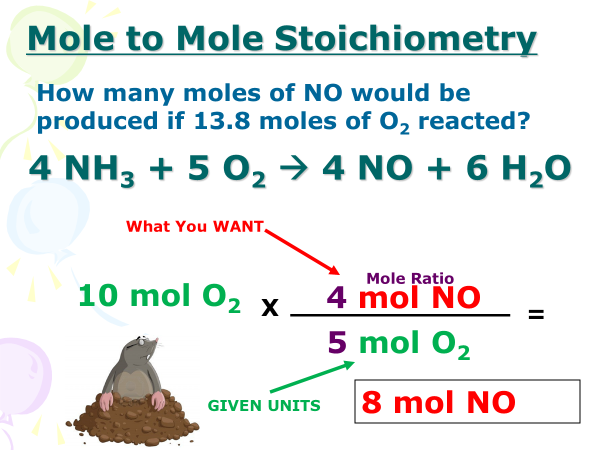
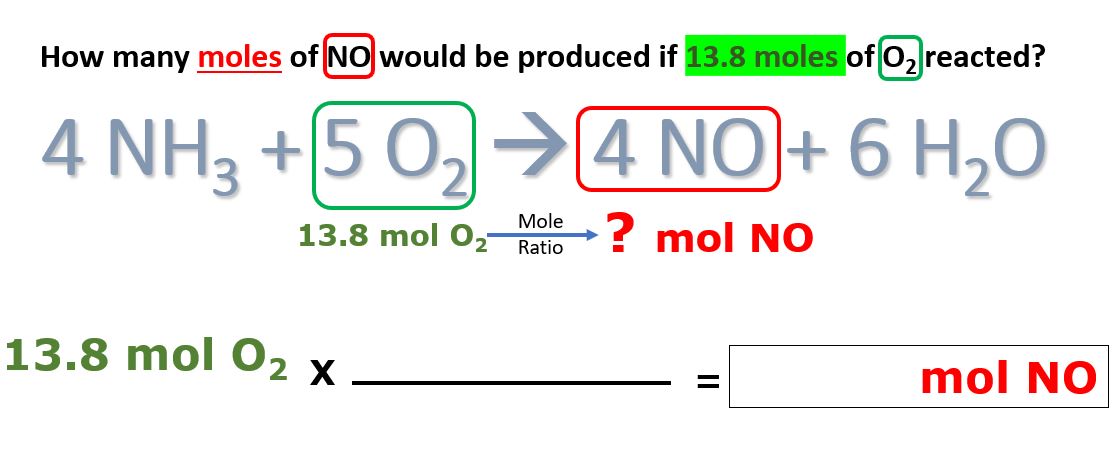
How many moles of NO would be produced if 13.8 moles of O2 reacted?

Notice the green color is where you start, and the red color is what you want (your endpoint).

Match the correct values and units so mols of O2 cancel out, and you are left with mol NO.

Given goes on the ground, diagonally down. (A)
What you WANT goes on top. (B)

MAKE SURE YOUR UNITS cancel out.
Other Answer Choices:
17.25
4 mol NO
5 mol O2
1 mol NO
1 mol O2
11.07
13.80
Required
1
MOLES to MOLES

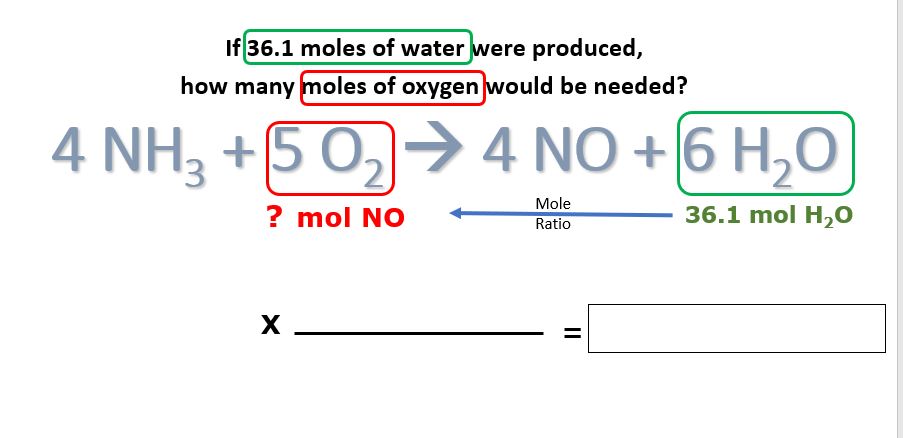
If 36.1 moles of water were produced, how many moles of oxygen would be needed?

Notice the green color is where you start and the red color is what you want (your end point).

Match the correct values and units, start with the given (36.1 moles of water) and then convert to mols of O2.

A: Given goes on the ground, diagonally down.
B: What you WANT goes on top.

MAKE SURE YOUR UNITS cancel out.
Other Answer Choices:
36.1 mol O2
43.32 mol O2
36.1 mol H2O
6 mol H2O
1 mol O2
30.08 mol O2
1 mol H2O
5 mol O2
6 mol O2
Required
1
MOLES to MOLES to GRAMS

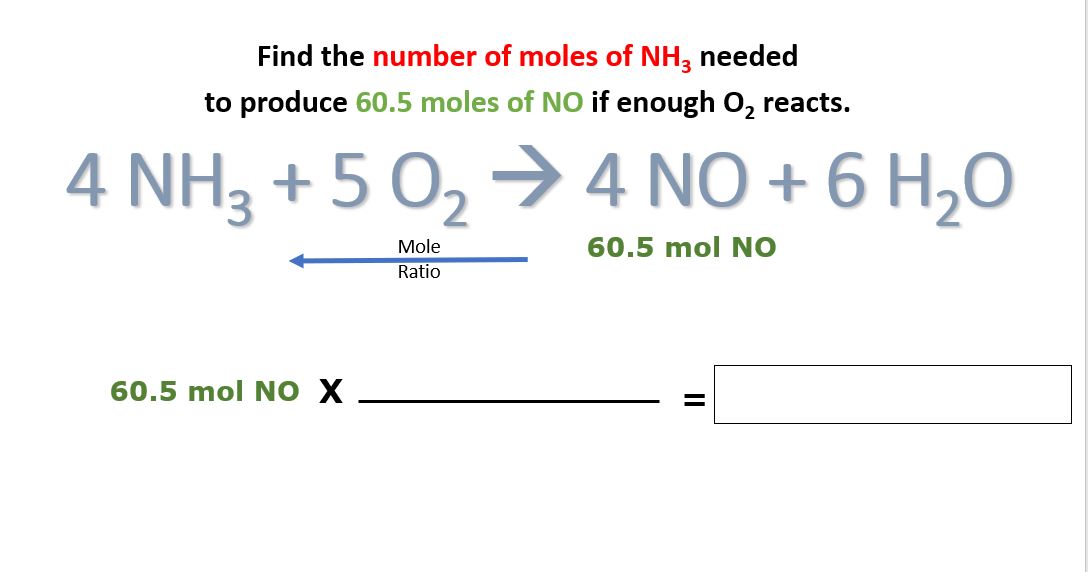
Find the number of moles of NH3 needed to produce 60.5 moles of NO if enough O2 reacts.

A: Given goes on the ground, diagonally down.
B: What you WANT goes on top.

MAKE SURE YOUR UNITS cancel out.
Other Answer Choices:
241.6 mol NH3
? mol NO
1 mol NH3
1 mol NO
15.13 mol NH3
4 mol NO
? mol NH3
4 mol NH3
60.5 mol NH3
Required
1
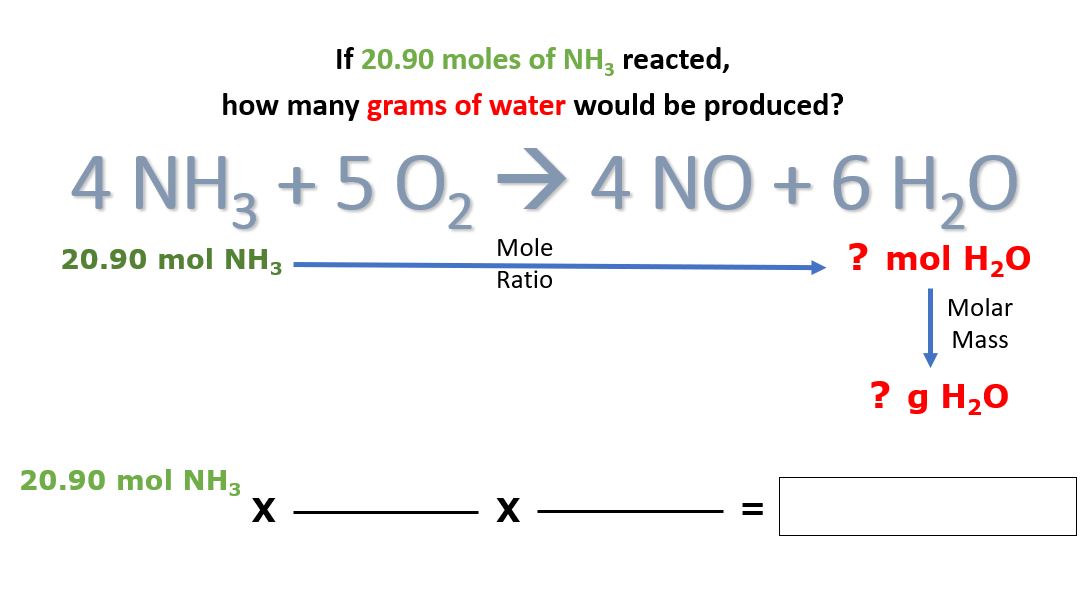
Hint: the molar mass of water is 18.02 g/mol (H: 2 * 1.01) + (O: 1 * 16.00) = 18.02 g/mol

A: Given goes on the ground, diagonally down.
B: What you WANT goes on top.

MAKE SURE YOUR UNITS cancel out.
Other Answer Choices:
564.80 g H2O
4 mol NH3
376.62 g H2O
6 mol H2O
1 mol H2O
18.02 g/mol
18.02 g H2O
1.74 g H2O
31.35 mol H2O
1 mol NH3
Checking for Understanding
1

What is the value of Avogadro's number?

1

A molecule of Al2(SO4)3 contains:

2

Match the coefficients with the correct substance and number of atoms for each element in the following equation: 2 C4H10 + 13 O2 -> 8 CO2 + 10 H2O

Draggable itemCorresponding Item
10 molecules
O2
13 molecules
C4H10
2 molecules
CO2
8 molecules
H20
8 atoms
C on one side of the reaction
26 atoms
H on one side of the reaction
20 atoms
O on one side of the reaction
Review: Mole Conversions
1

REVIEW: How many moles of magnesium is 3.01 x 10²² atoms of magnesium?

This is a two-step mole conversion problem.

1

REVIEW: Determine the volume, in liters, occupied by 0.030 moles of a gas at STP.

This is a two-step mole conversion problem.

Mixed Practice
1

How many grams is 4 moles of NaCl?

Some mole practice quesitons!

Here are some reminders about moles

What is a mole?
A mole is a big number of things.

How big is a mole?
Very big.
6.02 X 10²³ or about a trillion trillion.

How many atoms of carbon are in one mole of carbon?
6.02 X 10²³ atoms of carbon

What is the mass of one mole of carbon atoms?
12.0111g
1

What is the mass of 1 mole of an atom of hydrogen (H)?

1

What is the mass of 1 mole of hydrogen gas (H2)?

1

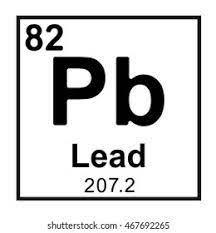
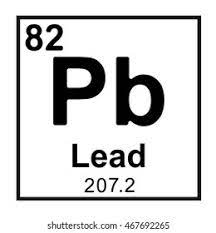
How many atoms are in ONE mole of the lead (Pb) contains?

1 mol of Pb = ______?________ atoms of Pb


1

What is the mass of one mole of the element lead?

1

How many atoms of carbon are needed to make one molecule of CS2?

1

How many atoms of sulfur are needed to make one molecule of CS2?

1

The abbreviation mol means mole or moles. To make 1 mol of carbon disulfide (CS2) molecules requires how many moles of carbon atoms?

1

The abbreviation mol means mole or moles. To make 1 mol of carbon disulfide (CS2) molecules requires how many moles of sulfur atoms?

1

One mole of carbon tetrachloride (CCl4) requires how many moles of carbon atoms?

1

One mole of carbon tetrachloride (CCl4) requires how many moles of chlorine atoms?

1

What are the units for molar mass? (hint: mass/furry animal)

3

What is a mole? Select all that apply.

Mole Ratios
1

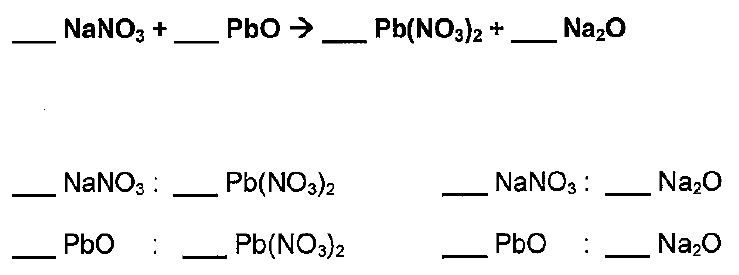
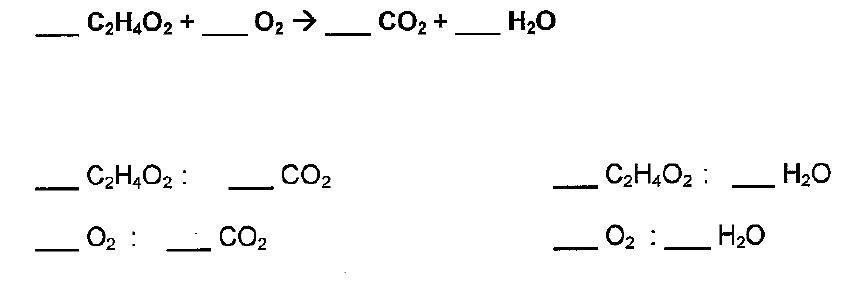
What type of reaction is this?

1

What are the coefficents for this reaction? *Include ones if needed*

Format: no commas, no spaces, only numbers
ex: 1212

1

What are the coefficents for this mole ratio? *Include ones if needed*

Format: number colon number
ex: 3:1 or 2:2 or 1:4

1

What are the coefficents for this mole ratio? *Include ones if needed*

Format: number colon number
ex: 3:1 or 2:2 or 1:4

1

What are the coefficents for this mole ratio? *Include ones if needed*

Format: number colon number
ex: 3:1 or 2:2 or 1:4

1

What are the coefficents for this mole ratio? *Include ones if needed*
Format: number colon number
ex: 3:1 or 2:2 or 1:4

1

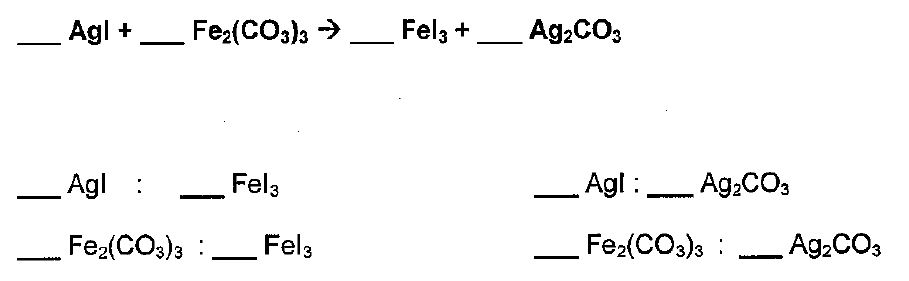
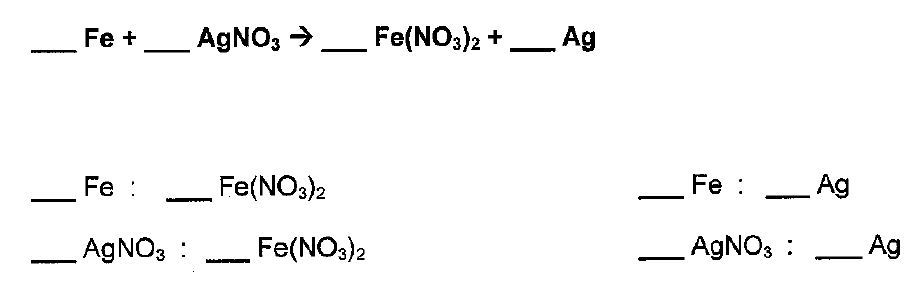
What type of reaction is this?

1

What are the coefficents for this reaction? *Include ones if needed*

Format: no commas, no spaces, only numbers
ex: 1212

1

What are the coefficents for this mole ratio? *Include ones if needed*

Format: number colon number
ex: 3:1 or 2:2 or 1:4

1

What are the coefficents for this mole ratio? *Include ones if needed*

Format: number colon number
ex: 3:1 or 2:2 or 1:4

1

What are the coefficents for this mole ratio? *Include ones if needed*

Format: number colon number
ex: 3:1 or 2:2 or 1:4

**DO NOT SIMPLIFY!!!!***
6 mols : 3 moles stays 6:3 NOT 3:2 :-)

1

What are the coefficents for this mole ratio? *Include ones if needed*
Format: number colon number
ex: 3:1 or 2:2 or 1:4

1

What type of reaction is this?

1

What are the coefficents for this reaction? *Include ones if needed*

Format: no commas, no spaces, only numbers
ex: 1212

HINT: When all of your Carbons and Hydrogens are balanced, then multiply each coefficient by 2 to help you.

1

What are the coefficents for this mole ratio? *Include ones if needed*

Format: number colon number
ex: 3:1 or 2:2 or 1:4

1

What are the coefficents for this mole ratio? *Include ones if needed*

Format: number colon number
ex: 3:1 or 2:2 or 1:4

1

What are the coefficents for this mole ratio? *Include ones if needed*

Format: number colon number
ex: 3:1 or 2:2 or 1:4

1

What are the coefficents for this mole ratio? *Include ones if needed*
Format: number colon number
ex: 3:1 or 2:2 or 1:4

1

What type of reaction is this?

1

What are the coefficents for this reaction? *Include ones if needed*

Format: no commas, no spaces, only numbers
ex: 1212

1

What are the coefficents for this mole ratio? *Include ones if needed*

Format: number colon number
ex: 3:1 or 2:2 or 1:4

1

What are the coefficents for this mole ratio? *Include ones if needed*

Format: number colon number
ex: 3:1 or 2:2 or 1:4

1

What are the coefficents for this mole ratio? *Include ones if needed*

Format: number colon number
ex: 3:1 or 2:2 or 1:4

1

What are the coefficents for this mole ratio? *Include ones if needed*

Format: number colon number
ex: 3:1 or 2:2 or 1:4

1

Given the balanced equation 2H2O -> 2H2 + O2, if you begin the reaction with 4 moles of H2O, how many moles of O2 will you obtain?

Stiochiometry Practice
1

In the balanced equation 2 Fe2O3 -> 4 Fe + 3 O2, if you start with 10 moles of Fe2O3, how many moles of Fe will you produce?

1

According to the balanced equation 3H2 + N2 -> 2NH3, if you utilize 9 moles of H2, how many moles of NH3 can you produce?

1

Using the balanced equation 2Na + Cl2 -> 2NaCl, if you start with 8 moles of Na, how many moles of NaCl will you achieve?

1

2. Given the balanced chemical equation: __ NH3 + __O2 -> __NO + __H2O, calculate the number of moles of Nitrogen Oxide (NO) produced from 8 moles of Ammonia (NH3).

1

In the reaction water, where hydrogen and oxygen gases are mixed, how many moles of Oxygen (O2) are needed to react with 4 moles of Hydrogen (H2)? (Hint: Write your balanced equation first!