How is your day?
¿Cómo va su día?
Siku yako iko vipi?
Umunsi wawe umeze ute?

How is your day?
What is today's date? Use the format MM/DD/YY - Itariki yuyu munsi niyihe? Koresha imiterere MM / DD / YY - ¿Cuál es la fecha de hoy? Utilice el formato MM / DD / YY - Tarehe ya leo ni nini? Tumia fomati MM / DD / YY
What is the title of the lesson you will be working on today?/Je! Ni kichwa gani cha somo ambalo utafanya kazi leo?/Nuwuhe mutwe w'isomo uzakora uyu munsi?/¿Cuál es el título de la lección en la que trabajará hoy?
Any other information I need to know to help you be successful today?/¿Alguna otra información que necesite saber para ayudarlo a tener éxito hoy?/Habari nyingine yoyote ninayohitaji kujua ili kukusaidia kufanikiwa leo?/Andi makuru yose nkeneye kumenya kugirango agufashe gutsinda uyu munsi?
Mark the way you see the pattern growing in the sequence of figures given.
Weka alama kwa jinsi unavyoona muundo unakua katika mlolongo wa takwimu zilizopewa.
Marque la forma en que ve el patrón creciendo en la secuencia de figuras dadas.
Shyira akamenyetso muburyo ubona imiterere ikura mukurikirana imibare yatanzwe.
Assuming the pattern continues in the same way, how many dots are there at 3 minutes?
Dufate ko icyitegererezo gikomeza muburyo bumwe, utudomo angahe kuri 3 minute?
Kwa kudhani muundo unaendelea vivyo hivyo, kuna dots ngapi kwa dakika 3?
Suponiendo que el patrón continúa de la misma manera, ¿cuántos puntos hay en 3 minutos?
How many dots are there at 100 minutes?
¿Cuántos puntos hay en 100 minutos?
Nibihe bangahe kuri 100 minute?
Je! Kuna nukta ngapi kwa dakika100?
How many dots are there at ? Model the pattern using a table, a graph, and an equation. Your model should indicate how many dots will be in the pattern at 3 minutes, 100 minutes, and t minutes. Be sure to show how your solution relates to the picture and how you arrived at your solution.
Je! Kuna nukta ngapi? Mfano wa muundo ukitumia meza, grafu, na equation. Mfano wako unapaswa kuonyesha ni nukta ngapi zitakuwa katika muundo kwa dakika 3, dakika 100, na dakika. Hakikisha kuonyesha jinsi suluhisho lako linahusiana na picha na jinsi ulivyofika kwenye suluhisho lako.
¿Cuántos puntos hay en? Modele el patrón usando una tabla, una gráfica y una ecuación. Su modelo debe indicar cuántos puntos habrá en el patrón a los 3 minutos, 100 minutos yt minutos. Asegúrese de mostrar cómo se relaciona su solución con la imagen y cómo llegó a su solución.
Hano hari utudomo bangahe? Tanga icyitegererezo ukoresheje imbonerahamwe, igishushanyo, hamwe. Moderi yawe igomba kwerekana umubare utudomo tuzaba mubishushanyo muminota 3, iminota 100, niminota. Witondere kwerekana uburyo igisubizo cyawe gifitanye isano nishusho nuburyo wageze kubisubizo byawe.
Table
ameza
meza
la tabla
Equation
Ecuación
Mlinganyo
Ikigereranyo
Create a pattern of dots that increases by 3 each minute, starting with t = 0. Write an equation that models your pattern.
Unda muundo wa nukta ambayo huongezeka kwa 3 kila dakika, ukianza na t = 0. Andika mwandano ambao unaunda muundo wako.
Crea un patrón de puntos que aumente en 3 cada minuto, comenzando con t = 0. Escribe una ecuación que modele tu patrón.
Kora igishushanyo cy'ududomo twiyongera kuri 3 buri munota, utangire kuri t = 0. Andika ikigereranyo cyerekana icyitegererezo cyawe.
Table of values
Jedwali la maadili
Tabla de valores
Imbonerahamwe yagaciro
Explicit Equation
Ikigereranyo cyeruye
Mlinganyo ulio wazi
Ecuación explícita
Graph
Grafico
Igishushanyo
Grafu
Arithmetic sequence:
Secuencia aritmética:
Imibare ikurikiranye:
Mlolongo wa hesabu:
Recursive thinking:
Kufikiria upya:
Pensamiento recursivo:
Gutekereza kenshi:
Recursive equation:
Ikigereranyo gisubiramo:
Mlinganyo wa kurudia:
Ecuación recursiva:
Explicit thinking:
Pensamiento explícito:
Gutekereza neza:
Kufikiria wazi:
What representation (table, graph, equation, etc.) did you find most helpful in understanding this problem? Explain your reasons.
¿Qué representación (tabla, gráfico, ecuación, etc.) le resultó más útil para comprender este problema? Explique sus razones.
What representation is new or confusing? How might it be helpful in working with problems of this type?
¿Qué representación es nueva o confusa? ¿Cómo podría ser útil para trabajar con problemas de este tipo?
Use the equation you created previously and graph it.
Koresha ikigereranyo waremye mbere hanyuma ushushanye.
Tumia equation uliyounda hapo awali na uifanye graph.
Usa la ecuación que creaste anteriormente y grafícala.
Recursive Equation
Usawazishaji wa kurudia
Ecuación recursiva
Ikigereranyo gisubiramo
Explicit equation:
Ikigereranyo cyumvikana:
Mlingano dhahiri:
Ecuación explícita:
Arithmetic sequence
Mlolongo wa hesabu
Secuencia aritmética
Urutonde rwimibare
Constant difference (d) (common difference)
Itandukaniro rihoraho (d) (itandukaniro rusange)
Tofauti ya kawaida (d) (tofauti ya kawaida)
Diferencia constante (d) (diferencia común)
Explicit equation
Ecuación explícita
Mlinganyo ulio wazi
Ikigereranyo cyeruye
Function notation
Imikorere Inyandiko
nukuu ya kazi
notación de función
Function Rule
Regla de función
Amategeko agenga imikorere
Kanuni ya Kazi
Input-output pair
Jozi ya kuingiza-pato
Par de entrada-salida
Iyinjiza-Ibisohoka
Intercepts
Ibisobanuro
Kukatiza
Intercepta
Rectangular coordinate system
Sistema de coordenadas rectangulares
Sisitemu yo guhuza urukiramende
Mfumo wa kuratibu wa mstatili
Recursive equation
Mlinganyo wa kurudia
Ecuación recursiva
Ingano isubiramo
Recursive thinking
Gutekereza kenshi
Kufikiria upya
Pensamiento recursivo
Representation
Representación
Guhagararirwa
Uwakilishi
Sequence
Mlolongo
Secuencia
Urukurikirane
Slope
Umusozi
Mteremko
inclinación
x-intercept
x-guhagarika
X-intersección
kukatiza x
y-intercept
intersección con el eje y
kukatiza y
y-guhagarika
In this pictures shown, each square represents 1 tile.
Muri aya mashusho yerekanwe, buri kare igereranya tile 1.
Katika picha hizi zilizoonyeshwa, kila mraba unawakilisha tile 1.
Sawiradaan la muujiyay, labajibbaaran kastaa wuxuu u taagan yahay 1 foorno.
En las imágenes que se muestran, cada cuadrado representa 1 ficha.

Draw Step 4 and Step 5.
Dibuja el Paso 4 y el Paso 5.
Shushanya Intambwe ya 4 n'Intambwe ya 5.
Chora Hatua ya 4 na Hatua ya 5.
Barbaro Tallaabada 4 iyo Tallaabada 5.
Daniel explained that the middle tower is always the same number as the step number. He also pointed out that the two arms on each side of the tower contain one less block than the step number.
Create an equation that fits Daniel's way of seeing the relationship.
Daniel alielezea kuwa mnara wa katikati siku zote ni sawa na nambari ya hatua. Alidokeza pia kuwa mikono miwili kila upande wa mnara ina kizuizi kidogo kuliko nambari ya hatua.
Unda equation inayofaa njia ya Daniel ya kuona uhusiano.
Daniel explicó que la torre del medio es siempre el mismo número que el número de escalón. También señaló que los dos brazos a cada lado de la torre contienen un bloque menos que el número de escalón.
Crea una ecuación que se ajuste a la forma en que Daniel ve la relación.
Daanyeel wuxuu sharxay in munaaradda dhexe mar walba la mid tahay lambarka tallaabada. Waxa kale oo uu tilmaamay in labada gacmood ee dhinac walba ee taawarka ay ku jiraan hal block ka yar lambarka tallaabada.
Samee isla'eg ku habboon habka Daanyeel u arko xiriirka.
Daniel yasobanuye ko umunara wo hagati uhora ari umubare umwe nintambwe. Yagaragaje kandi ko amaboko yombi kuri buri ruhande rw'umunara arimo umuhanda umwe ugereranije n'umubare w'intambwe.
Kora ikigereranyo gihuye nuburyo bwa Daniel bwo kubona isano.
Sara counted the number of tiles at each step and made a table. She explained that the number of tiles in each figure was always 3 times the step number minus 2.
Create an equation that fits Sara's way of seeing the relationship.
Sara yabaze umubare w'amabati kuri buri ntambwe maze akora ameza. Yasobanuye ko umubare w'amabati muri buri shusho buri gihe wikubye inshuro 3 intambwe ukuyemo 2.
Kora ikigereranyo gihuye nuburyo bwa Sara bwo kubona umubano.
Sara alihesabu idadi ya vigae kwa kila hatua na kutengeneza meza. Alielezea kuwa idadi ya vigae katika kila takwimu kila wakati ilikuwa mara 3 ya nambari ya hatua ukiondoa 2.
Unda equation inayofaa njia ya Sara ya kuona uhusiano.
Sara contó el número de fichas en cada paso e hizo una mesa. Explicó que el número de fichas en cada figura era siempre 3 veces el número de paso menos 2.
Cree una ecuación que se ajuste a la forma en que Sara ve la relación.
Sara waxay tirisay tirooyinka tiles tallaabo kasta waxayna samaysay miis. Waxay sharraxday in tirada tiles ee shaxan kasta ay mar walba 3 jeer ahayd lambarka tallaabada laga jaray 2.
Samee isla'eg ku habboon habka Sara u aragto xiriirka.
Nia focused on the number of blocks in the base compared to the number of blocks above the base. She said the number of base blocks were the odd numbers starting at 1. She also noticed the number of tiles above the base followed the pattern 0, 1, 2, 3, 4. She organized her work in the table.
Create an equation that fits Nia's way of seeing the relationship.
Nia waxay diiradda saartay tirada baloogyada saldhigga marka la barbar dhigo tirada baloogyada ka sarreeya saldhigga. Waxay sheegtay in tirada baloogyada salka ahi ay yihiin tirooyin aan caadi ahayn oo ka bilaabanaya 1. Waxa kale oo ay ogaatay tirada taayirada ka sarraysa saldhigga inay raacday hannaankii 0, 1, 2, 3, 4. Waxay abaabushay shaqadeedii miiska.
Samee isla'eg ku habboon habka Nia u arko xiriirka.
Nia se centró en la cantidad de bloques en la base en comparación con la cantidad de bloques sobre la base. Ella dijo que la cantidad de bloques de base eran los números impares que comienzan en 1. También notó que la cantidad de fichas sobre la base seguía el patrón 0, 1, 2, 3, 4. Organizó su trabajo en la mesa.
Crea una ecuación que se ajuste a la forma en que Nia ve la relación.
Nia yibanze ku mubare wahagaritswe muri base ugereranije numubare wahagaritswe hejuru. Yavuze ko umubare wibibanza fatizo ari imibare idasanzwe guhera kuri 1. Yabonye kandi umubare wamabati hejuru yikibanza yakurikije icyitegererezo 0, 1, 2, 3, 4. Yateguye imirimo ye kumeza.
Kora ikigereranyo gihuye nuburyo bwa Nia bwo kubona umubano.
Nia ililenga idadi ya vitalu kwenye msingi ikilinganishwa na idadi ya vitalu juu ya msingi. Alisema idadi ya vitalu vya msingi vilikuwa idadi isiyo ya kawaida kuanzia 1. Aligundua pia idadi ya vigae juu ya msingi ilifuata muundo 0, 1, 2, 3, 4. Alipanga kazi yake kwenye meza.
Unda equation ambayo inafaa njia ya Nia ya kuona uhusiano.
Based on the function notation provided, evaluate the function to determine the output.
Example:
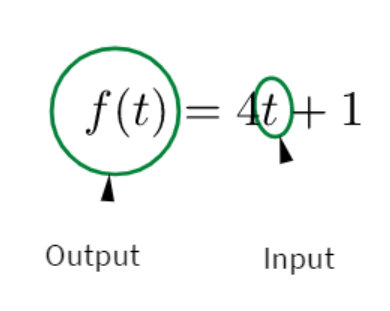
Instead of using x and y in an equation, like y = 5x + 1, mathematicians often write f(n) = 5n + 1 because it can give more information. With this notation, the direction to find f(2) means to replace the of n with 2 and perform the operations to find f(n). The point (n, f(n) ) is the same location on the graph as (x, y), where n describes the location along the x-axis and f(n) is the height of the graph.
Kulingana na nukuu ya kazi iliyotolewa, tathmini kazi ili kubaini pato.
Mfano:
Badala ya kutumia x na y katika equation, kama y = 5x + 1, wanahisabati mara nyingi huandika f (n) = 5n + 1 kwa sababu inaweza kutoa habari zaidi. Kwa nukuu hii, mwelekeo wa kupata f (2) unamaanisha kuchukua nafasi ya n na 2 na kufanya shughuli kupata f (n). Hoja (n, f (n)) ni eneo sawa kwenye grafu kama (x, y), ambapo n inaelezea eneo kando ya mhimili wa x na f (n) ni urefu wa grafu.
Según la notación de función proporcionada, evalúe la función para determinar la salida.
Ejemplo:
En lugar de usar xey en una ecuación, como y = 5x + 1, los matemáticos suelen escribir f (n) = 5n + 1 porque puede dar más información. Con esta notación, la dirección para encontrar f (2) significa reemplazar el de n con 2 y realizar las operaciones para encontrar f (n). El punto (n, f (n)) es la misma ubicación en el gráfico que (x, y), donde n describe la ubicación a lo largo del eje x y f (n) es la altura del gráfico.
Ukurikije imikorere yamenyeshejwe yatanzwe, suzuma imikorere kugirango umenye ibisohoka.
Urugero:
Aho gukoresha x na y muburinganire, nka y = 5x + 1, abahanga mu mibare bakunze kwandika f (n) = 5n + 1 kuko ishobora gutanga amakuru menshi. Hamwe niyi nyandiko, icyerekezo cyo gushakisha f (2) bisobanura gusimbuza n na 2 no gukora ibikorwa byo gushaka f (n). Ingingo (n, f (n)) ni ahantu hamwe ku gishushanyo nka (x, y), aho n isobanura ahantu hafi ya x-axis na f (n) ni uburebure bwishusho.
Iyada oo ku saleysan tilmaamaha shaqada ee la bixiyay, qiimee shaqada si loo go'aamiyo wax soo saarka.
Tusaale:
Halkii loo isticmaali lahaa x iyo y ee isla'egta, sida y = 5x + 1, xisaabiyeyaashu waxay inta badan qoraan f (n) = 5n + 1 maxaa yeelay waxay bixin kartaa macluumaad dheeraad ah. Astaantan, jihada lagu helo f (2) waxaa loola jeedaa in lagu beddelo n oo lagu beddelo 2 oo la sameeyo hawlgallo si loo helo f (n). Barta (n, f (n)) waa isla goobta garaafka sida (x, y), halkaas oo n ku tilmaamaysaa meesha ku teedsan x-dhidibka iyo f (n) waa dhererka garaafka.
Given that f(n) = 8n - 3 and g(n) = 3n - 10, evaluate the following functions with the indicated values.
Urebye ko f (n) = 8n - 3 na g (n) = 3n - 10, suzuma imirimo ikurikira hamwe nagaciro kerekanwe.
Marka la eego f (n) = 8n - 3 iyo g (n) = 3n - 10, ku qiimee shaqooyinka soo socda qiimayaasha la tilmaamay.
Kwa kuwa f (n) = 8n - 3 na g (n) = 3n - 10, tathmini kazi zifuatazo na maadili yaliyoonyeshwa.
Dado que f (n) = 8n - 3 y g (n) = 3n - 10, evalúe las siguientes funciones con los valores indicados.
f(1) =
g(0) =
f(5) =
g(-4) =