Log in
Sign up for FREE
arrow_back
Library

Earth Science Checkpoint

star
star
star
star
star
Last updated about 4 years ago
15 questions
Required
1
SCI.8.10a
Required
1
SCI.8.10b
Required
1
SCI.8.10a
Required
1
SCI.8.7a
1
SCI.8.7a
Required
1
SCI.8.7b
Required
1
SCI.8.7b
Required
1
SCI.8.7b
Required
1
SCI.8.9c
Required
1
SCI.8.9b
Required
1
SCI.8.9c
Required
1
SCI.8.9c
Required
1
SCI.8.9c
Required
1
SCI.8.9c
Required
1
SCI.8.9a
Question 1
1.

Question 2
2.

Question 3
3.

Question 4
4.

Question 5
5.

Question 6
6.

Question 7
7.

Question 8
8.

Question 9
9.

Question 10
10.

Question 11
11.

Question 12
12.

Question 13
13.

Question 14
14.

Question 15
15.

Which of the following changes would remove the source of energy that generates the convection that makes wind here on Earth?
Blocking all solar energy.
Removing all the salt from seawater.
Reversing the rotation of Earth.
Growing more vegetation in barren areas.
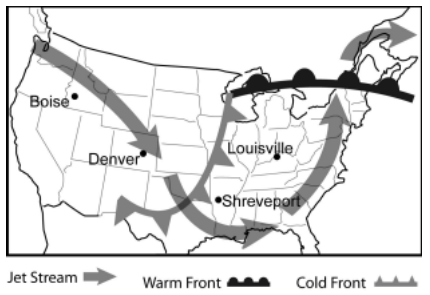
Rain and even severe thunderstorms are often associated with the passage of a cold front. Based on this information, and that provided in the weather map, which city shown is likely the one to experience severe, rainy conditions in the next day?
Louisville
Boise
Denver
Shreveport
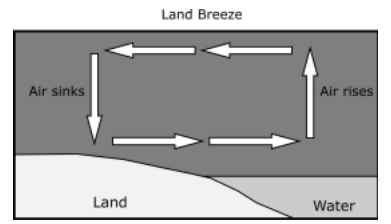
An illustration of how a convection current creates a wind, called a land breeze, is provided.


Which of the following best explains what creates this convection current?
During the evening, the land cools off more quickly than the water, so the air is different temperatures.
The rotation of Earth makes the air above it rotate, but not the same over land and water.
Salt in the ocean makes it more dense than the land, so its gravity pulls more on the air above it.
Because of its mass, Earth’s gravity creates a high pressure area over both the land and water.
In the summer many people enjoy going to the beach. The photograph shows a beach in Argentina, which is located in the Southern Hemisphere. Which diagram shows the position of the Earth when it is summer in Argentina?
What is the main reason that summer is warmer than winter?
Earth’s magnetic field is stronger in the summer than it is the rest of the year.
Earth rotates slower around the Sun during the summer than it does the rest of the year.
The tilt of Earth’s axis results in more direct radiation from the Sun in the summer.
Earth is closer to the sun during the summer than during the other seasons.
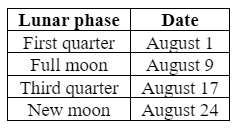
  1. Osvaldo observes the moon several times during the month of August. He sketches the appearance of the moon on four days—August 1, August 9, August 17, and August 24—and identifies each lunar phase. Osvaldo’s data is shown in the table below.


On which date should Osvaldo expect the next new moon to take place?
September 22
September 12
September 7
August 7
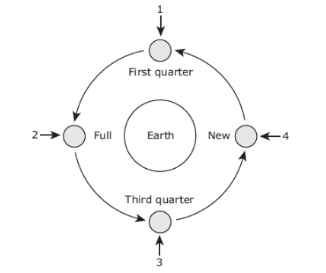
  1. The diagram below shows four phases of the moon as it revolves around Earth.


A student builds a model based on this diagram. The student uses foam balls to represent the moon and Earth and a flashlight to represent the sun. The student should shine the flashlight on the model of Earth from position –
1
2
3
4
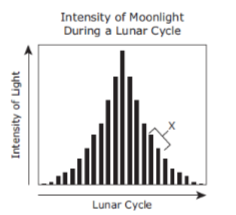
The moon reflects different amounts of sunlight onto Earth at different times. This reflected sunlight is commonly called moonlight. The graph below shows the intensity of moonlight at different times in a lunar cycle.


Which moon phase most likely occurs at the time in the cycle represented by an X on the graph?
When the contour lines are close together on a topographic map, this indicates that the…
slope of the landform is steep.
slope of the landform is flat.
landform is tall.
landform is short.
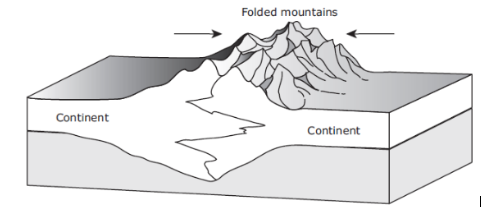
The model below shows two continental plates.


The folded mountains in this model form at which type of plate boundary?
Subduction boundary
Convergent boundary
Divergent boundary
Transform boundary
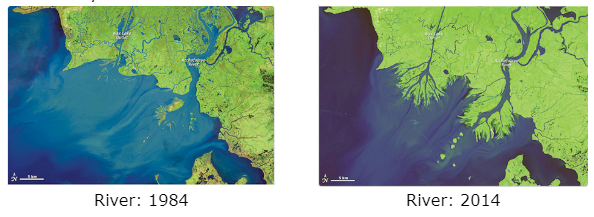
Which of the following statements best describes the cause for changes to the land over the course of 30 years?

A glacier is eroding and depositing glacial till at the bottom of a landform, such as a mountain.
An alluvial fan is created as a result of erosion and deposition of material from a mountain stream emptying onto land.
A delta is created as a result of erosion and deposition by water from the river mouth feeding in to the ocean.
A delta is created as a result of erosion and deposition by wind from the land into the ocean.
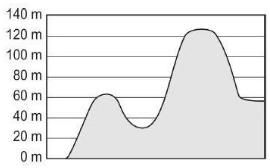
The diagram below shows a side view of a landform with different elevations.


Which of the following maps best represents this landform?
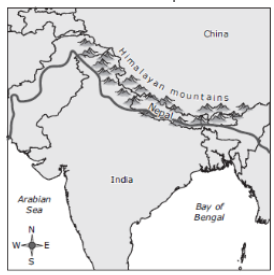
The Himalayan Mountains are shown in the map below.

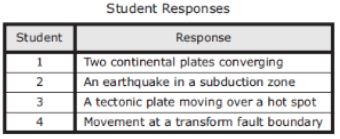
Four students were asked to identify the geologic process that caused this mountain range to form. Their responses are shown below.

Which student correctly identified the geologic process that formed the Himalayan Mountains?

Student 1
Student 2
Student 3
Student 4
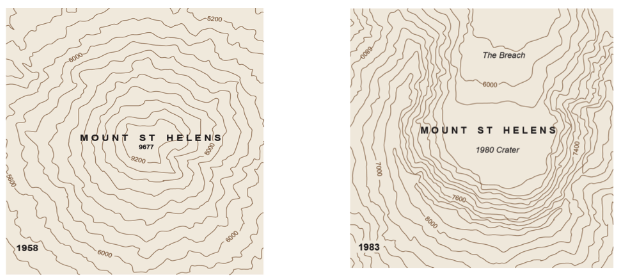
The diagrams below are topographic maps of Mount St. Helens in Washington state. They were made before and after the volcano erupted in 1980. What do these 2 maps tell us about the eruption?

The eruption melted a glacier and caused massive flooding.
The eruption blew out the north wall of the volcano’s cone.
The eruption destroyed most of the surrounding forest.
The eruption did not change the shape of the volcano.
What process in the mantle drives the movement of Earth’s tectonic plates?
Continental drift
Sea floor spreading
Pangea
Convection