8th Grade United States History: Pre-Assessment

Last updated over 2 years ago
11 questions
Read the personal account of the explosion of the USS Maine, the excerpt from the official report of the incident by the U.S. Naval Court of Inquiry, the excerpt from the March 6, 1898, front page article in the San Francisco Chronicle, the image from “Who Did It? The Maine Question” and the timeline. Then answer the questions that follow.
Untitled Section
1

Source 1
On February 15, 1898, the USS Maine exploded and sank in Havana Harbor. This account of the explosion of the USS Maine is from Lieutenant John J. Blandin who survived the blast. His account was recorded in the book History of Our War with Spain (Washington J.R. Jones, 1898).
Account of Lieutenant John J. Blandin

<1> "I was on watch, and when the men had been piped below I looked down the main hatches and over the side of the ship. Everything was absolutely normal. I walked aft to the quarter deck behind the rear turret, as is allowed after 8 o'clock in the evening, and sat down on the port side, where I remained for a few minutes. Then for some reason I cannot explain to myself now, I moved to the starboard side and sat down there. I was feeling a bit glum, and in fact was so quiet that Lieutenant J. Hood came up and asked laughingly if I was asleep. I said "No, I am on watch." Scarcely had I spoken when there came a dull, sullen roar.”

<2> “Would to God that I could blot out the sound and the scenes that followed. Then came a sharp explosion - some say numerous detonations. I remember only one. It seemed to me that the sound came from the port side forward. Then came a perfect rain of missiles of all descriptions, from huge pieces of cement to blocks of wood, steel railings, fragments of gratings, and all the debris that would be detachable in an explosion." "I was struck on the head by a piece of cement and knocked down, but I was not hurt, and got to my feet in a moment. Lieutenant Hood had run to the poop, and, I supposed, as I followed, he was dazed by the shock and about to jump overboard. I hailed him, he answered that he had to run to the poop to help lower the boats. When I got there, though scarce a minute could have elapsed, I had to wade in water up to my knees, and almost instantly the quarter deck was awash. On the poop I found Captain Sigsbee, as cool as if at a ball, and soon all the officers except Jenkins and Merritt joined us." [Editor's Note: Both Jenkins and Merritt were killed.]

<3> "Captain Sigsbee ordered the launch and gig lowered, and the officers and men, who by this time had assembled, got the boats out, and rescued a number in the water. Captain Sigsbee ordered Lieutenant Commander Wainwright forward to see the extent of the damage and if anything could be done to rescue those forward or to extinguish the flames, which followed close upon the explosion and burned fiercely as long as there were any combustibles above the water to feed them. Lieutenant Commander Wainwright on his return reported the total and awful character of the calamity, and Captain Sigsbee gave the last sad order, "Abandon Ship," to men overwhelmed with grief indeed, but calm and apparently unexcited."

<4> "Meanwhile, four boats from the Spanish cruiser ALFONSO XII arrived, to be followed soon by two from the Ward Line steamer CITY OF WASHINGTON. The two boats lowered first from the CITY OF WASHINGTON were found to be riddled with flying debris from the MAINE and unfit for use. Captain Sigsbee was the last man to leave his vessel and left in his own gig."

<5> "I have no theories as to the cause of the explosion. I cannot form any. I, with others, had heard the Havana harbor was full of torpedoes [Editor's Note: Torpedo was then a synonym for mine], but the officers whose duty it was to examine into that reported that they found no signs of any. Personally, I do not believe that the Spanish had anything to do with the disaster. Time may tell. I hope so. We were in a delicate position on the MAINE, so far as taking any precautions was concerned. We were friends in a friendly or alleged friendly port and could not fire upon or challenge the approach of any boat boarding us unless convinced that her intention was hostile.”

<6> “I wish to heaven I could forget it. I have been in two wrecks and have had my share. But the reverberations of that sullen, yet resonant roar, as if the bottom of the sea was groaning in torture, will haunt me from many days, and in the reflection of that pillar of flame comes to me even when I close my eyes."
Bibliography: Young, James Rankin, History of Our War with Spain, (Washington: J. R. Jones, 1898) 59-61.

1. Based on the information in paragraph <3> the men on the ship can best be described as (Source 1):
1

Carefully read paragraph <5>. Which statement best summarizes Lieutenant Blandin’s opinion of the cause of the explosion (Source 1)?

1

Source 2
In 1898, the battleship USS Maine was sent to Havana, Cuba, to protect U.S. interests during a Cuban revolt against Spain. On February 14, the vessel exploded and sank. Many Americans blamed Spain, and the incident helped trigger the Spanish-American War. The excerpt below is from an official report of a U.S. Naval Court of Inquiry into the sinking of the Maine. The report was released on March 21, 1898.

<1> “… [T]he vertical keel [of the ship] is broken in two and the flat keel is bent at an angle similar to the angle formed by the outside bottom plating. This break is now about six feet below the surface of the water, and about thirty feet above its normal position.

<2> . . . . In the opinion of the court, the MAINE was destroyed by the explosion of a submarine mine, which caused the partial explosion of two or more of her [ammunition storage rooms]…The court has been unable to obtain evidence fixing the responsibility for the destruction of the MAINE upon any person or persons.”

Which sentence in the official report of the U.S. Naval Court (Source 2) indicates confusion regarding who caused the explosion of the USS Maine?

1

Select the statement from Lieutenant Blandin’s report (Source 1) that refutes the opinion of the U.S. Naval Court (Source 2):

1

Source 3
This excerpt appeared as a front-page story on March 6, 1898, in The San Francisco Call.

The Call correspondent has the best of grounds for saying that Consul General Lee. . . has been quietly conducting an investigation of his own, independently of the Naval Court; that he has employed detectives who have obtained front Havana sailors evidence strongly pointing to a plot to destroy the Maine, and that he filed a report with the State Department expressing the opinion that although the Spanish Government was not in any way responsible for the Maine's destruction, it appears the work was done by Spaniards who were sympathizers of [Spain’s governor in Cuba] Weyler.”

Which statement best summarizes what the reporter wants the reader to believe regarding the sinking of the battleship Maine (Source 3)?

1

What wording from the article (Source 3) in The Call indicates there was confusion over who is responsible for the explosion of the Maine?

1

What is the relationship between Lieutenant Blandin’s account (Source 1) and the article in The Call (Source 3)?

1

Source 4
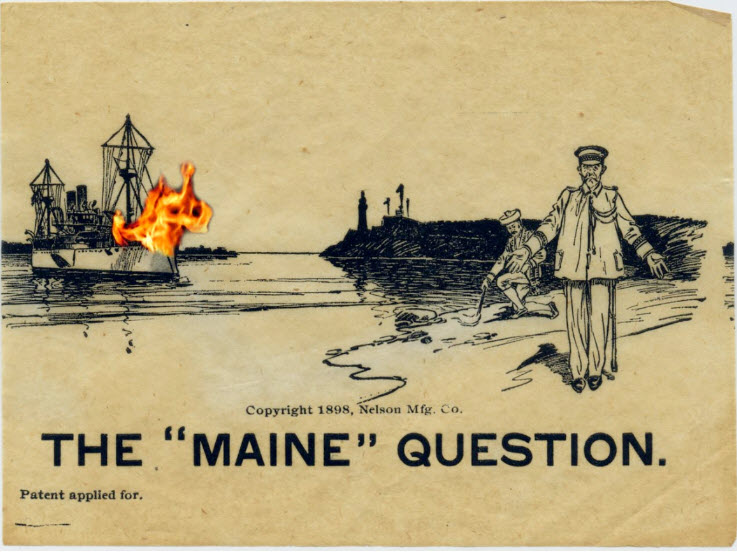
The image is from the 1898 children’s game “Who did it? The Maine Question,” a game containing an envelope, a fuse, and tiny bits of explosive powder adhered to several sheets of paper with an image of the Maine printed on them.
Carefully examine the image and answer the corresponding question.

What evidence in the image (Source 4) illustrates confusion regarding the explosion of the USS Maine?

1

“Who Did It? The Maine Question” was a children’s game created in 1898 (Source 4). The title of the game implies which of the following?

1

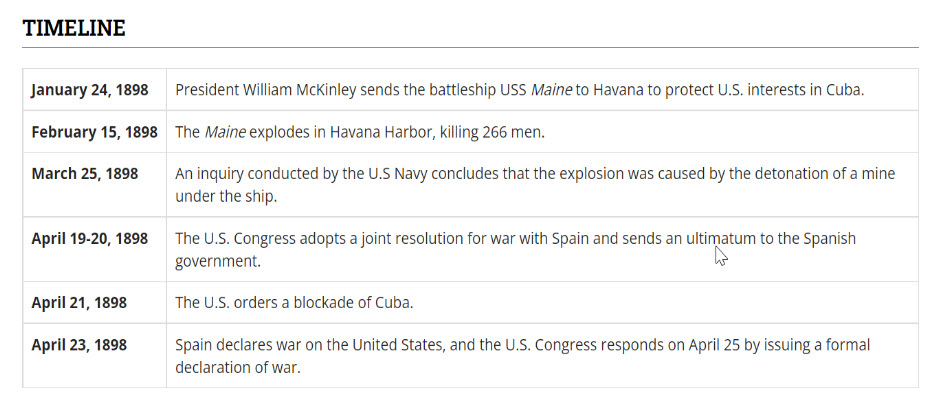
According to the timeline (Source 5), which event resulted in the U.S. issuing a formal declaration of war against Spain?

1

For this question, you will write an essay based on the source(s) and image. Your writing should:
  • Present and develop a central idea.
  • Provide evidence and/or details from the source(s) and image.
  • Use correct grammar, spelling, and punctuation.
Based on Lieutenant John Blandin’s account (Source 1), the excerpt from the official report of the incident by the U.S. Naval Court of Inquiry (Source 2), the excerpt from the March 6, 1898, front-page article in the San Francisco Chronicle (Source 3), and the children’s game (Source 4); write a letter to President McKinley in which you argue that the cause of the sinking of the USS Maine is uncertain. Be sure to use details from the personal account, the two excerpts, and the image.