1
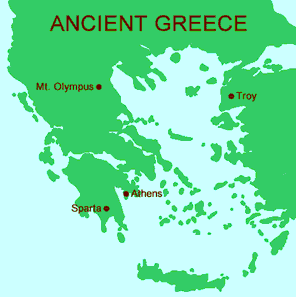
What geographic feature is shown here to identify a piece of land surrounded by water on three sides?
What geographic feature is shown here to identify a piece of land surrounded by water on three sides?
What geographic feature is shown here to identify a piece of land surrounded by water on three sides?
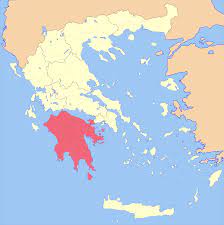
What is shaded red in this image? This is the peninsula forming the souterhn part of the mainland of Greece; Sparta is located here!
Match the following terms with the correct definition
| Draggable item | arrow_right_alt | Corresponding Item |
|---|---|---|
Aegean Sea | arrow_right_alt | An area within a country that is small like a city but acts like a country. It will have its own laws, language, army, and culture. |
city-state | arrow_right_alt | A city-state in Greece known for it's education and philosophy |
Mount Olympus | arrow_right_alt | A city-state in Greece known for having a strong army |
Ionian Sea | arrow_right_alt | Home of the Greek gods |
Athens | arrow_right_alt | This body of water separates Europe and Africa |
Mediterranean Sea | arrow_right_alt | This body of water is to the west of Greece |
Sparta | arrow_right_alt | This body of water is to the east of Greece; it is considered an "arm" of the Mediterranean Sea. |
Match the following terms with the correct definition
| Draggable item | arrow_right_alt | Corresponding Item |
|---|---|---|
Aristotle | arrow_right_alt | A Greek philosopher who developed the socratic method--questioning; sentenced to death for "corrupting Athens 'youth" |
Socrates | arrow_right_alt | way of teaching developed by Socrates that used a question-and-answer format to force students to use their reason to see things for themselve |
Socratic Method | arrow_right_alt | A greek philosopher who was the student of Socrates and teacher of Aristotle Believed in the wisest people ruling the people |
Plato | arrow_right_alt | A Greek Philosopher: he taught Alexander the Great, started a famous school, studied with Plato |
Match the following Accomplishment terms with the correct definition
| Draggable item | arrow_right_alt | Corresponding Item |
|---|---|---|
Trojan War | arrow_right_alt | The 27 year war between Athens and Sparta that Sparta won. This war left Greece as a whole weak and ready to fall to its neighbors in the north. |
Persian Wars | arrow_right_alt | An athletic competition held every four years in honor of Zeus. |
Peloponnesian Wars | arrow_right_alt | A series of wars between the Greeks and the Persians. |
Trojan Horse | arrow_right_alt | A 10 year war fought between the Mycenaean Greeks and the city of Troy (from Greek mythology). This story is famously told in the Iliad by Homer. |
Homer | arrow_right_alt | A large hollow wooden figure of a horse (filled with Greek soldiers) left by the Greeks outside Troy during the Trojan War. This technique was what allowed Greece to defeat Troy |
Olympic Games | arrow_right_alt | An Ancient Greek poet, author of The Iliad and The Odyssey. |
Match the following political terms with their definitions
| Draggable item | arrow_right_alt | Corresponding Item |
|---|---|---|
Hellenistic Period | arrow_right_alt | A style of government that gives power to the citizens to make decisions through voting. |
Alexander the Great | arrow_right_alt | A government ruled by a few powerful people |
Monarchy | arrow_right_alt | A form of government in which the ruler is an absolute dictator. This means they are not restricted by a constitution/ laws/ opposition, etc. |
Oligarchy | arrow_right_alt | A monarchy ruled by a king or queen. |
Democracy | arrow_right_alt | Between 334 and 323 BCE this man conquered the Persian Empire, reached the Indus Valley, founded many Greek-style cities, and spread Greek culture across the Middle East. |
Tyranny | arrow_right_alt | After Alexander's death, Greek art, education, and culture merged with those in the Middle East. Trade and important scientific centers were established, such as in Alexandria and Egypt. |