
We are almost finished with this research project. This part of the process is dedicated to creating the first draft of your essay. Before we write the first draft, we need to refresh our memories on a few style pointers.
The First Draft of the research paper.
How many direct quotes can you use in your research essay?

Paraphrasing is a vital skill when a writer wants to effectively make use of a specific source passage in a paper, presentation, or project. Put simply, paraphrasing is the process of re-communicating a specific source passage using new or unique words, and condensing the source ideas into a more simplified form.
In many cases, paraphrasing a source is preferable to direct quotation because it demonstrates that a writer has mastered the source material, along with allowing for a more fluid, accessible reading by the intended audience. Understanding how to effectively paraphrase will also ensure that sources are used appropriately and without plagiarism.
Read the following statements carefully:
Statement I: Paraphrasing is a vital skill when a writer wants to effectively make use of a specific source passage in a paper, presentation, or project.
Statement II: Put simply, paraphrasing is not the process of re-communicating a specific source passage using new or unique words, and condensing the source ideas into a more simplified form.
Statement III: Understanding how to effectively paraphrase will also ensure that sources are used appropriately and without plagiarism.
Which of the above Statement(s) is/are correct:

n example of an effective paraphrase might look something like the following. This example is based on a passage on page 207 of the fictitious source: Understanding Deconstruction by James Sinclare.
With the 1967 publication of his landmark text, Of Grammatology, Algerian-born French philosopher Jacque Derrida fundamentally altered the trajectory of 20th-century literary theory with the introduction of his analysis tool known as deconstruction. Unlike prior literary theories which prioritized analyzing a text exclusively from within the intended messaging of the author, Derrida argued that socio-political meanings were also found in the unspoken, unrecognized, unintended messages of a text. This process functions by assuming that words and, therefore, sentences, paragraphs, and texts, carry meanings and messages that flow well beyond the control of the author, betraying unseen biases that provide insight into the assumptions, backgrounds, and influences of the writer. This theory fundamentally altered the landscape of literary theory across western civilization.
Sample Paraphrase:
Jacque Derrida's theory of deconstruction, first published in the 1967 book Of Grammatology, changed the way western literary theorists approach a text by looking for the "unspoken, unrecognized, unintended" meanings that lie underneath the chosen words of the author (Sinclare 207).
Notice that the sample paraphrase helpfully synthesizes the paragraph into a single sentence by prioritizing the most critical ideas, and includes a quoted phrase that was important enough to cite directly. Remember that quotations are not required in a good paraphrase, but they may be used sparingly to bring greater depth or import.
What does the sample paraphrase synthesize the paragraph into?

While similar in outcome and methodology, paraphrasing and summarizing are different strategies for interacting with a source. As noted above, paraphrasing is a term used to describe the re-communication of a specific idea or set of ideas from a limited portion of a text. Alternatively, summarizing is a term applied to the act of re-communicating only the main ideas and key concepts of a source as a whole.
A source summary is offered when a writer needs to communicate the essential ideas of an entire text rather than a core idea from one portion of a text. In contrast to the example of paraphrasing above, a summary would:
identify the book or other large source to be a reference,
utilize key terms or phrases used throughout the source,
identify the key ideas from the entire book as a whole,
and connect the source material to the project at hand.
Paraphrasing allows a writer to pull key ideas from a source into a new context.
Put simply, a summary is a radical condensing of the key ideas of an entire source. As is true with a paraphrased source, even though the writer uses his or her own words to re-communicate the key information, the original source must be appropriately cited.
Often source summaries are used by writers to draw conceptual frameworks or broad thematic trends from a variety of sources into a current project. This strategy allows the writer to make use of important concepts and terms without requiring them to quote or paraphrase numerous key passages from throughout a source.
Re-communication of a specific idea or set of ideas from a limited portion of a text is paraphrasing?
A summary is a radical condensing of the key ideas of an entire source.
Read the following statements carefully:
Statement I: While similar in outcome and methodology, paraphrasing and summarizing are different strategies for interacting with a source.
Statement II: Alternatively, summarizing is not a term applied to the act of re-communicating only the main ideas and key concepts of a source as a whole.
Statement III: A source summary is offered when a writer needs to communicate the essential ideas of an entire text rather than a core idea from one portion of a text.
Which of the above Statement(s) is/are correct:

Paraphrasing is also different from directly quoting a source. In some cases, the exact phrasing of an idea or the use of specific words within a source is either too effective, unique, or essential to the writer's current project to simply paraphrase. In such instances, a writer may choose to quote a statement using the source's exact words. While paraphrasing a source provides the writer a tool for communicating the broader idea of a specific passage, quotations allow the writer to show his or her audience exactly how the source's author stated the concept or idea.
In general, a writer should seek to use direct quotations sparingly. When done correctly, direct quotations can be incredibly powerful, lending the authority and credibility of the source's author to the current project. However, if used too extensively quotations can have the opposite effect, causing the current writer to appear poorly versed in the topic or afraid of owning the ideas.
What should a writer use sparingly?
When is it best to use a direct quotation?
When used correctly, direct quotations can be incredibly powerful because it lends authority and credibility?

An effective paraphrase may be written by following a few basic steps. When paraphrasing a paragraph, a writer should:
Familiarize him or herself with the context of the paragraph (i.e., re-read and understand the chapter or section in which the paragraph is situated).
Identify the key three to four ideas within the paragraph that are most important to re-communicate.
Without looking at the paragraph, briefly restate those three to four ideas in one or two unique sentences.
Make use of quotation marks for any specific and unique terms taken directly from the paragraph.
Review the new paraphrase to ensure that it does not plagiarize the original paragraph.
And finally, ensure that the source is cited as part of the new paraphrase.
Read the following statements carefully:
Statement I: An effective paraphrase may be written by following a few basic steps.
Statement II: When paraphrasing a paragraph, a writer should: without looking at the paragraph, briefly restate those three to four ideas in one or two unique sentences.
Statement III: Make use of quotation marks for any specific and unique terms taken directly from the paragraph.
Which of the above Statement(s) is/are correct:

Plagiarism is, essentially, academic or intellectual theft and occurs when a writer takes the unique ideas or specific wording from a source and presents it as their own rather than telling the reader where it was found. Plagiarism is considered a red line in the world of academic and professional writing and can result in expulsions, fines, job or position loss, and more depending on the extent of the infraction.
Avoiding plagiarism is fairly simple, as long as a writer is intentional and careful during the composition process. A few basic rules of thumb for avoiding plagiarism are:
When in doubt, attribute the source. If a writer finds the same information in multiple sources it may be common knowledge, thus not requiring attribution. However, if the information or specific wording is not found in multiple places, it is considered good practice to cite the source of the material.
When paraphrasing, it is important to avoid similar paragraph or sentence structures, specific word sequences, or technical terminology from the source unless necessary. If you do, make sure to cite your source after stating the information
Ask another person to review a paraphrase after it is written. Having a peer, especially someone familiar with the topic, review the paraphrase will go a long way toward avoiding plagiarism.
When in doubt, what should a writer do to avoid plagiarism?

A full MLA citation consists of two main parts: the in-text citation and the works cited page citation. The in-text citation and the works cited page citation are different types of citation. Both types must be included in a paper.
The citation on the works cited page at the end of the paper contains all the required information about every source used for the paper, such as books and articles. If the reader wants to review the same source that the writer has referred to, the reader will use the works cited page because it contains all the information needed to locate it.
The in-text citation is included in a sentence within the paper itself. It lets the reader know that the author of the paper used ideas or quoted language from another source. This is an essential step to avoid plagiarism. The MLA in-text citation contains just enough information that the reader can know which source on the works cited page was used to provide the information in the paragraph.
What are the two main parts of a full mla citation?

In-text citations get their own section because of the many problems they cause. It seems easy enough - you should use an in-text citation in your paper whenever you are paraphrasing, discussing someone else's ideas, or taking a quotation from another source. Basically, when you're writing about someone else's work, it should be clear whose work it is that you're writing about. If you're writing about your own thoughts, you don't need an in-text citation. When you start writing about someone else's, you need to give them attribution or credit. This allows the reader to then find the source in the works cited list and read it for themselves if they like.
When quoting or paraphrasing information or ideas from outside sources, in-text citations are included to let the reader know the source of the information, ideas, or exact language. Quotations use the exact language from a source, enclosed in quotation marks. Paraphrasing involves rewording the ideas of another author using one's own language. In both cases, it is essential to include the author's last name and the page number of the source that contains the author's language or idea. This information is enclosed in parentheses, like this: (Quinn 169).
These two pieces of information are usually included at the end of the sentence that contains the cited idea and should be placed before the period:
When Poe attended West Point, cadets were prohibited from keeping novels, poetry, or books that were unrelated to their studies, unless they had special permission (Quinn 169).
Alternatively, when the author's name is included as part of the sentence, the in-text citation will include only the page number:
Quinn notes that when Poe attended West Point, cadets were prohibited from keeping novels, poetry, or books that were unrelated to their studies, unless they had special permission (169).
As Quinn has observed of Poe's poem ''Fairyland'', "The remainder of the poem is an almost impish fancy of Poe's, pretending to criticize the very imaginative conception he has just established" (164).
The reader only needs the author's last name and page number because the works cited page will contain a full citation for the source.
In-text citations can vary depending on the number of authors.
When a source has two authors, both authors' last names are included in the in-text citation, like this: (Woodward and Bernstein 34).
If there are three or more authors, only one name is needed and should be followed by "et al.": (Franck et al. 287).
For sources with no known author or editor, the title can be used in place of an author's name: ("Hand-Eye Development" 15).
What can be used in place of an authors name for sources with no known author or editor?
What should be followed by the name of the author if there are three or more authors?
When a source has two authors, both authors' last names are included in the in-text citation?
Normally, with a book source, you use the author's name and page number. Because websites don't always have authors, use whatever comes first in your citation, be it the author's name, the title of the page, or the title of the website. You do not need to use a page or paragraph number with the website.
Therefore a citation would look like the following in a sentence: Cats enjoy sleeping for many hours a day (Fitzgerald).
You only use the last name when using the author's name.
If there is no author listed, use a shortened form of the title. Try to stick to 3 or 4 words that will lead the reader directly to the citation at the end. If you are using the page title (because the author's name is not available), it would look like the following sentence: Cats enjoy sleeping for many hours a day ("Sleeping Habits of Felines").
If there is no author listed, use what form of the title?
How many words should you try to stick to when creating a shortened title?

The Works Cited Page Sources are cited in MLA style so that a reader can find the same work if they are so inclined, and the MLA Handbook discusses the “core elements” that should appear (and the ORDER they should appear) for a source in any works cited list. I believe that it is easier to understand these “core elements” in the context of actual examples, and it’s important to remember that every citation won’t contain all (or even most) of the “core elements.” I outline them here (including the punctuation that follows each) as an aid to understanding why elements of a citation are in the order they’re in:.
1. Author. - This is the creator of the work, and could be a writer, artist, group, or organization. Individuals are presented last name first, then the full first name (and middle initial, if provided). For multiple (and anonymous) authors of the work, see the examples below.
2. Title of source. - The title is placed in quotation marks if it’s part of a bigger piece of work (like a chapter in a book or an episode of a television series). It is italicized if it is “self-contained” (like a whole book, or collection of poetry, or entire television series). If there is no title for a work, a description is provided (e.g. marble sculpture).
3. Title of container.- A container is what holds the source you are using in your paper. So, if the source is an online video on YouTube, then YouTube is the container. Similarly, a newspaper (like the New York Times or Wall Street Journal) is the container for a newspaper article, and a journal is the container of a journal article.
4. Contributors. - This can refer to everything from the directors of movies to the translators of books to the performers in a play. Sometimes they’re listed, sometimes not, depending on the context and the focus of the paper.
5. Version. - For some sources, it’s important to know the version used. For example, the Bible could be presented in the King James version (KJV), the New International version (NIV), the Christian Standard version (CSB), and about a dozen others. The reader should know what version you used in your paper.
6. Number. - This could refer to a volume and/or issue number for a journal or the season and episode number for a television series.
7. Publisher. - This could be something obvious, like the publisher of a book, or something less obvious, like the studio that produces movies or television series.
8. Publication date. - The same source is sometimes published at different times in different mediums. For example, a magazine or newspaper article could come out earlier on the magazine or newspaper’s website. You would report the publication date of the source you used, usually in the format of date, month (abbreviated), and year (20 Dec. 2019).
9. Location. - This is a “jargony” way of saying page numbers. So a newspaper article might appear in section C, page 3 of a physical newspaper, and be cited as “p. C4” (but not in quotes!). If a source takes up multiple pages (like in a book or a journal), it is preceded by “pp.” (pp. 34-63). For performances viewed in person (such as a play or concert), the location is where the performance took place. For websites and sources located in a digital network, URLs and DOIs are provided (see examples below).
Supplemental Elements. - The date the information was accessed is included in a citation where there is no date provided for when the information was posted or if the source has been altered or changed. This information is provided at the end of the citation in the form of date, month, and year (Accessed 31 Oct. 2021.)
A note about the number of authors As can be seen in the “core elements” above, the author of a source comes first in a citation.
If there is only one author, they are listed last name first, then a comma, then the rest of their name (as presented in the source). For example, my favorite book of all time is Ernest Hemingway’s The Sun Also Rises, and the original print edition would be cited as: Hemingway, Ernest. The Sun Also Rises. Scribners, 1926.
What about a source with TWO authors? The first author is listed the same way (last name first), but the second author is written out as you would normally write a name (first name first). Here’s an example of the famous book by the Washington Post journalists who broke the story about the Watergate break-in that brought down President Nixon in 1972: Bernstein, Carl, and Bob Woodward. All the President’s Men. Simon & Schuster, 1974.
What about a source with THREE OR MORE authors? While this would be more common with a journal article or a translation, I’d like to use a book example with three authors to keep things congruent. But who writes a book with two other people? Well, in 2016, three New York Times bestselling authors, Karen White, Beatriz Williams, and Lauren Willig worked together to release a historical fiction novel called The Forgotten Room. As you can see in the example below, things simplify quite a bit when a source has three or more authors, with the first author listed (last name first) followed by the phrase “et al.” (which means “and others”): White, Karen, et al. The Forgotten Room. Penguin, 2016. Note: The same rules apply to every other type of work with multiple authors.
Online Media - Websites The term “website” can cause confusion because it is so all-encompassing. For example, most journal articles are available online, and we cite them slightly differently depending on whether we used a physical print journal or an online database to access them. However, there are many sources which we can only access online, and that’s mostly what I mean by “websites.” A consideration when using websites as sources is whether they would be judged to be “legitimate.” There are times when information from a website may be the most up-to-date source for a particular topic. Information from sources like the Mayo Clinic (mayoclinic.org), the National Institute of Mental Health (nimh.nih.gov), and the Centers for Disease Control and Prevention (cdc.gov) are credible and cover a variety of topics. I also admit to having a soft spot for Science Blogs (scienceblogs.com) and the brilliant Cecil Adams at The Straight Dope (straightdope.com).. Articles from websites can also be confusing because sometimes an article has an author, sometimes there is an organization that is the “author,” and sometimes there’s no author (or date) provided for the source. Each of these situations is presented below:
Website article with an individual author (or two). The problem with websites is that unlike research journals, they are not peerreviewed, and so any author can pretty much write anything, and who knows if it has any validity? However, many students will use information from websites to provide examples and anecdotes for their paper. The citation for an article from a website contains the same “core elements” as any other source - author(s), title of the material (in quotes), source (or “publisher”) of the material (in italics), the date the information was posted (if available), and retrieval information (the URL).
One and two author examples follow:
One author: McIntosh, James. “What is a Stroke? What Causes Strokes?” Medical News Today, 5 Sept. 2014, www.medicalnewstoday.com/articles/7624.php#treatment_ and_prevention. De Silva, Matthew. “Need a New Year’s Resolution? Here’s What It’s Like to Quit Facebook.” Quartz, 31 Dec. 2019, www.qz.com/1776702/thinking-aboutquitting-facebook-heres-what-its-like.
Two authors: Paddock, Michael, and Connie Nordqvist. “What is Claustrophobia? What Causes Claustrophobia?” Medical News Today, 26 Sept. 2014, www.medicalnewstoday. com/articles/37062.php.
Website with no author or date Sometimes people just throw things up on the web without any author or publication date, but don’t despair! Remember that the works cited list is for the reader to be able to find a source you used in your paper, and so you should provide the information you have access to.
For example, here’s an authorless, undated general article on retiring to Costa Rica (a retirement goal of mine): “Living in Costa Rica.” International Living, www.internationalliving.com/countries/ costa-rica/live. Accessed 14 May 2021.
Note: The date the information was accessed is included in a citation when there is no date provided for when the information was posted or if the source has been altered or changed.
Website with a group author
The information from sources such as the Mayo Clinic (mayoclinic.org), the National Institute of Mental Health (nimh.nih.gov), and the Centers for Disease Control and Prevention (cdc.gov) usually comes from a “group author,” meaning the organization itself. In the two examples, the “author” and “publisher” are the same organization, and so the “publisher” information can be omitted.
Centers for Disease Control and Prevention. “Stroke Facts.” 6 Sept. 2017, www.cdc.gov /stroke/facts.
National Institute of Mental Health. “Post-Traumatic Stress Disorder (PTSD).” May 2019, http://www.nimh.nih.gov/health/topics/post-traumatic-stress-disorder-ptsd/ index.shtml.
Type your rough draft in Google Docs. Then, share the document by giving your teacher access, and copying and pasting the share URL here. Your first draft needs to be in MLA with a Works Cited Page.
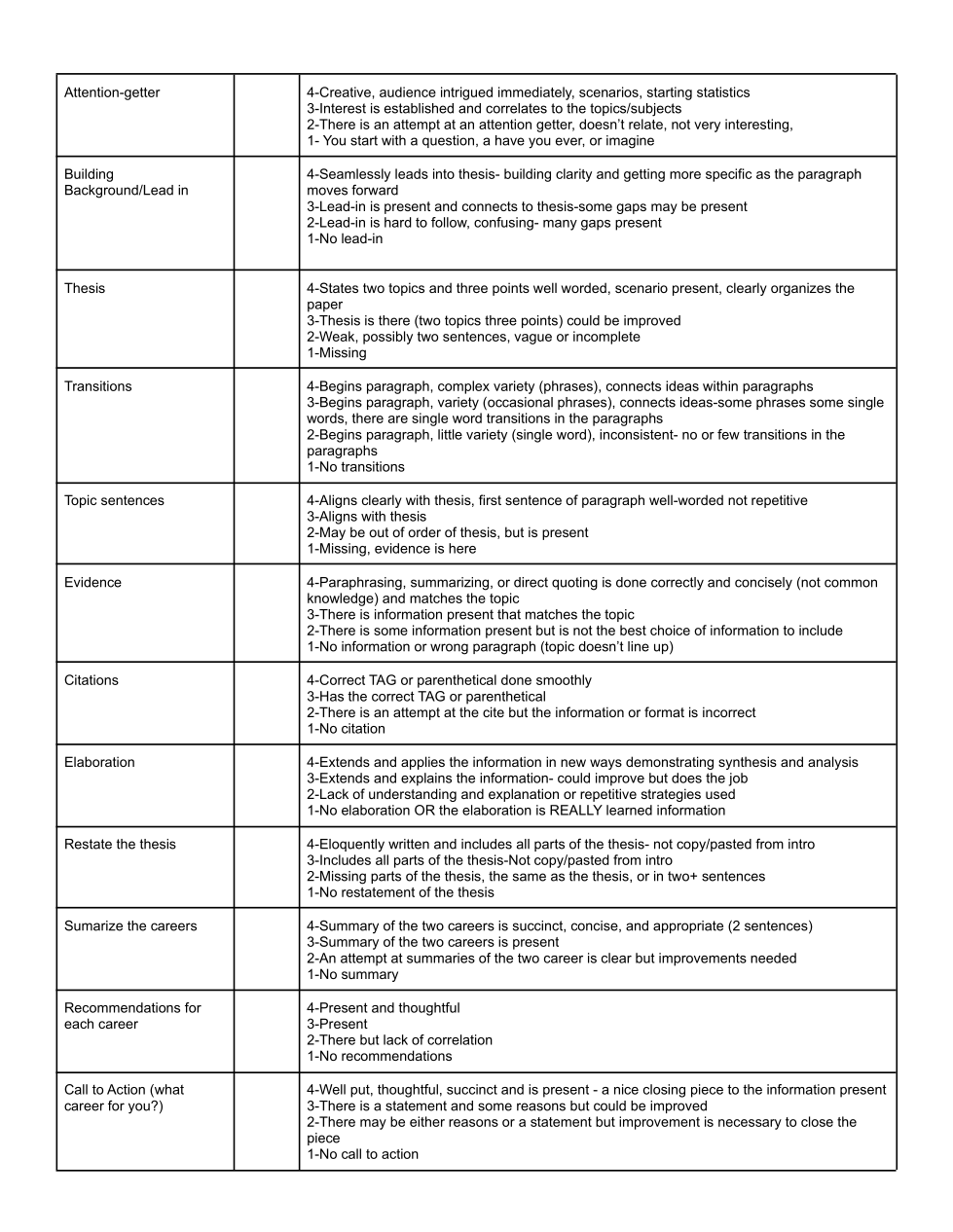
Attention-Getter
Building Background/Lead in
Thesis
Transitions
Topic sentences
Evidence
Citations
Elaboration
Restate the thesis
Summarize the careers
Recommendations for career(s)
Call to action