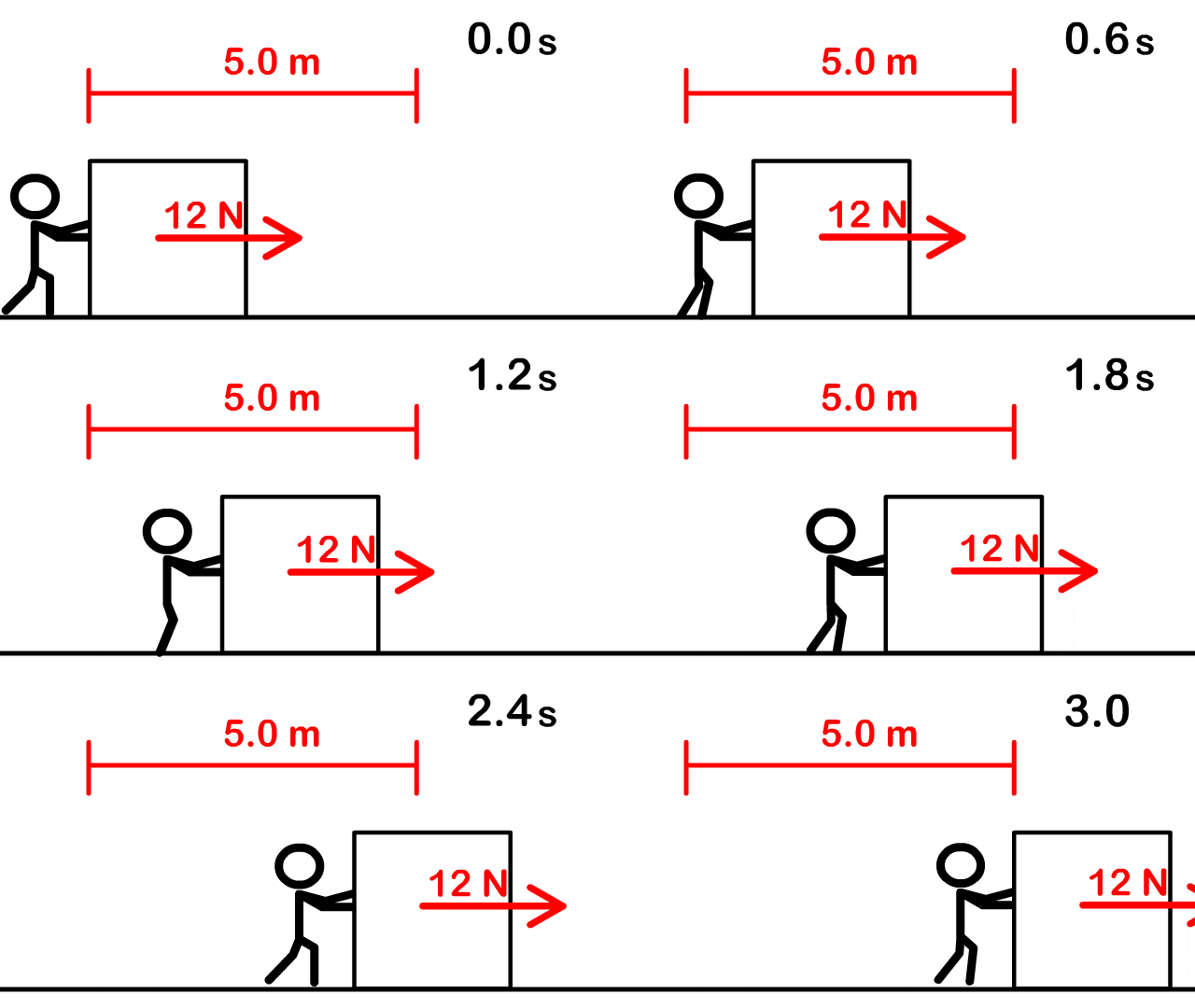
Describe how you know that work was done in this GIF.
Describe how you know that work was done in this GIF.
Describe how you know that work was done in this GIF.
The amount of force (to a point) while pulling the car up the hill at an increasing angle. The work that was done .
Match the 'Example' to the appropriate classifciation:
there was no force to cause the dispalcement
force directly caused the displacement
the item sits on the shelf with 40J of Potential Energy
there was zero displacement
vertical displacement was 4m, the horizontal force was 20N
Work Was Done
No Work Was Done
Calculate the work done by a 40-N force (directed at a 20° angle to the vertical) to move a 5-kilogram box a horizontal distance of 500 cm across a rough floor at a constant speed of 0.7 m/s. (Make sure you show your work for partial credit!)
If you double the amount of displacement of a spring relative to its equilibrium position, then you the PEspring.
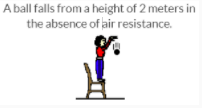
There is a ball that is 55m above the zero line that has a mass of 55kg. The ball current PEgrav =
When you quadruple the speed of an object, you its KE by a factor of .
When you reduce the speed of an object by a factor of 3, you its KE by a factor of .
Determine the kinetic energy of a 70-kg roller coaster car that is moving with a speed of 11.1 m/s.
Olver Weightver, the former platform diver for Harrison, had a kinetic energy of 11,000 J just prior to hitting the Pool. If Olver's mass is 100 kg, then what is his speed?
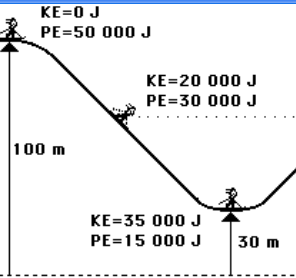
Describe a way that the skier could increase their height to be above 100m at the next hill?
Classify this example.
An electrical circuit is simply an energy tool.
How much does it cost to power an induction stove that draws 6 amps of current for 32minutes and 45 seconds when plugged into a 240-volt outlet? ( Remember, Centerpoint charges you about $0.16/kWh)
(There are multiple ways to get the correct answer, justify with your shown work!)
Predict the appropriate use of parallel or series circuits.
burglar alarm
less wires
GFCI recepticals
want a failure to not affect all devices/bulbs
need the components to have the same voltage
want a failure to affect all devices/bulbs
Series Circuit
Parallel Circuit
Match the left definition with the appropriate term on the right.
measure of the resistance to electrical flow
measure of how much electricity is being pushed
= V/R
= I*R
measure of the electrical push through a wire
= V/I
Ohms
Current
Volts
Explain what was discovered in Ethan's cord length experiment.
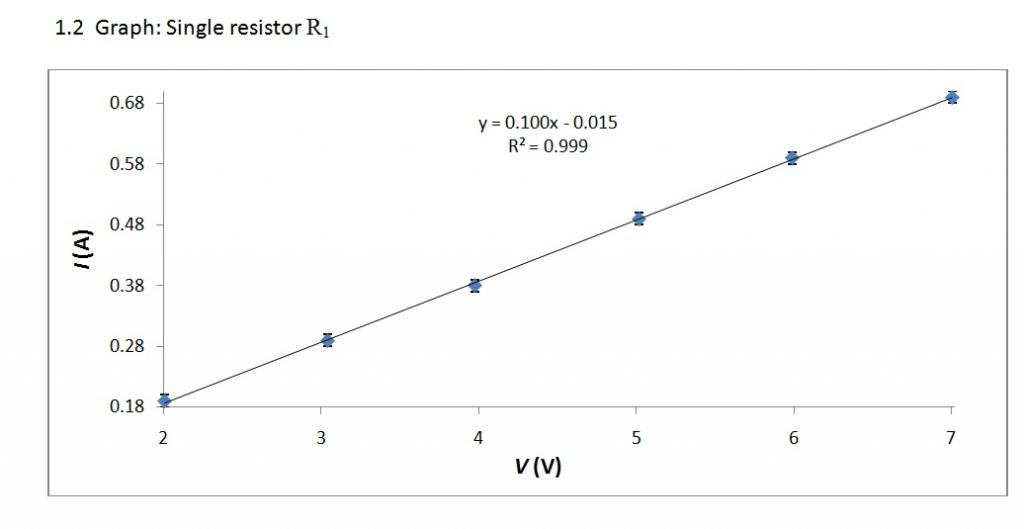
Calculate the Ohms of the single resistor using this graph.
Where is the electrical resistance the highest?

What can affect electrical resistance?

Describe the motion using the following key terms correctly:
Resting Position
Equilibrium
Restoring Force
Damping
On the graph, demonstrate all 4 amplitudes.
In your own words, describe periodic motion using a rocking chair as a reference.
On the graph, demonstrate ONE cycle.
Based on your findings from the 'Mass on a Spring' Lab, predict what would happen to the period.
...the period increases | ...the period decreases | |
|---|---|---|
As damping increased... | ||
As stiffness decreased... | ||
As mass decreased... |
Based on your findings from the 'Predict the Pendulum' Lab, predict what would happen to the frequency.
...the frequency increases | ...the frequency decreases | |
|---|---|---|
As gravity increased... | ||
As the string length decreased... | ||
As mass decreased... |
A pendulum is observed to complete 36 full cycles in 2 minutes 10 seconds. Determine the period of the pendulum.
A pendulum is observed to complete 36 full cycles in 2 minutes 10 seconds. Determine the frequency of the pendulum.
A mass is tied to a spring and begins vibrating periodically. The distance between its highest and its lowest position is 60 cm. What is the amplitude of the vibrations?
Using the pendulum swing in the picture, visually represent the change in period and frequency if:
The mass of the yellow ball INCREASED.
As a transverse wave travels through a rope from left to right, the parts of the rope _____.
For a longitudinal wave, the particles of the medium move ______ to the direction that the wave moves.
The frequency of a wave describes _____.
The wavelength of a wave increases if the ______.
A sound wave is a pressure wave; regions of high (compressions) and low pressure (rarefactions) are established as the result of the vibrations of the sound source. These compressions and rarefactions result because sound
A sound wave is different than a light wave in that a sound wave is
Drag and drop each of the following items to the correct category.
considered 'nodal'
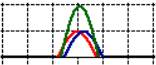
two upward pulses traveling in opposite directions within a medium
considered 'anti-nodal'
an upward and downward pulse traveling in the same direction within a medium
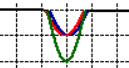
two downward pulses traveling in the same direction within a medium

an upward and downward pulse traveling in opposite directions within a medium
Constructive Interference
Destructive Interference
Neither
What seperates noise from music?
Pictured here is the formula we used in our resonance lab with the PVC pipes:
Explain each part of the formula and its purpose.
A harmonic ...
A blue light wave approaches a mirror at 40degrees, which means that the light wave will reflect off the mirror at _____ degrees.
Where could you find all of the visible light in the EM Spectrum?
Explain why a piece of paper would appear reddish-orange when hit with ROYGBIV light.