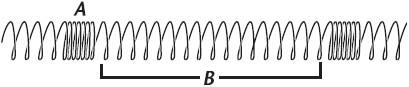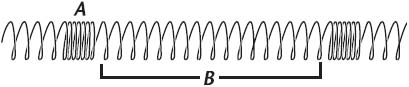
What type of mechanical wave is produced by the action of this coiled spring?
What type of mechanical wave is produced by the action of this coiled spring?
The maximum distance that the particles of a medium move from the rest position is the
The distance between two corresponding parts of a wave is the wave’s
The speed of a wave is its wavelength multiplied by its
Electromagnetic waves can transfer energy without a(n)
Why do you see lightning from a distant storm before you hear thunder ?
Mechanical waves are created when a source of energy causes a medium to
An electromagnetic wave consists of
How many properties of waves are there?
In a longitudinal wave moving along a spring, areas where the coils are farthest apart are
called
The highest point of a transverse wave is called
The more
In the phenomenon known as the
The
The
Energy transferred from electromagnetic waves through matter and space is called electromagnetic radiation.
The three types of mechanical waves are transverse waves, latitudinal waves, and surface waves.
Frequency is measured in units called hertz.
Dividing the distance a wave travels by the time it takes to travel that distance gives you the wave's speed
The height of a wave's trough depends on its amplitude.
Waves that require a medium through which to travel are called electromagnetic waves.
What type of mechanical wave is produced by the action of this coiled spring?
Name and describe the parts of the wave labeled A and B.
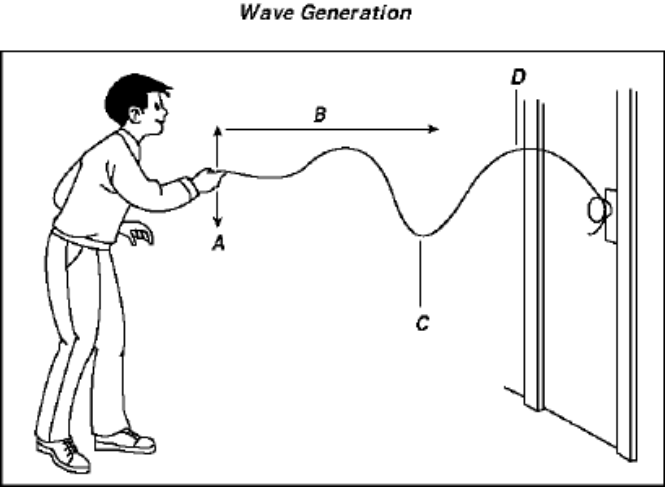
What kind of wave is being generated?
Look at diagram above. In what direction does the medium move relative to the direction of the wave? Explain.
Look at diagram above. What does the person transfer to the rope by pulling it up and down at point A?
Compare and contrast the motions of ocean waves with the motions of longitudinal and transverse waves.
Compare how polarized light is different from non-polarized light.