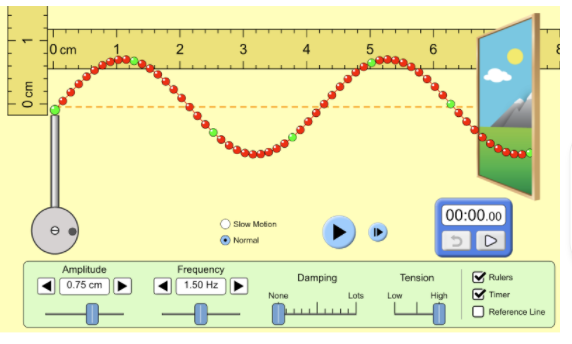
A wave is known to have a frequency of 1.5 Hz, wavelength of 4.0 cm, and amplitude of 0.75 cm when it is on high tension. Try the problems, then use the simulation to check your answer if you need to.
This is an original activity not a cloned activity from the NGSS Patterns Physics curriculum. This is an extra practice opportunity, or could be used as a quiz.
A wave is known to have a frequency of 1.5 Hz, wavelength of 4.0 cm, and amplitude of 0.75 cm when it is on high tension. Try the problems, then use the simulation to check your answer if you need to.
Identify the crest.
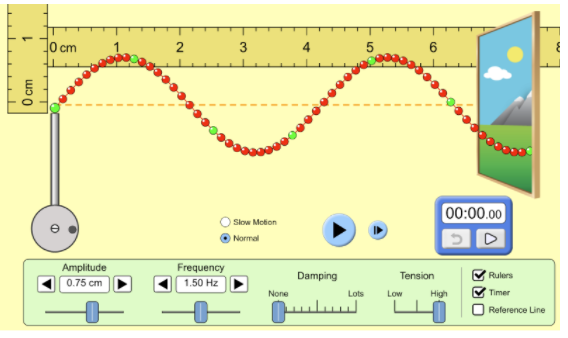
Identify the trough.
Identify the equilibrium.
Identify the wavelength.
Identify the amplitude.
If the amplitude of the wave is doubled, the wave will have a resulting frequency that is:
If the frequency of the original wave is doubled, the wave will have a resulting amplitude that is:
If the frequency of the original wave is doubled, the wave will have a resulting wavelength that is:
If the amplitude of the wave is doubled, the wave will have a resulting velocity that .
Using the information for the original wave, the wave velocity is:
A bat chasing a moth emits a sequence of three chirps (speed of sound = 350 m/s) every 0.010 seconds and later hears the echos of the chirps as detailed in the diagram.
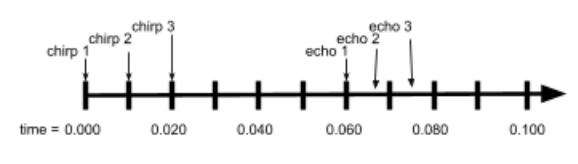
Estimate how much time passed between the first chirp and the return of the first echo.
Estimate the relative distance to the moth when the bat hears the first echo.
Estimate the relative distance to the moth when the bat hears the third echo.
Describe the relative motion of bat and the moth.
What could you infer if the bat heard echo 1 first in his left ear, then echo 2 simultaneously in both ears, and then echo 3 first in his right ear?
What could you infer about the moth if the echo was louder versus quieter at the same location?