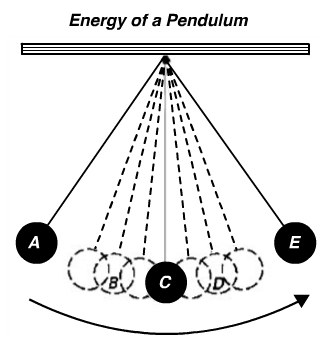
If the pendulum is allowed to continue to swing, it will eventually come to a stop. Explain
why.
If the pendulum is allowed to continue to swing, it will eventually come to a stop. Explain
why.
The ability to do work or cause change is called
Energy is measured in units called
What type of energy does a spinning turbine have?
An example of something that stores chemical energy is
What type of energy transformation is taking place when natural gas is used to heat water?
Which of the following has kinetic energy?
Potential energy that depends on height is called
The rate at which energy is transferred is called
How would you calculate an object’s mechanical energy?
Energy stored in the nucleus of an atom is called
Nuclear fusion reactions occur in
A large truck and a small car are moving at the same speed. The truck has greater kinetic energy because its
A change from one form of energy to another is called a(n)
A mountain climber at the peak has
To maintain your body temperature, your body converts chemical potential energy into
As water runs over a waterfall, its potential energy is converted into
The law of
Mechanical energy is associated with the motion, position, or
The kinetic energy of a book on a shelf is equal to the work done to lift the book to the shelf.
Whenever a moving object experiences friction, some of its kinetic energy is changed into thermal energy.
Energy can be neither destroyed nor created.
A compressed spring has elastic potential energy.
In a machine, work output is less than work input because some energy is converted into thermal energy.
A nuclear reaction in which the nuclei of atoms join together is called nuclear fission.
Explain why a thrown football has both potential and kinetic energy. What is the combined energy called?
If the pendulum is allowed to continue to swing, it will eventually come to a stop. Explain
why.
Describe the energy of a bowling ball as it rolls toward and hits a bowling pin.
Name and describe 4 different forms of energy.