4.3 Quiz

Last updated over 3 years ago
18 questions
1

Unpolarised light of intensity I0 passes through a polariser and then through an analyser rotated at 60° from the polariser. The intensity of the light exiting the analyser is IA. Calculate the ratio:
IA/I0

1

A candle lights a darkened room, emitting a wave of amplitude A. At a distance d, the intensity is I.
A second candle emits a wave of amplitude 2A. At what distance from this candle would you need to stand to measure an intensity I?

1

A dark room is lit by a candle. At a distance d from the candle, the measured intensity is I. What will the measured intensity be at a distance 2d from the candle?

1

A student practises their public singing. Their sound currently carries an energy of value, E, to the back of the room.
If the student then sings twice as loud, what will the energy carried by the sound waves be?

1

What is the angle between rays and wavefronts, in degrees? Give your answer without unit.

1

Which of the following facts about polarisation is correct?

1.Light can be polarised by reflection from a metallic surface.

2.When light is polarised by reflection, the plane of polarisation is perpendicular to the reflecting surface.

3.When sound is reflected from a non-metallic surface, the reflected wave will be partially polarised.

4.When light is reflected from a boundary between two materials, it will be 100% plane polarised when the reflected and the refracted ray are perpendicular.

1

A source emits radiation, such that the intensity is 70.0W⋅m−2 at a distance of 130m from the source. For a wave of double the amplitude, at what distance from the source will the intensity be double that of the original wave? Give your answer in metres, to three significant figures

1

Below is a wavefront diagram for a source of radiation with period 350ms
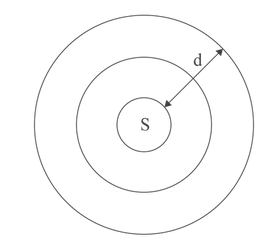

If the speed of the wave is 0.240m⋅s−1 , what is the value of d, in cm? Give your answer to three significant figures.
1

Unpolarised light is incident upon two polarisers, which have an angle of θ between the planes of polarisation. If the original intensity is 300W⋅m−2, and the final intensity is 62W⋅m−2, what is the value of θ, to the nearest degree? Assume negligible change in distance from source. Give your answer without a unit.

1

A speaker is rated at 200.W and creates sound waves spherically around it. Determine the intensity of the sound waves at a distance of 1.0m in front of the speaker. Leave your answer without units and give it to 2 significant figures.

1

A speaker is rated at 200W and creates sound waves spherically around it. Susan stands 1m from the speaker, Polly stands 2m from the speaker. What is the ratio of the intensity of the sound wave recorded by Polly to the intensity of the sound wave recorded by Susan? Give your answer to two significant figures.

1

A sound source is heard with an intensity of 0.20W⋅m−2 at a distance of 18.5m away. What is the ratio of the intensity at a distance of 18.5m  to the intensity at 26.5m? Give your answer to three significant figures.

1

Progressive (travelling) waves S and T have the same frequency and are in the same medium. S has amplitude 2.0m and intensity IT has an intensity of 4I. What is the amplitude of T? Give your answer in metres, to two significant figures and without a unit.

1

A transverse wave of amplitude of A and frequency f gives an intensity of I at a distance x from a point source. By what factor does the intensity change if the amplitude is doubled and the distance to the source is halved?

1

The intensity of plane polarised light, at 30∘ to the vertical is I. After passing through an analyser at 60∘ to the vertical, what is the intensity measured?

1

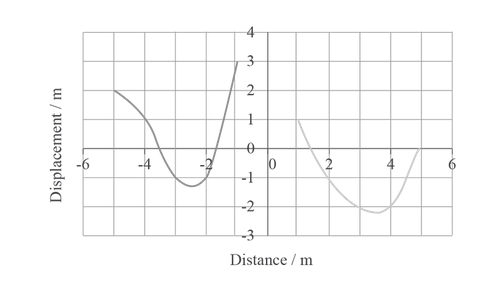
Both the pulses below are moving at 0.5m⋅s−1
towards each other. All distances where there is no line shown on the graph have a zero displacement.


What is the displacement from the equilibrium position at a distance of 1m, after 4s passed? Give your answer in metres, to one significant figure and without a unit.

1

Polarized light is incident on a polarizer before it is observed. Which of the following is a possible angle from the direction of the polarized light (in degrees) for which the polarizer could be oriented such that the intensity of observed polarized light is reduced to one-fourth of its original value?

1

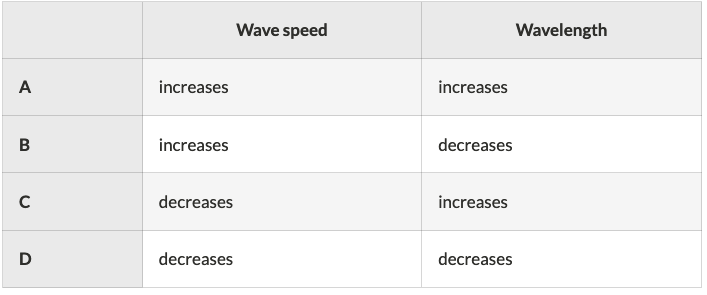
When a sound wave enters a denser medium, what happens to the wave speed and wavelength?