Log in
Sign up for FREE
arrow_back
Library

Chemical equilibrium combined

star
star
star
star
star
Last updated about 1 year ago
20 questions
Required
1
Required
1
Required
1
Required
1
Required
1
Required
1
Required
1
Required
1
Required
1
Required
1
Required
1
Required
1
Required
1
Required
1
Required
1
Required
1
Required
1
Required
1
Required
1
Required
1
Question 1
1.

Question 2
2.

Question 3
3.

Question 4
4.

Question 5
5.

Question 6
6.

Question 7
7.

Question 8
8.

Question 9
9.

Question 10
10.

Question 11
11.

Question 12
12.

Question 13
13.

Question 14
14.

Question 15
15.

Question 16
16.

Question 17
17.

Question 18
18.

Question 19
19.

Question 20
20.

Hydrogen gas and iodine gas are introduced into a flask, which is then sealed and allowed to reach dynamic chemical equilibrium.
The balanced equation is:

H2(g) + I2(g) ⇌ 2HI(g).

Which one of the graphs shows how the rates of the forward and reverse reactions change with time?
Which of the following is true regarding the concentration of products, for a chemical system at equilibrium?
The concentrations of products will not change because there are no more reactants.
The concentrations of products will not change because the limiting reagent is gone.
The concentrations of products will not change because the forward and reverse rates are equal.
The concentrations of products will change continually because of reversibility.
For the following system at equilibrium, which statement is INCORRECT?

Only one reaction will be affected by a change in temperature
It is a homogeneous equilibrium
The forward reaction is exothermic
The total change in enthalpy for the products is -184 kJ
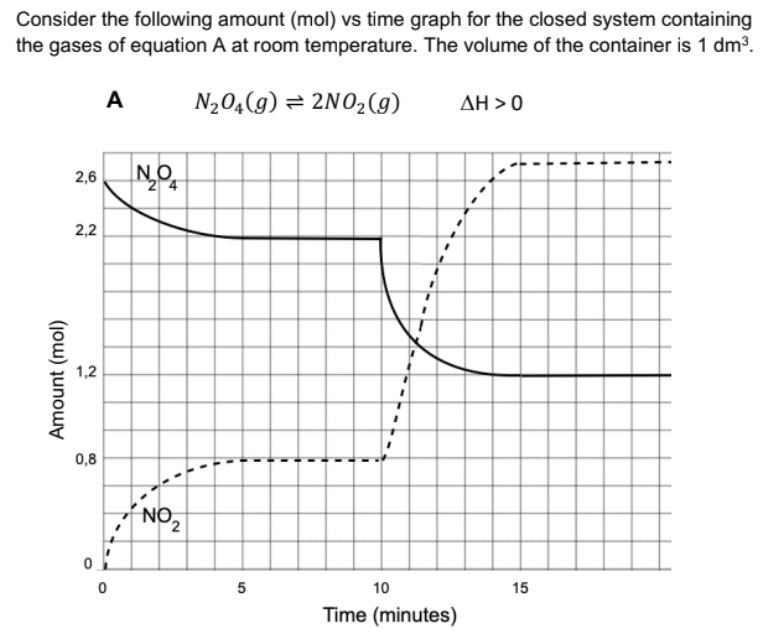
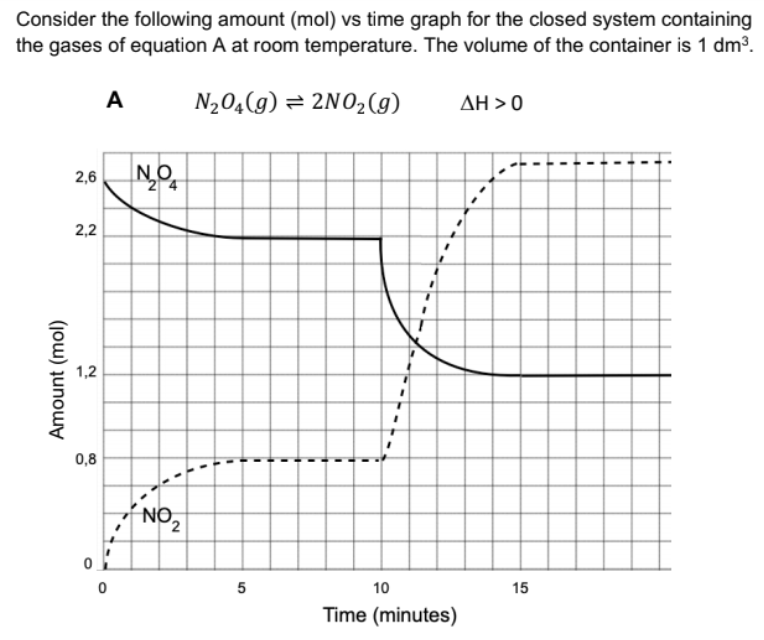
Consider the amount (mol) vs. time graph for the closed system containing the gases of equation A at room temperature. The volume of the container is 1 dm3.
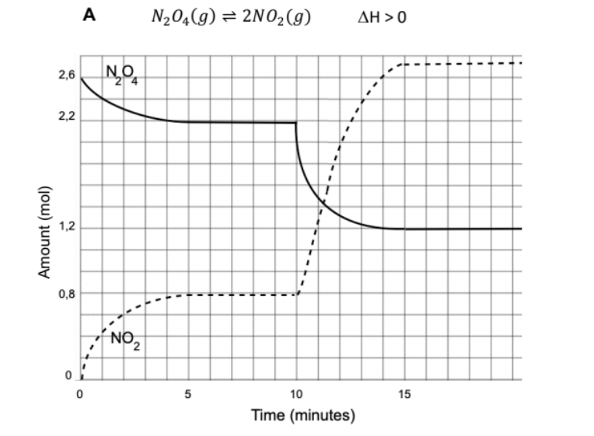
At which of the following time(s) is the the system NOT in equilibrium?
7 min
15 min
12 min
3 min
18 min
A disturbance to temperature was made at 10 minutes. Which reaction was favoured?
reverse reaction
forward reaction
Therefore, considering your answer above, what temperature change was made at 10 minutes?
Temperature was increased
Temperature was decreased
Given the following system at equilibrium:

The addition of Cl- ions will cause the concentration of Ag+(aq) to
Decrease as the amount of AgCl(s) increases
Increase as the amount of AgCl(s) increases
Decrease as the amount of AgCl(s) decreases
Increase as the amount of AgCl(s) decreases
Given the following system at equilibrium:


Increasing the concentration of N2(g) will increase the forward reaction rate due to:
An increase in the number of effective collisions
A decrease in the number of effective collisions
A decrease in the activation energy
An increase in the activation energy
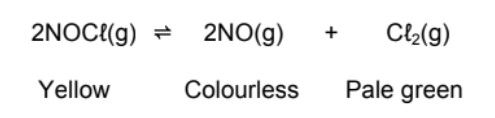
Consider this system at equilibrium:

What colour could the gas mixture possibly be at equilibrium?
none of these
pale green
greenish yellow
all of these are possible
yellow
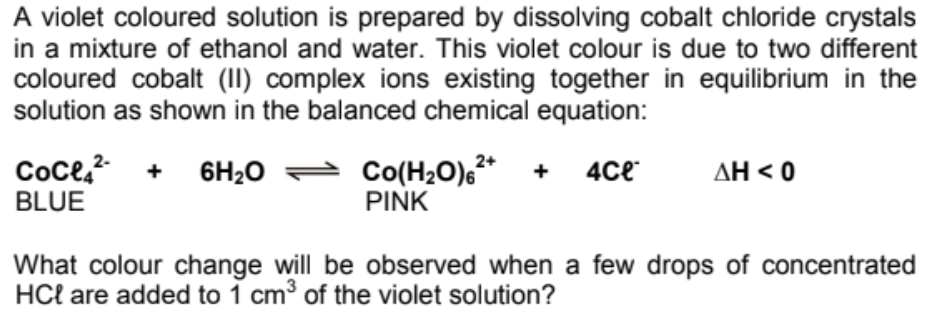
No colour change occurs
The solution turns more pink
The solution turns more blue
The solution turns colourless
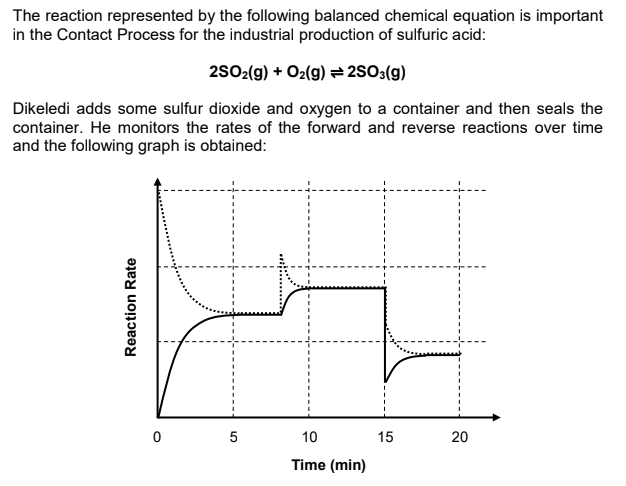
What disturbance was made at 8 minutes?
SO2 was added into the system
SO2 was removed from the system
SO3 was removed from the system
SO3 was added into the system
What disturbance was made at 15 minutes?
Temperature was decreased
Temperature was increased
SO3 was removed from the system
SO3 was added into the system
Which reaction was favoured at 15 minutes?
Reverse reaction
Forward reaction
Increasing the pressure in a gaseous system at equilibrium causes .....
The reverse reaction rate to increase
All of these options are correct
The forward reaction rate to increase
The concentration of the gases to increase
Consider the Haber reaction system at equilibrium.


What happens when pressure is decreased?
The yield of ammonia increases
The reverse reaction is favoured.
Nitrogen gets used up more quickly
The reverse reaction speeds up
Consider the following system in equilibrium.


Pressure is increased by reducing the volume of the container.
What does NOT happen as a result?
All of these things happen as a result
The forward reaction is favoured
All the gases increase in concentration
Both reaction rates increase
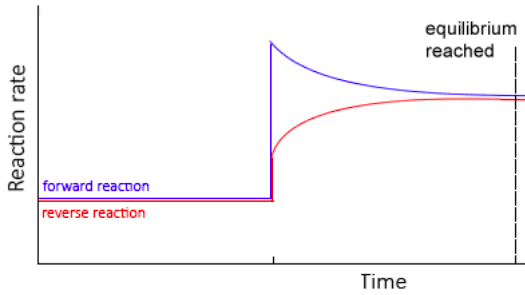
Consider the following graph.
What is NOT a possible cause of the disturbance?
Increase in concentration of reactants
Increase in pressure
Increase in temperature
Decrease in volume
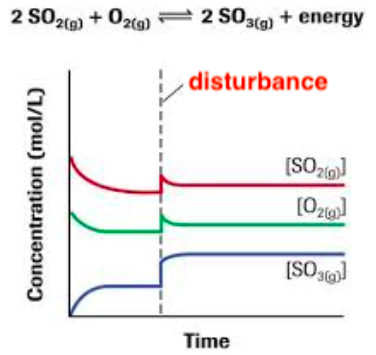
Consider the following system at equilibrium which experienced a disturbance.


What was the disturbance?
An increase in temperature
An increase in pressure of the system
A increase in concentration of the system
An increase in the volume of the system
What is the equilibrium constant Kc expression for the following balanced equation?