Log in
Sign up for FREE
arrow_back
Library
APUSH Period 7.3 (Ch. 33-34) Quiz - SY22
By Haiyen Truong
star
star
star
star
star
Share
share
Last updated over 1 year ago
11 questions
Add this activity
1
IICI.01
KC 7.3.I
WOR 2.0
1
IIUR.01
KC 7.3.II
WOR 2.0
1
KC 7.3.II
RPU.01
WXT 2.0
1
IIUR.01
KC 7.3.I
WOR 2.0
1
KC 7.2.II
SQN.01
WXT 2.0
1
IICI.01
KC 7.3.II
1
IICI.01
KC 7.3.III
WXT 1.0
1
KC 8.1.I
RAG.01
WOR 2.0
1
IIUR.01
KC 7.3.III
WXT 2.0
1
IIUR.01
KC 7.3.III
WXT 2.0
0
Question 1
1.
Review:
With the outbreak of World War I in 1914, the great majority of Americans
favored entering the war in support of the Allies.
earnestly hoped to stay out of the war.
supported the Central Powers.
wanted to form a military alliance of neutral nations.
Chapter 33:
Franklin D. Roosevelt and the Shadow of War (1933-1941)
Question 2
2.
America’s fervent isolationism in the 1930s can best be attributed to
their regrets about participating in WWI.
the totalizing impact of the Great Depression and the need to focus on getting out of it.
All of these answers are correct.
the failure to recognize the gravity of the militaristic and expansionist threat posed by the Fascist dictators of Germany, Japan, and Italy.
Question 3
3.
The purpose of the Lend-Lease Act was to
were ready to fight Germany but not Japan.
lend money to impoverished farmers.
provide military supplies to the Allies.
create military bases outside the borders of the United States.
Question 4
4.
In sharp contrast to WWI, in the aftermath of Pearl Harbor in WWII, Americans were
provide subsidies to railroads and businesses.
ready to use conscription, if necessary, to raise an army.
nationalize major industries.
nearly unanimous in support of the war.
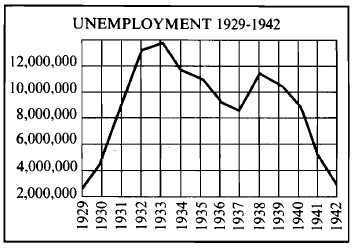
Questions 5 refers to the following graph.
Question 5
5.
Which of the following was most responsible for the change shown between 1938 and 1942 on the chart above?
A global economic boom following the Great Depression
The illness and death of unemployed workers
Industrial mobilization related to the Second World War
Legislation of the second New Deal
Chapter 34:
America in World War II (1941-1945)
Question 6
6.
Which of the following best describes the experience of Americans of Japanese descent during the Second World War?
The Department of the Army repatriated them forcibly to Japan.
They were forced to take loyalty oaths along with Americans of Italian and German descent.
The Supreme Court intervened to protect them from wartime hysteria.
They were forced from their homes and businesses on the West Coast into detention camps.
Question 7
7.
The bracero program encouraged
federal courts to protect the civil rights of Mexican Americans in the 1960s.
Latino immigrants to pursue United States citizenship.
the United States media to broadcast Latino music and movies in the 1980s.
Mexican workers to come to the United States as temporary laborers from the 1940s to the 1960s.
Question 8
8.
All of the following have been cited as reasons for the dropping of atomic bombs on Japan in 1945
EXCEPT
the need to
demonstrate American superiority in weaponry to the Soviet Union.
block a planned Japanese invasion of the United States
save American lives.
force the unconditional surrender of Japan.
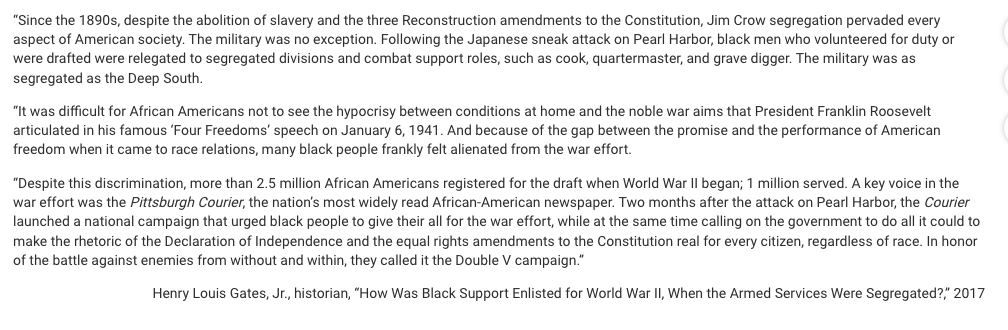
Questions 9-10 refer to the following excerpt.
Question 9
9.
Which of the following best explains how actions such as those described in the excerpt affected wartime mobilization?
The economic crisis deepened as a result of military spending.
The public widely rejected the internment of Japanese Americans.
Many women experienced new economic and social opportunities.
Immigration declined because of improving unemployment rates.
Question 10
10.
Which of the following best explains a result of the developments described in the excerpt?
Many African American men preferred to remain as sharecroppers rather than enlist in the military.
The United States government allowed African American enlistment only after the attack on Pearl Harbor.
New employment opportunities opened up for African Americans in industrial and defense industries.
African Americans entered the military because they could not find employment owing to the Great Depression.
Question 11
11.
Congrats on finishing the final Mastery assessment of Period 7 (1890-1945)!
The AP U.S. History Exam is one week away (Friday, May 6th, 2022). How are you feeling?
visibility
View drawing