Intro to Probability Lesson
star
star
star
star
star
Last updated about 3 years ago
37 Nsɛmmisa
1
1
1
1
1
1
1
1
1
1
1
1
1
1
1
1
1
1
1
1
1
1
1
1
1
1
1
1
1
1
1
1

1
If you had to describe what probability means to someone... what would you say?
Order these events in order from LEAST likely to happen to MOST likely to happen
The fire alarm will go off during 5th period
It will snow tomorrow in Carlsbad
I drive to 7-11 at any time and the store will be open
You find a random student and the chances that student is wearing shorts
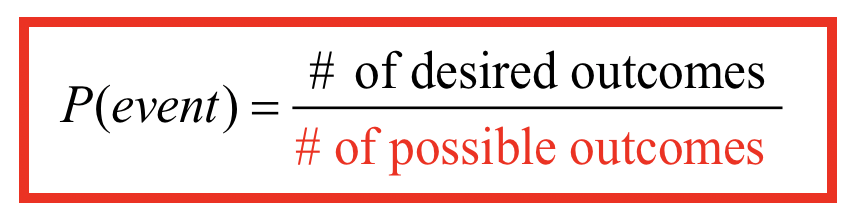
Probability means how likely it is that an event will happen
And this is how we can find it when there is a random event
This can be written as a fraction, or a decimal, or a percent!
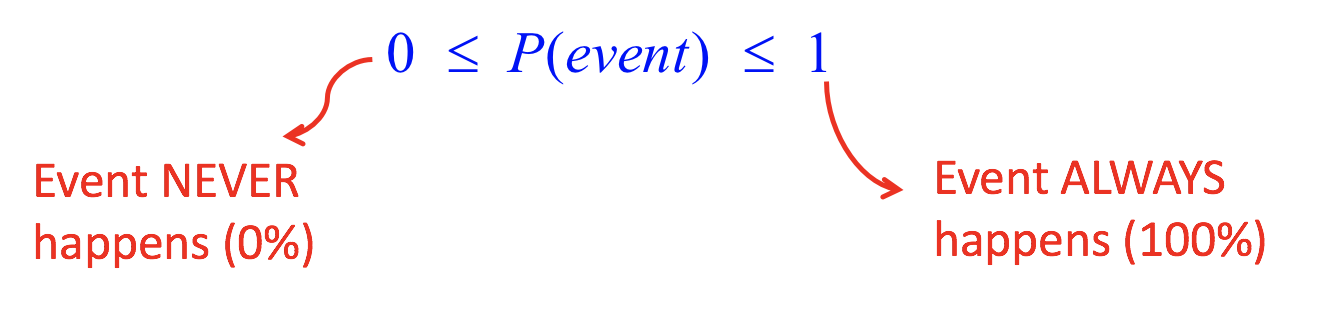
A probabilty is always between 0 and 1 (or 0 and 100%) that it will happen
Lets say we flip a coin. What is the probability that we flip a coin once, and it lands on heads?
We can write this as P(heads), or the probability of landing on heads
What would this be as a fraction?
What would this be as a decimal?
Let's try a little harder!
Let's say we roll a 6-sided dice once.
Find each of the following
P(rolling a 3)
P(rolling an odd number)
write as a fraction or round to 2 decimal places
Each student in a class of 27 gets a raffle ticket. If I pick one raffle ticket, what is the probability that your name will be chosen?
P(your name is picked) as a fraction?
as a decimal (rounded to 3 decimal places)
as a percent
A Complement Event can be useful sometimes.
This happens when there are only 2 outcomes.
The complement of an event happening is that event NOT happening.
For example...
The complement of passing your math test is NOT passing your math test.
Notice the notation.
If you add the probability of an event happening and the probability of that event NOT happening, what will they add up to?
Shooting a basket and making it
What is the P(E')? That is, what is the complement event?
You roll two dice and get doubles. What is the complement event?
If you select one marble at random, what is P(picking a red marble)
Lets say we want to find the probability of picking a marble other than blue??
What is the complement event of picking a marble other than blue?
Lets say we want to find the probability of picking a marble other than blue??
Lets use the complement to find this
Since the 2 probabilites have to add to 1, we can use
P(picking other than blue)=1-P(picking a blue)
So what would the probability be of picking a marble other than blue?
Write as a fraction
Your favorite restaurant is closed the first day of each month. Find the probability of going to the restaurant on any random day and it being open?
Use the complement to find P(restaurant being open)
Write as a fraction
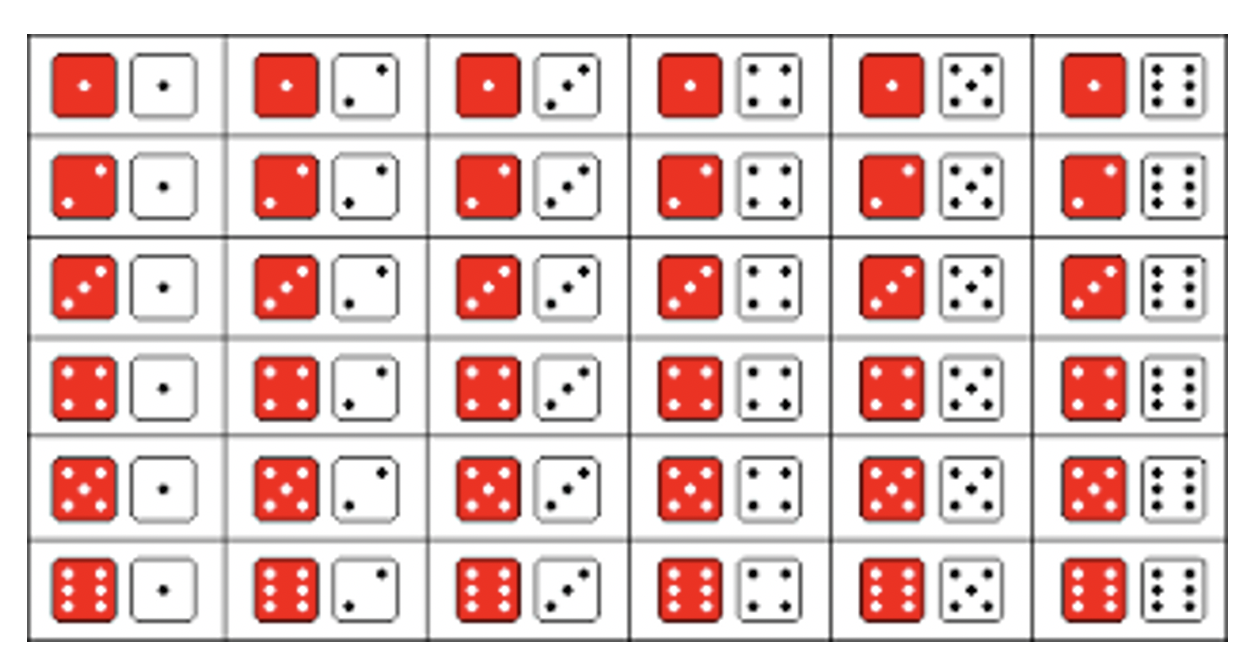
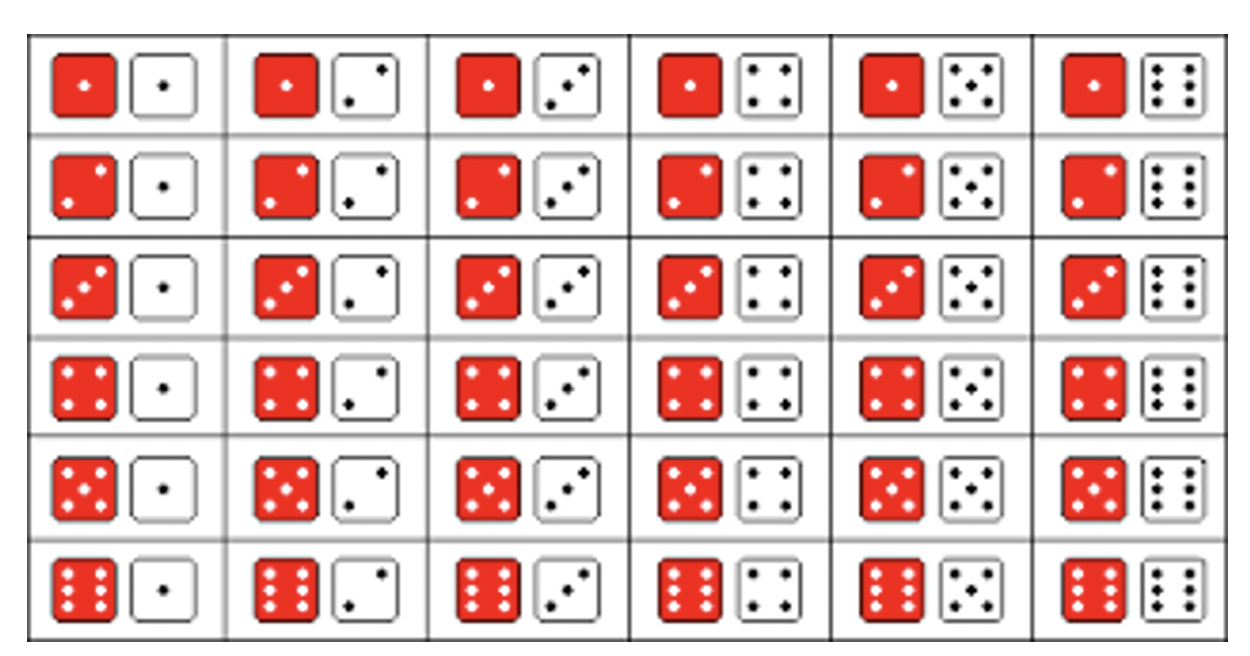
A list of all possible outcomes is called your SAMPLE SPACE
When you roll two dice at the same time, this is your sample space
If you roll 2 dice, find the probability of each.
Write each as a fraction using /
Make sure to reduce each fraction
P(rolling 2 dice and your total adding up to 2)
P(3)
P(4)
P(5)
P(6)
P(7)
P(8)
P(9)
P(10)
P(11)
P(12)
P(rolling doubles)
After looking at the probabilities for each, what number would have been the best bet for the horse races???
P(getting one head and one tail when tossing a coin twice)
it might help to write out your sample space
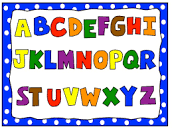
P(Drawing a letter from alphabet and getting a consonant.)
*Use the complement and write as a fraction
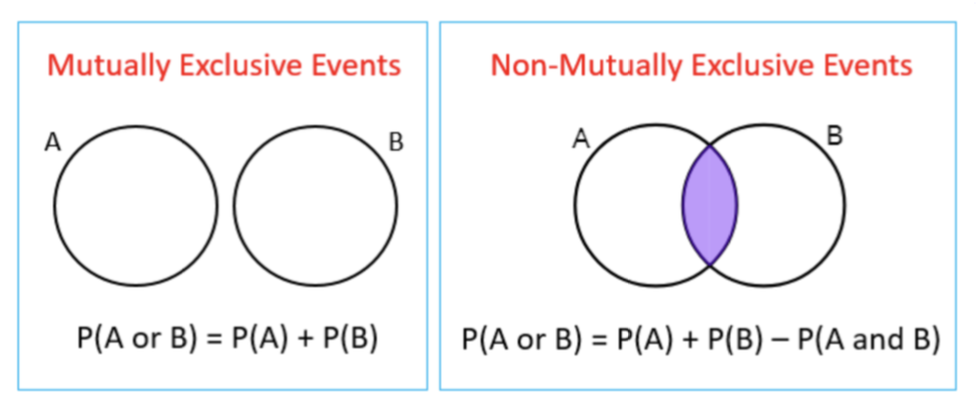
Events are mutually exclusive if they CANNOT happen at the same time. Think exclusive
If this happens, we have to take into account the overlap!
Are the events mutually exclusive? (think can they happen at the same time? If so, they are NOT exclusive)
Flipping a coin and getting heads. And flipping a coin and getting tails
Are the events mutually exclusive?
Rolling a dice and getting a 4, and rolling a dice and getting an odd number
Are the events mutually exclusive?
Rolling a dice and getting a 4, and rolling a dice and getting an odd number
Are the events mutually exclusive?
Rolling 2 dice. Getting doubles, and getting a total of 10
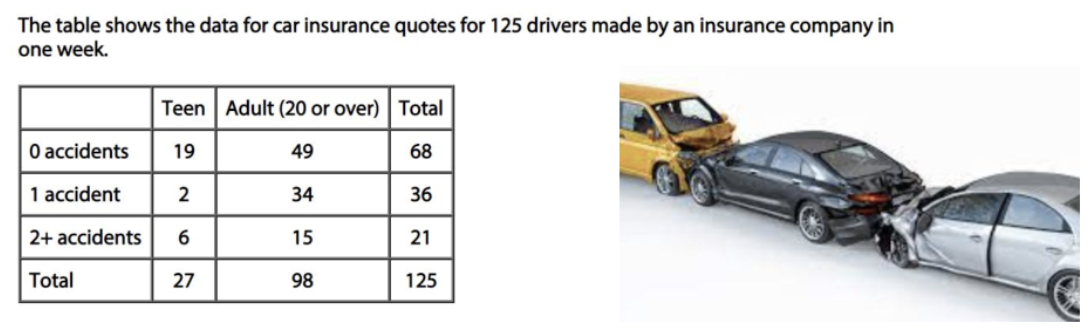
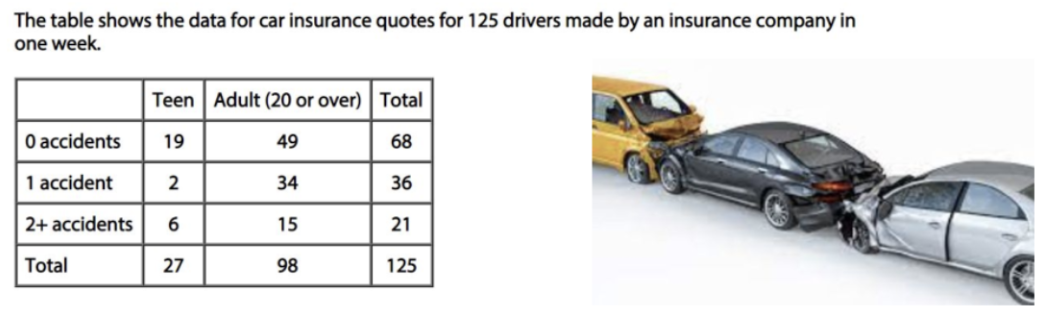
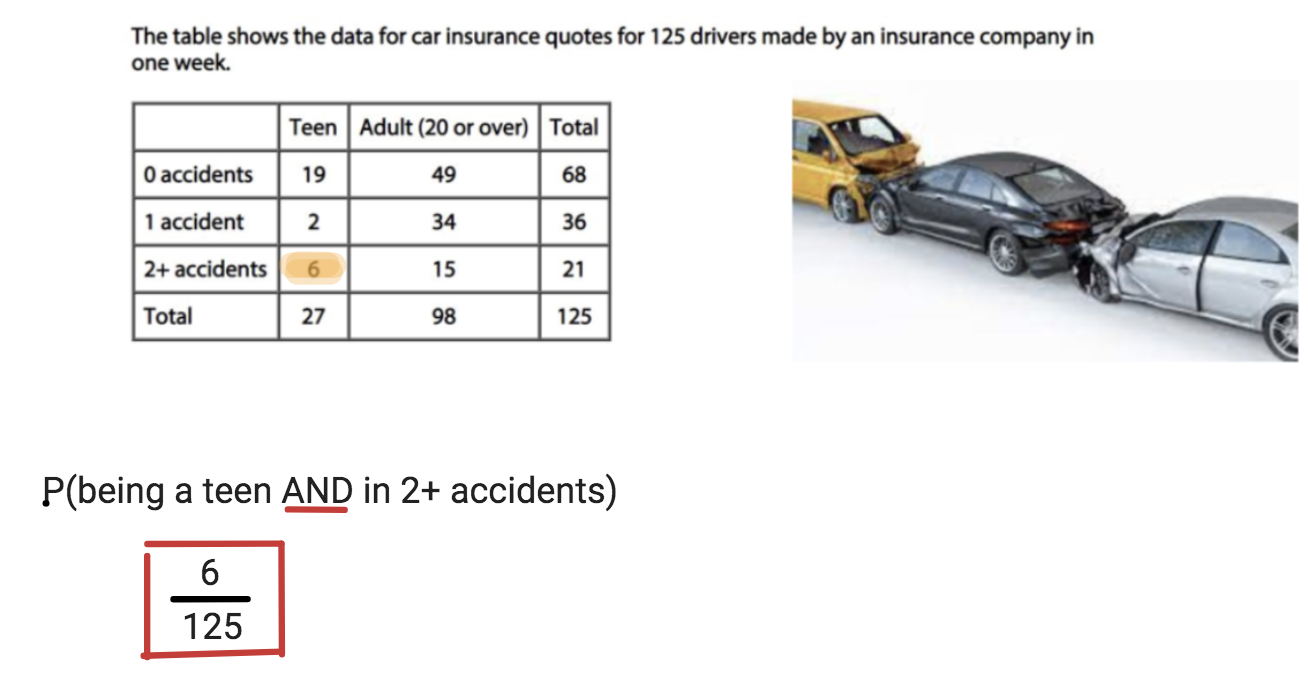
Use this for the next few questions
How many total drivers were there?
How many drivers had 2+ accidents
How many drivers were teens?
What is the probability that a driver picked at random is an adult over 20?
remember, this would be the number of adults/TOTAL number of drivers
Are the events mutually exclusive or overlapping
being in 1 accident and being in 2+ accidents
What is the probability that a driver was in 1 accident OR 2+ accidents
(write as a fraction)
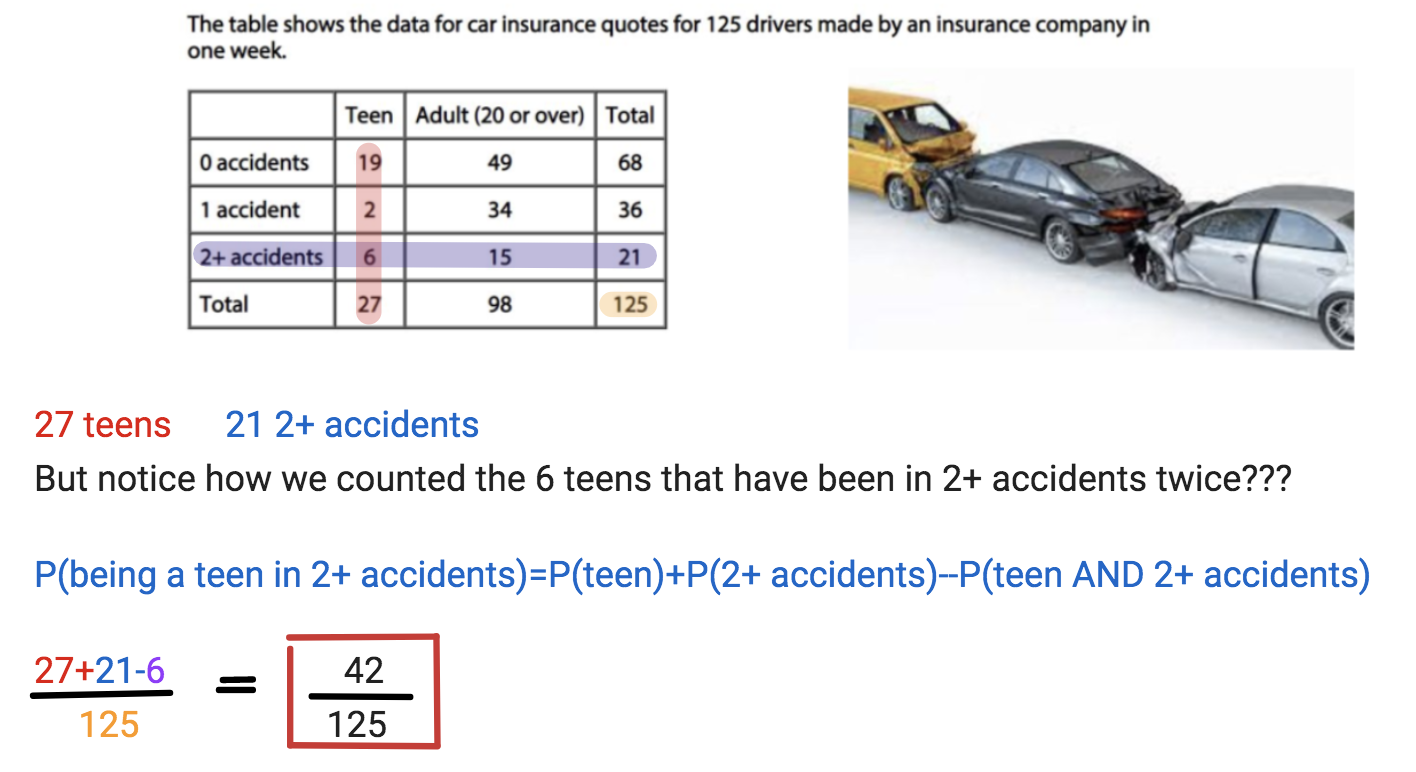
Are being a teen and being in 2+ accidents mutually exclusive?
Find the probabilty of being a teen OR has been in 2+ accidents
Because of this overlap, we have to make sure not to count it twice!!!
You try !
P(0 accidents)
P(being an adult or having 0 accidents)
If we are looking for AND, then we are just looking for the overlap
P(adult AND has never had an accident)
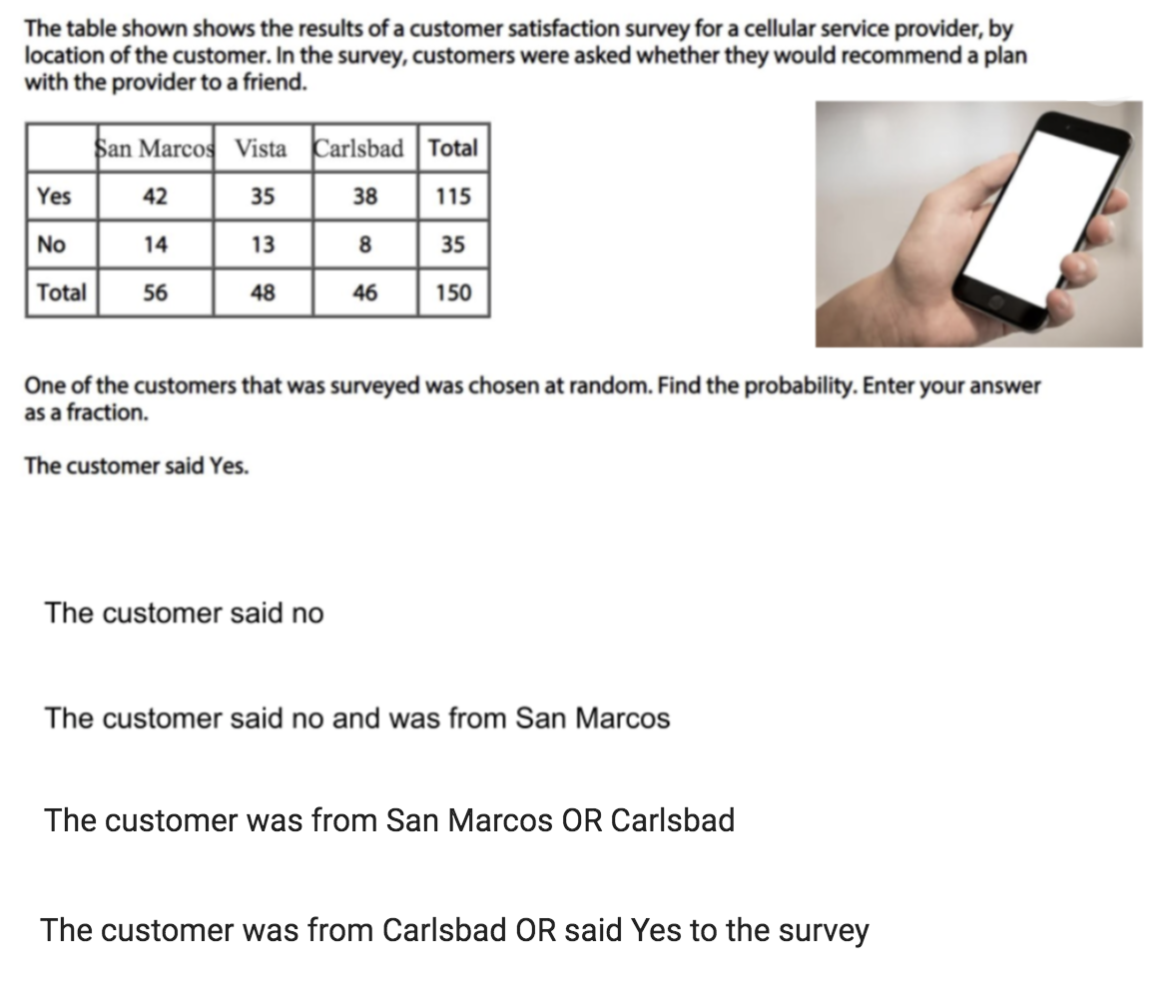
P(customer said no)
P(no AND from San Marcos)
P(was from san marcos OR Carlsbad)
P(from carlsbad OR said YES)
You have 26 letters in a hat, and you draw 1 letter at random.
What is the probability that you choose a letter in the word "Love" or "algebra"