Log in
Sign up for FREE
arrow_back
Library

Chapter 3 Review

star
star
star
star
star
Last updated almost 4 years ago
74 questions
1
1
1
1
1
1
1
1
1
1
1
1
1
1
1
1
1
1
1
1
1
1
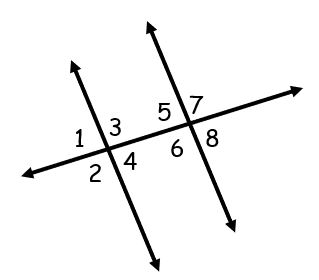
Use the diagram below for the next 5 questions.
1
1
1
1
1
Question 6
6.

Question 7
7.

Question 8
8.

Question 9
9.

Question 10
10.

Question 11
11.

Use the diagram below for the next 3 questions.
1
1
1
Use the proof below for the next 5 questions.
1
1
1
1
1
Question 20
20.

Two lines that are not coplanar and do not intersect are called?

Use the points below for the next 2 questions.

(2, 5) and (-4, 8)
1
1
Use the points below for the next 2 questions.

(-3, -7) and (-3, 4)
1
1
1
1
1
1
1
1
1
1
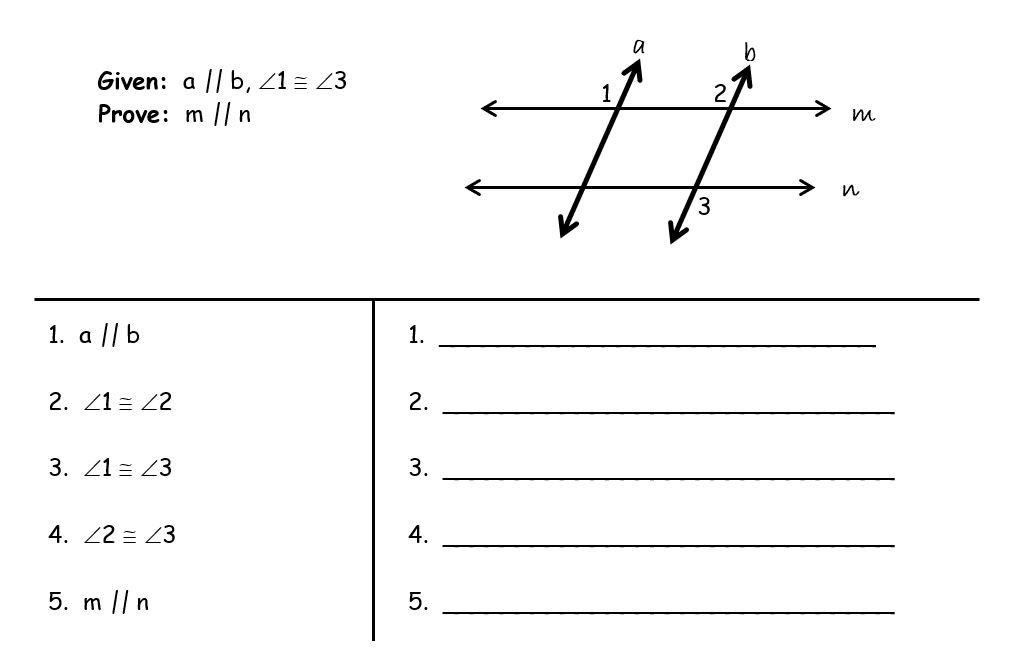
Use the proof below for the next 5 questions.
1
1
1
1
1
Use the diagram below for the next 3 questions.
1
1
1
Use the linear equation below for the next 2 questions.

1
Question 41
41.

1
Use the linear equation below for the next 2 questions.

1
Question 43
43.

1
Question 45
45.

Write the equation of a line with a slope of 8 and a y-intercept of -1/2.

Question 46
46.

Write the equation of a line that passes through the point (2, 3) and has a slope of -2.

Question 47
47.

Write the equation of a line parallel to y = 1/4x + 2 through the point (12, -5).

Question 48
48.

Write the equation of a line perpendicular to y = 1/4x + 2 through the point (12, -5).

Question 49
49.

Question 50
50.

Question 51
51.

Question 52
52.

Use the lines below for the next 2 questions.

Line 1: (10, 7) and (13, 9)

Line 2: (-4, 3) and (-1, 5)
1
1
1
Use the lines below for the next 2 questions.

Line 1: (2, -3) and (7, -1)

Line 2: (1, 9) and (3, 4)
1
1
1
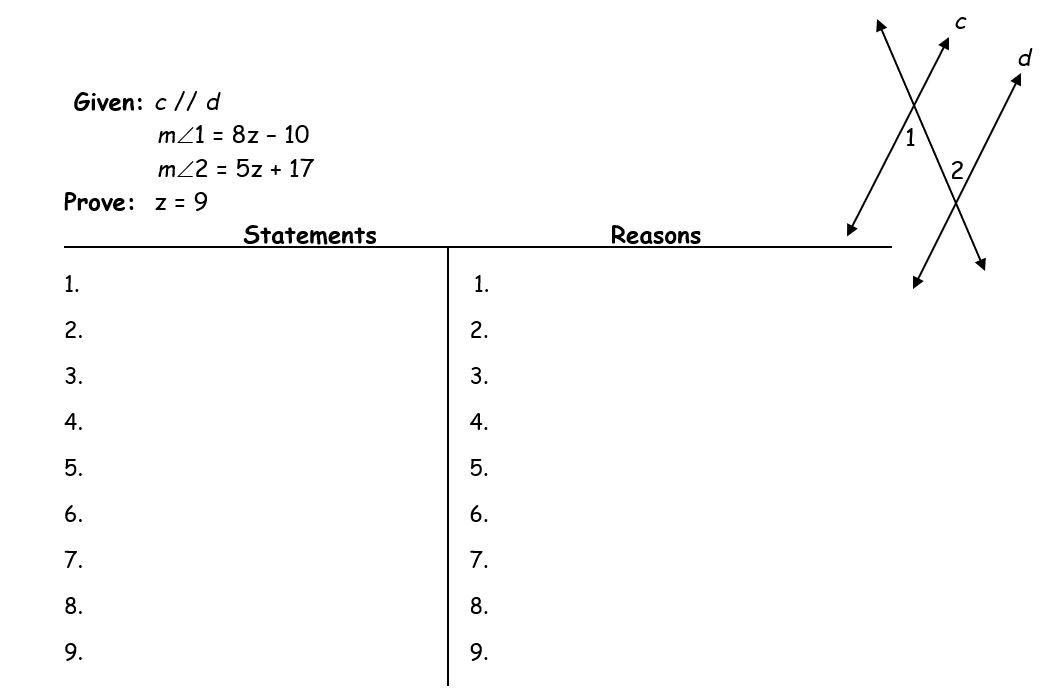
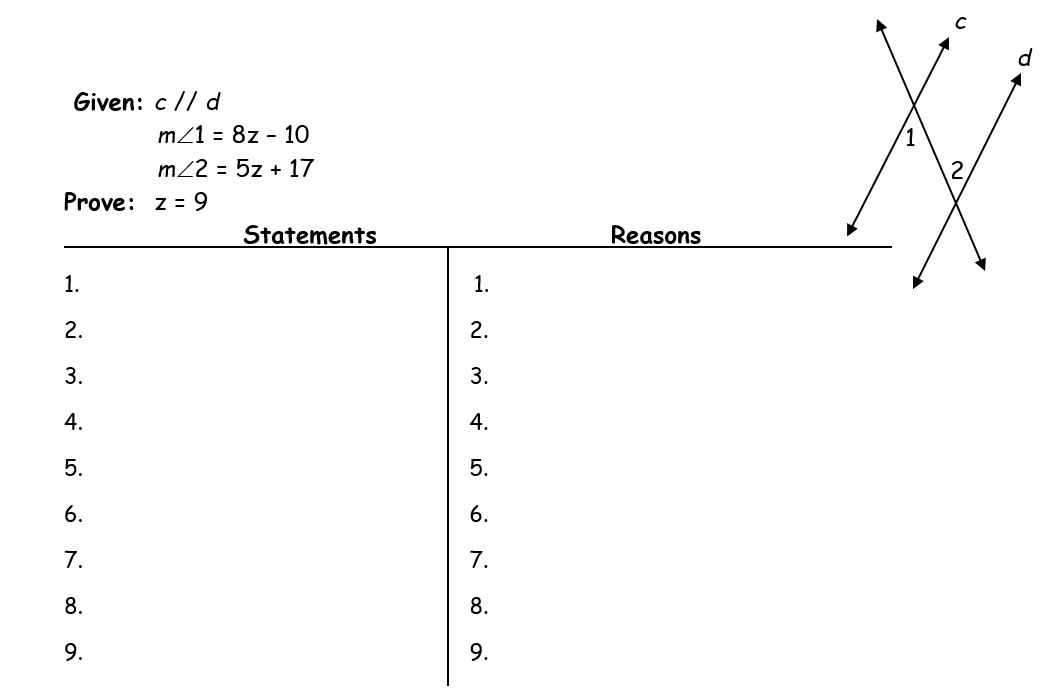
In the proof below, first reorder the statements to complete the left side of the proof. Then, provide the reasons for each statement.
Question 59
59.

1
1
1
1
1
1
1
1
1
Question 69
69.

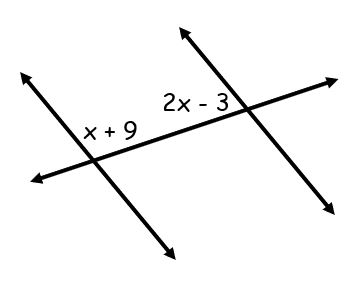
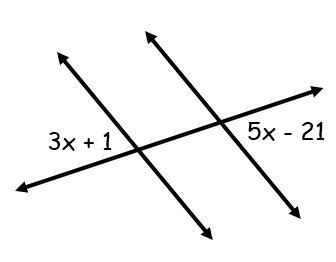
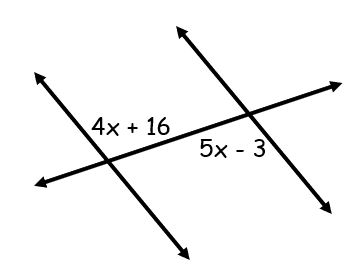
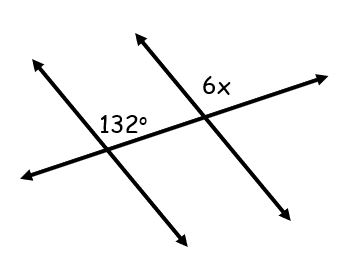
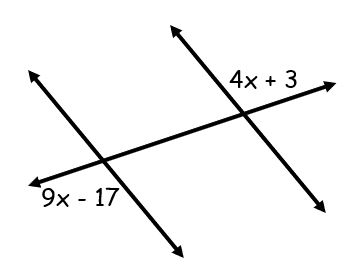
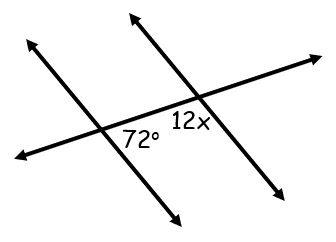
Using the diagram below, find the value of x.

Question 70
70.

Using the diagram below, find the value of x.

Question 71
71.

Using the diagram below, find the value of x.

Question 72
72.

Using the diagram below, find the value of x.

Question 73
73.

Using the diagram below, find the value of x.

Question 74
74.

Using the diagram below, find the value of x.

Question 1
1.

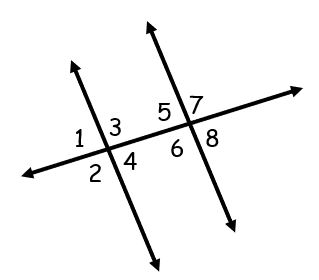
\angle{1} and \angle{} _______ are Alternate Exterior Angles.

Question 2
2.

\angle{3} and \angle{} _______ are Consecutive Interior Angles.

Question 3
3.

\angle{3} and \angle{} _______ are Alternate Interior Angles.

Question 4
4.

\angle{2} and \angle{} _______ are Corresponding Angles.

Question 5
5.

\angle{5} and \angle{} _______ are Vertical Angles.

Consecutive Interior Angles are _________________.
Congruent
Supplementary
Corresponding Angles are _________________.
Congruent
Supplementary
Alternate Interior Angles are _________________.
Congruent
Supplementary
Alternate Exterior Angles are _________________.
Congruent
Supplementary
Vertical Angles are _________________.
Congruent
Supplementary
A Linear Pair is _________________.
Congruent
Supplementary
Question 12
12.

If m\angle{1} = 72o, then m\angle{5} = ________

Question 13
13.

If m\angle{4} = 66o, then m\angle{6} = ________

Question 14
14.

If m\angle{7} = 102o, then m\angle{2} = ________

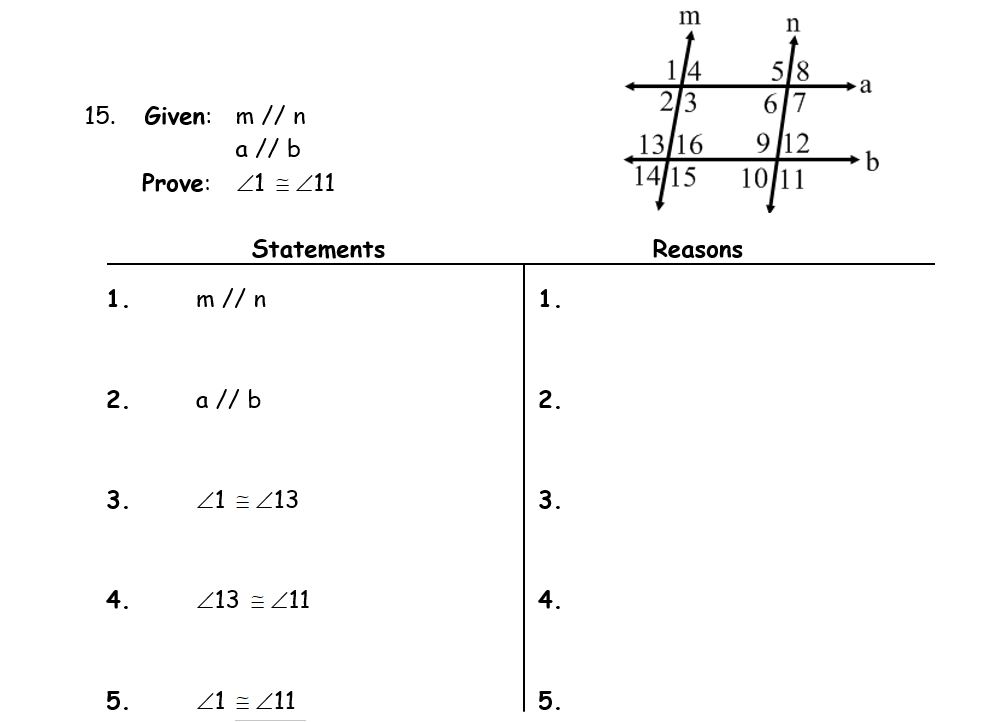
Question 15
15.

Reason #1

Question 16
16.

Reason #2

Question 17
17.

Reason #3

Question 18
18.

Reason #4

Question 19
19.

Reason #5

Question 21
21.

What is the slope between these two points?

Question 22
22.

Question 23
23.

What is the slope between these two points?

Question 24
24.

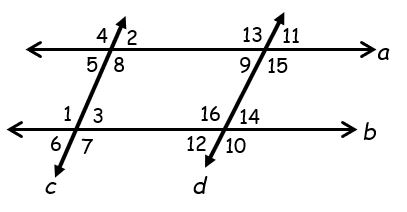
Use the diagram below for the next 8 questions.

For each question, determine which lines (a & b, c & d, or none), if any, must be parallel with the given information.
Question 25
25.

Question 26
26.

Question 27
27.

Question 28
28.

Question 29
29.

Question 30
30.

Question 31
31.

Question 32
32.

Question 33
33.

Reason #1

Question 34
34.

Reason #2

Question 35
35.

Reason #3

Question 36
36.

Reason #4

Question 37
37.

Reason #5

Question 38
38.

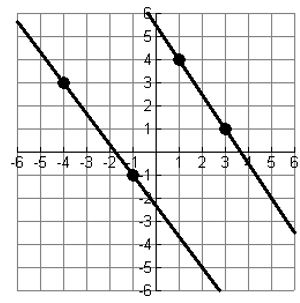
What is the slope of the line on the left?

Question 39
39.

What is the slope of the line on the right?

Question 40
40.

What is the slope of this line?
Question 42
42.

What is the y-intercept of this line?

What is the slope of this line?
Question 44
44.

What is the y-intercept of this line?

Determine if the following pairs of lines are parallel, perpendicular, or neither:


Parallel
Perpendicular
Neither
Determine if the following pairs of lines are parallel, perpendicular, or neither:


Parallel
Perpendicular
Neither
Determine if the following pairs of lines are parallel, perpendicular, or neither:


Parallel
Perpendicular
Neither
Determine if the following pairs of lines are parallel, perpendicular, or neither:


Parallel
Perpendicular
Neither
Question 53
53.

What is the slope of Line 1?

Question 54
54.

What is the slope of Line 2?

Question 55
55.

Question 56
56.

What is the slope of Line 1?

Question 57
57.

What is the slope of Line 2?

Question 58
58.

Put the statements in the correct order to complete the proof.
z = 9
\angle{1} \cong \angle{2}
3z - 10 = 17
8z - 10 = 5z + 17
m\angle{1} = 8z - 10
m\angle{1} = m\angle{2}
c || d
3z = 27
m\angle{2} = 5z + 17
Using the correct order of the proof completed above, state the reasons for each step.
Question 60
60.

Reason #1

Question 61
61.

Reason #2

Question 62
62.

Reason #3

Question 63
63.

Reason #4

Question 64
64.

Reason #5

Question 65
65.

Reason #6

Question 66
66.

Reason #7

Question 67
67.

Reason #8

Question 68
68.

Reason #9

Determine the type of slope from your answer above.
Rises
Falls
Vertical
Horizontal
Determine the type of slope from your answer above.
Rises
Falls
Vertical
Horizontal
\angle{2} \cong \angle{9}
a || b
c || d
None
\angle{9} \cong \angle{12}
a || b
c || d
None
\angle{1} is supplementary to \angle{5}
a || b
c || d
None
\angle{4} \cong \angle{10}
a || b
c || d
None
\angle{11} \cong \angle{12}
a || b
c || d
None
\angle{7} is supplementary to \angle{12}
a || b
c || d
None
\angle{3} \cong \angle{6}
a || b
c || d
None
\angle{1} \cong \angle{16}
a || b
c || d
None
Are the lines parallel?
Yes
No
Are these lines parallel, perpendicular, or neither?
Parallel
Perpendicular
Neither
Are these lines parallel, perpendicular, or neither?
Parallel
Perpendicular
Neither